
Mount Sinai in Arabia: The Evidence, Site by Site
Paul placed Sinai in Arabia. Here is what stands there.
Writing to churches in Galatia around AD 50, Paul was building an allegory about two covenants when he stopped to place a mountain: "Now Hagar is Mount Sinai in Arabia" (Galatians 4:25). The geography is incidental to his point. He needed his readers to know where Sinai stood, and he wrote as though they already did.
Somewhere between the first century and the fourth, the location was lost.
The mountain venerated today stands in Egypt, on the Sinai Peninsula. It was identified in the fourth century by Helena, mother of Constantine, and a monastery went up at its foot two hundred years later. The name has stayed there ever since. But when Moses encountered the burning bush at "Horeb, the mountain of God," he was tending his father-in-law's flock in Midian (Exodus 3:1), and Midian was never in Egypt. It lay east of the Gulf of Aqaba, in what is now northwest Saudi Arabia.
That is the geographic problem in one paragraph, and it is old. What is new is that the country, Saudi Arabia, is open.
For three decades, researchers and travelers have documented this mountain in Midian. Jabal al-Lawz, also spelled Jebel al-Lawz, or more specifically Jabal Maqla. What they found is not a single decisive proof. It is a convergence of characteristics and evidence, each perhaps unremarkable on its own, but which all together look very much like what Exodus describes: a scorched summit standing black against a range of pale granite, an altar at the western base carved with bovine figures, marble pillars set beside a larger altar, a split rock above a dry watercourse, a concealed plateau that a party could climb without being seen from the camp below, a cave, and so on.
And it has not been thoroughly excavated. The Saudi government has fenced the Golden Calf altar site, but some archaeological work has been done in Midian and at a nearby grave site. By and large the claims on these pages rest on surface observation, photography, satellite imagery and the written record. Where the evidence is suggestive rather than conclusive, we say so.
The material below is organized in four groups. The Mountain covers what is physically present at Jabal al-Lawz / Jabal Maqla. The Exodus Route Through Arabia follows points along the journey that leads there, from the sea crossing to the last camp before the mountain. Arabia in the Bible looks at the wider peninsula, its oases and its long Jewish and biblical history. The Ancient Record sets out what Josephus, Philo, Paul and the early geographers actually wrote.
Read in any order. Each piece stands on its own, and the case is cumulative rather than sequential.
The Mountain
Everything physically present at Jabal al-Lawz and the blackened peak of Jabal Maqla, feature by feature: what can be seen, what can be measured, what the biblical text requires at that spot, and where the strongest objection lies.
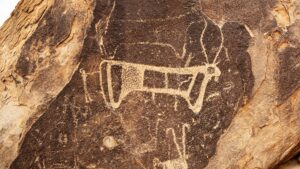
The Golden Calf Altar in Saudi Arabia: Egyptian Cattle Gods at the Foot of Jabal al-Lawz
Dozens of bulls and cows are cut into a natural outcrop standing above the plain below Jabal Maqla. The Saudi survey that catalogued them denies any Egyptian connection in absolute terms, then grants in the previous paragraph that cattle worship was common here. Where the case for this mountain actually rests.
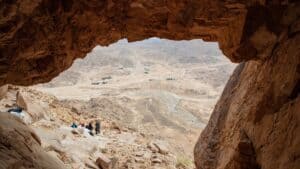
Elijah’s Cave at Mount Sinai in Arabia: Why the Prophet Fled to Horeb
Every English Bible says Elijah reached “a cave” at Horeb. The Hebrew says the cave, a specific one the writer expected his readers to know. On the eastern face of Jabal Maqla there is exactly that: a true cave, high on the mountain, set where the text puts it and open to the slope.
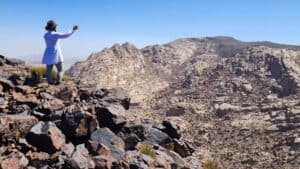
The Plateau of the Seventy Elders: Where They Saw the God of Israel
Seventy-four men once saw the God of Israel, ate and drank in His presence, and lived to walk back down. Exodus 24 puts the scene on a plateau partway up the mountain, hidden from the plain and wide enough for the gathering. On Jabal Maqla, climbers still reach it today.
The Exodus Route Through Arabia
The path that leads to the mountain. Where a nation crossed the sea, where the water turned sweet, where the rock was struck, and where Amalek attacked the stragglers at the rear.
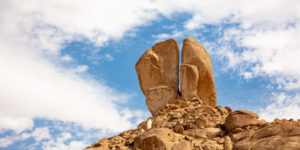
Rephidim and the Split Rock of Horeb in Saudi Arabia
Near Jebel al-Lawz in Saudi Arabia stands a towering split boulder. Exodus 17 says Moses struck the rock at Horeb and water gushed out. Isaiah 48:21 confirms it. Paul told the Corinthians the rock was Christ. The site, the battle with Amalek that followed, and the typology Paul built on both.
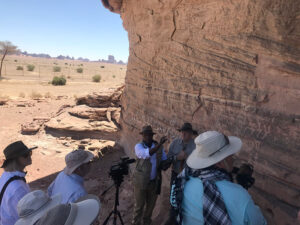
Documentation of Midian – How do we know Moses was Here?
In northwest Saudi Arabia, an oasis called Al Bad’ still goes by a far older name: Madyan. Caves there carry Jethro’s name, and a well nearby is called the Well of Moses. French archaeologist Guillaume Charloux confirmed the identification in a peer-reviewed survey.

Priest of Midian – Jethro’s Tombs Near Mt. Sinai
“And Moses was content to dwell with the man, and he gave Moses his daughter Zipporah “ Exodus 2:21 The Priest of Midian – Jethro’s Tombs Still Standing in Saudi Arabia By Jennifer Bartlett Though they all approach Him differently, what unites the top three religions in the world is the God of Abraham. To observant Jews He is the holy…
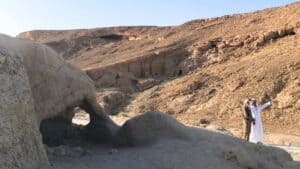
Did Jethro Know YHWH Before Moses?
Midian was Abraham’s son through Keturah. Abraham sent those sons east with more than livestock. Before Moses ever climbed it, Exodus already calls the place the mountain of God. When Jethro says “Now I know,” the Hebrew points to confirmation, not conversion. The genealogy, the bush, and what Exodus 18 actually says.
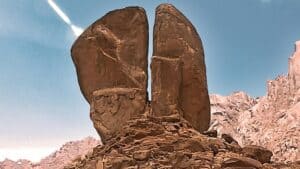
Rephidim in the Bible: What the Name Means and Why It Matters
Rephidim means refreshment, yet Israel camped there and found no water at all. A look at what the name means, the rock Moses struck at Horeb, and where Rephidim falls on the road to Sinai.
Arabia in the Bible
Arabia appears in Scripture far more often than most readers notice, from the oases named by Isaiah and Jeremiah to the fortress towns that held Jewish communities for centuries, and on into the prophecies of Ezekiel.
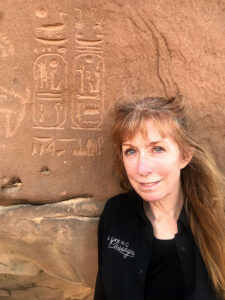
The Cartouche of Rameses III in the Saudi Arabian Desert
In Saudi Arabia’s Hisma Desert, an ancient campsite surrounded by petroglyphs and Thamudic inscriptions bears an Egyptian royal cartouche. The site sits two hours from Jabal al-Lawz. What an Egyptian military presence this deep into Arabia tells us about the region’s connections to the biblical world.

Jews of Khaybar: Four Traditions, One Desert Mystery
Ninety-five miles north of Medina, the ruins of a Jewish fortress rise above a date-palm oasis. The locals call it Jabal al-Yahud, the Mountain of the Jews. The two leading tribes called themselves priestly and claimed descent from Aaron. Four traditions explain how they got there, and they do not agree.
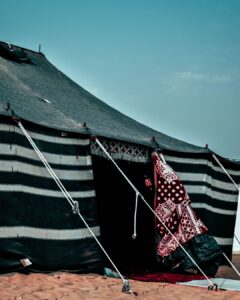
The Rechabites in Arabia: What Became of the Family That Never Broke Its Vow
Jeremiah set wine before them and told them to drink. They refused, having kept a single command for two and a half centuries. Then Babylon came, and the Rechabites disappear from Scripture. A twelfth-century traveler crossing Arabia reported finding them at Tayma, still refusing.
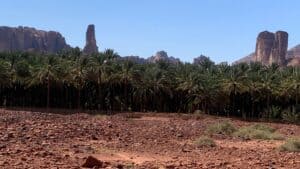
AlUla in the Bible: Dedan, the Oasis of Traders, and the Jews Who Came After
Ezekiel listed what the merchants of Dedan carried: ivory, ebony, saddlecloths for riding. The town he named is the oasis now called AlUla, and about two thousand inscriptions are carved into a canyon there, in a script that died out.
The Ancient Record
Before satellite imagery and before archaeology, people wrote down where they thought the mountain was. Josephus, Philo, Paul and the early Arab geographers all had an opinion, and they are worth reading directly.
New content coming soon!
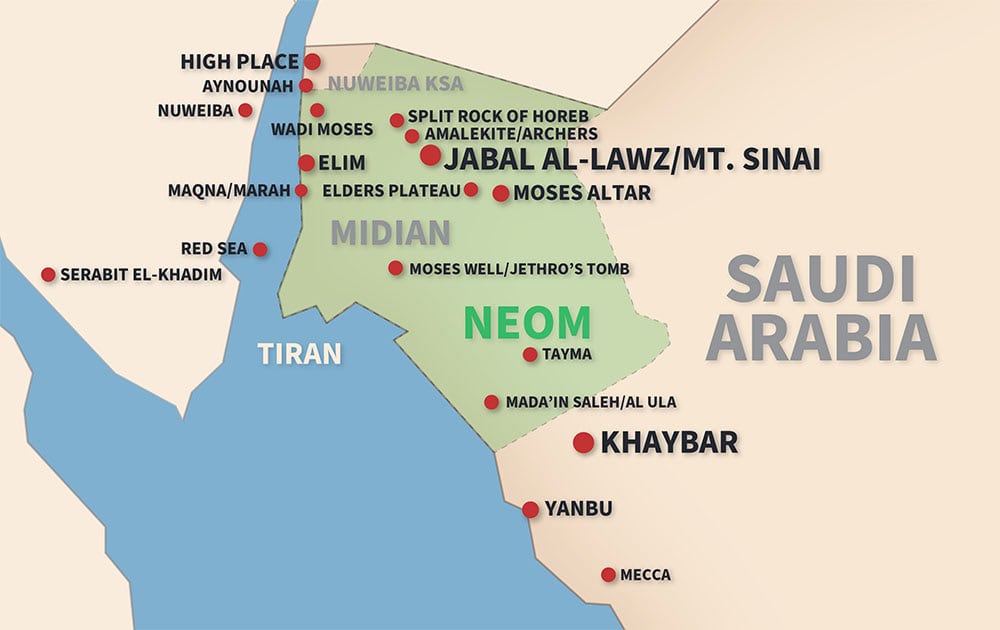
The case for Jabal al-Lawz has never rested on one find. It rests on the number of separate things that would each have to be coincidence: the scorching confined to a single summit in a range of pale rock, the altar with its carved cattle standing where Exodus 32 puts one, the pillars, the split rock, the plateau, the cave, and a mountain sitting in Midian exactly where Paul said Sinai was.
Any one of them can be argued with, and on these pages we argue with them ourselves. What is harder is explaining all of them at once, in one place.
The site is fully available even for climbers. Travelers reach it every year now, stand on the plain where a nation is said to have camped, and look up at a summit that is genuinely, visibly black.
That view is the part nobody has been able to describe adequately. It is worth going to see.