The Plateau of the Seventy Elders: Where They Saw the God of Israel
Once in the entire Torah, a group of men climbed a mountain, saw the God of Israel, ate and drank in His presence, and walked back down alive. It happened on the way up Mount Sinai, at a place high enough to be private and low enough that Moses still had farther to climb afterward. On Jabal Maqla, that place is a concealed bowl in the rock, and you can stand in it.
What happened at the plateau of the seventy elders
Others climbed with Moses this time. Most of what occurs on the mountain happens between the LORD and Moses alone. Exodus 24 is the exception. Before Moses ascends to receive the tablets, the LORD summons a delegation:
Come up to the LORD, you and Aaron, Nadab, and Abihu, and seventy of the elders of Israel, and worship from afar. Moses alone shall come near to the LORD, but the others shall not come near, and the people shall not come up with him. (Exodus 24:1–2)
Seventy-four men in all: Moses, Aaron, Aaron’s two sons, and seventy elders. They climb together to a set point, and there the text describes something it describes nowhere else.
Then Moses and Aaron, Nadab, and Abihu, and seventy of the elders of Israel went up, and they saw the God of Israel. There was under his feet as it were a pavement of sapphire stone, like the very heaven for clearness. And he did not lay his hand on the chief men of the people of Israel; they beheld God, and ate and drank. (Exodus 24:9–11)
The scene is a covenant meal. Earlier that day, at the foot of the mountain, Moses had sealed the covenant with blood, dashing half against the altar and half against the people (Exodus 24:6–8). The meal that follows is the ratification. In the ancient Near East a covenant between two parties was confirmed by eating together, and here one party is God. The line “he did not lay his hand on the chief men” marks the danger they were in. To see God was expected to be fatal, as the LORD Himself later tells Moses: “man shall not see me and live” (Exodus 33:20). Seventy-four men saw Him and sat down to eat.
Where did the seventy elders see God?
The text does three things that turn a theophany into a geographic test.
It places the meeting partway up the mountain, not at the summit. The seventy go up in verse 9, but Moses is called higher in verse 12, leaving them behind: “Come up to me on the mountain,” and then, six days later, Moses “entered the cloud and went up on the mountain” (Exodus 24:12, 18). The elders’ plateau is a landing on the route, above the plain and below the peak.
It requires the place to be private. The elders see God without the nation seeing what they see. Whatever this location is, the camp on the plain below cannot look up into it, and the people who were forbidden to approach cannot witness the meal.
It requires room. Seventy-four men stand, look, sit, and eat, and that takes a floor, not a ledge.
A mountain that hosted this event should have a feature that satisfies all three at once: partway up, screened from the plain, and large enough to seat a delegation. On the traditional Sinai at St. Catherine’s, candidate plateaus exist, but the fit is loose. On Jabal Maqla, the fit is specific.
Does the plateau on Jabal Maqla match the biblical description
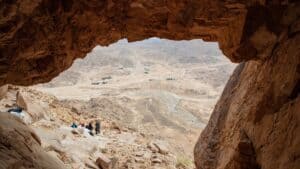
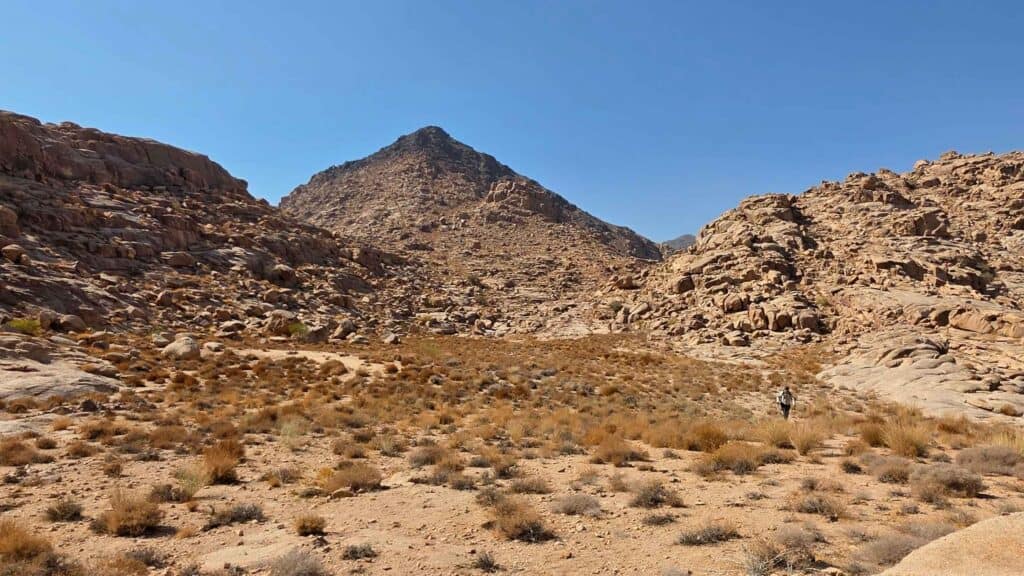
About two thousand feet up the mountain, off the main line of ascent, the rock opens into a concealed bowl. Eyewitnesses who have stood in it describe it as crater-like though not volcanic, and as private. From inside it you cannot see the valley floor where the camp of Israel would have stood, and nothing that happened inside it could have been watched from below.1
In any case, the size works. The plateau is broad, open ground, wide enough for the gathering of seventy-four with room to spare. Living Passages has led climbers to it many times, and a full party stands on it without crowding, as you can see below.2
A skeptic will raise the obvious objection: many mountains have plateaus, and the flat spot proves nothing.
It holds against any one feature in isolation. The test is whether one feature satisfies all of the text’s constraints at once, not merely whether a level place exists somewhere on the mountain: a floor large enough for seventy-four, set partway up rather than at the peak, and concealed from the plain so that a private audience with God could happen out of the nation’s sight. The Maqla Lesser plateau satisfies all three, and it sits within the same precinct as the altar, the twelve pillars, the golden calf site, and the cave, each answering its own line of the same narrative. So, the plateau is one entry in a cumulative case.
The sapphire pavement and the throne of God
The elders looked down and saw, under God’s feet, “a pavement of sapphire stone, like the very heaven for clearness.” The same image returns in the prophets. When Ezekiel is given a vision of the throne, he describes above the expanse “the likeness of a throne, in appearance like sapphire” (Ezekiel 1:26). The same stone is a floor beneath God’s feet in Exodus and the throne itself in Ezekiel. The elders were standing, for one meal, on the pavement of heaven.
The covenant meal on the mountain prefigures what comes later. Isaiah promises that the LORD of hosts “will make for all peoples a feast” on Mount Zion (Isaiah 25:6), and the pattern closes at the marriage supper of the Lamb. The meal the seventy ate in God’s presence, sealed in blood and eaten on the Mountain of God, is the opening instance of a table that Scripture returns to.
How long is the climb to the plateau of the seventy elders?
Reaching the plateau is a climb, not a hike.
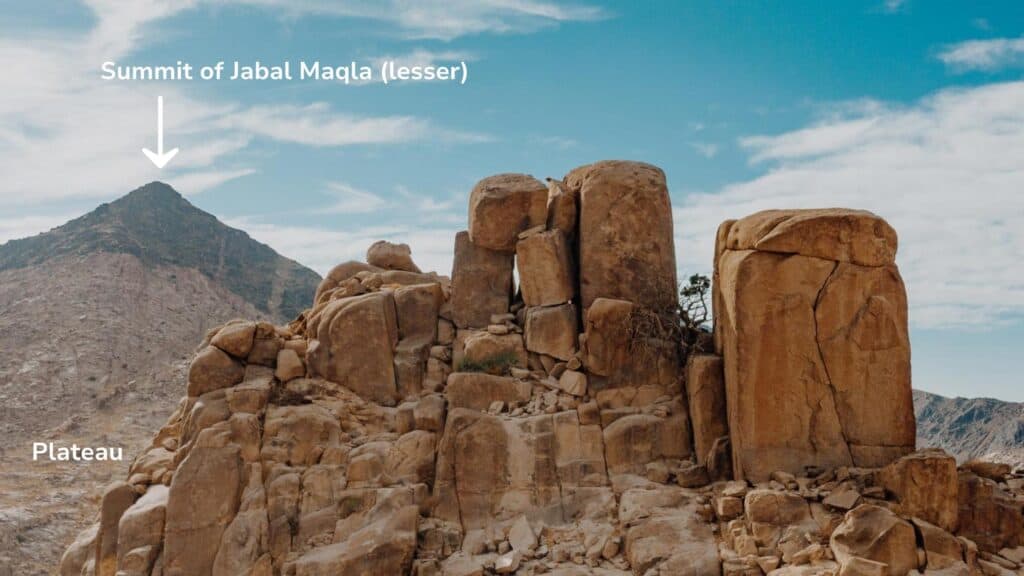
Climbers start before dawn from the camp on the plain, near the Moses Altar and the twelve pillars at roughly five thousand feet. The full ascent to the blackened summit of Maqla covers about 1.9 miles and gains around 2,240 feet, topping out near 7,250 feet. 3 On rough ground with no trail, that ascent runs about three and a half hours for a fit climber moving steadily. The plateau is the first major landing on that route, reached in the earlier part of the climb, before the summit. Once climbers reach the plateau, they choose whether to turn back for camp or press on to the summit. It could take 45 minutes to an hour to climb to the top from the plateau.
Living Passages leads small groups to Jabal Maqla and the sites of the Exodus route in Saudi Arabia, where you can climb to the plateau of the seventy elders and read Exodus 24 on the ground where it happened. Seeing the evidence for yourself, rather than taking anyone’s word for it, is the reason to go. Upcoming dates and details are on the Saudi Arabia tours page.
Notes
- The eyewitness description of the plateau as a concealed, crater-like but non-volcanic bowl roughly two thousand feet up Jabal Maqla, invisible from the plain, is recorded in Charles A. Whittaker, The Biblical Significance of Jabal al-Lawz (Louisiana Baptist University), May 2003. https://jabalallawz.weebly.com/uploads/2/1/0/4/21048306/chuck_whittaker_jabal_al_lawz.pdf ↩︎
- Living Passages field observation across many expeditions to Jabal Maqla; the plateau comfortably holds a full climbing group with substantial open ground to spare. ↩︎
- Elevation of the base area near the Moses Altar and ascent distance from GPS hiking record, February 2026. ↩︎