The Golden Calf Altar in Saudi Arabia: Egyptian Cattle Gods at the Foot of Jabal al-Lawz
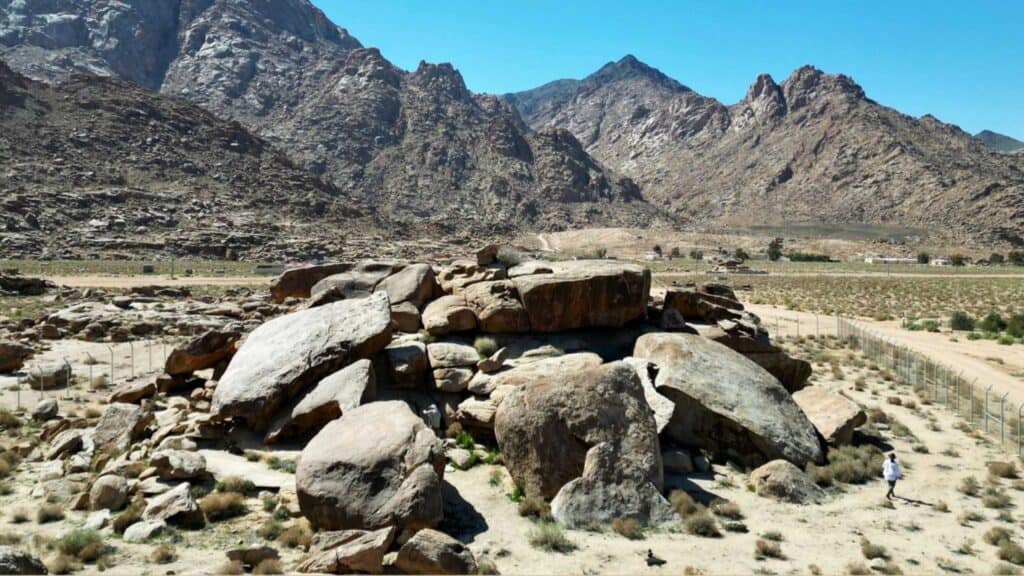
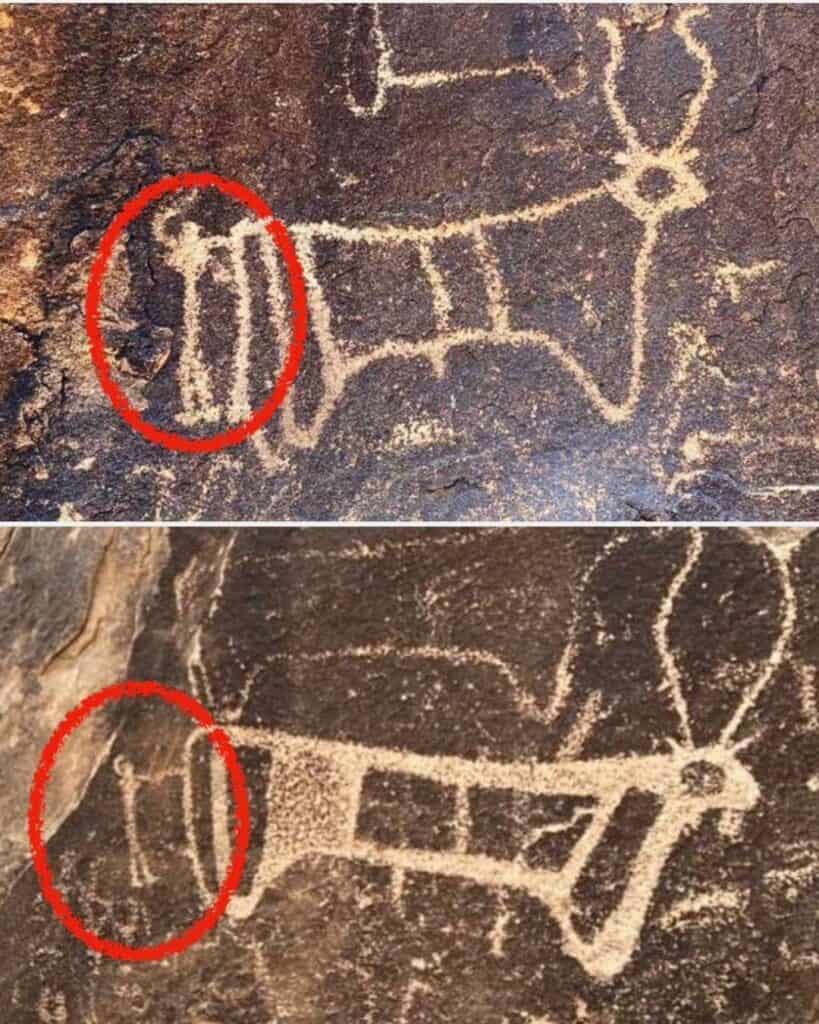
The plain below Jabal Maqla is flat and open, and one thing breaks it. An outcrop of rock stands lifted above the sand as a jumble of large stones, having cattle glyphs on its exposed surfaces. The bovines are heavy-bodied, and beneath several of them stand human figures with their arms upraised.1 The Saudi government has fenced around it and it’s archaeological survey holds that these carvings common to the Bajda area adjacent have no connection to Egypt at all.2
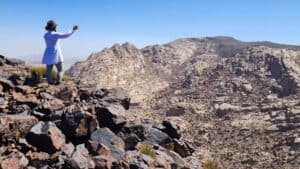
Jabal Maqla is the black-capped southern peak of the al-Lawz range, and it is the mountain this sits below. Though nearly every book and documentary on the subject calls this entire range Jabal al-Lawz, that name stands for the highest mountain of NW Arabia four and a half miles north.
Where Is the Golden Calf Altar at Jabal al-Lawz?
A few hundred yards east of the Moses altar and marble pillars, the outcrop stands out on the level ground.3 It measures 15 to 20 meters across (50 to 65 feet) and rises 4 to 5 meters (13 to 16 feet) above the plain, with an eastward entry to a flat platform on top northward.4
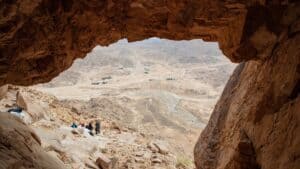
From the mouth of Elijah’s cave, high on the mountainside, you can see it and it’s visible from the foot of the mountain, which is where a man coming down from upon the mount would first catch sight of the camp.5 Around it the ground runs open and level in every direction.
Do the Petroglyphs show Hathor, Apis, and Egyptian Cult Imagery?
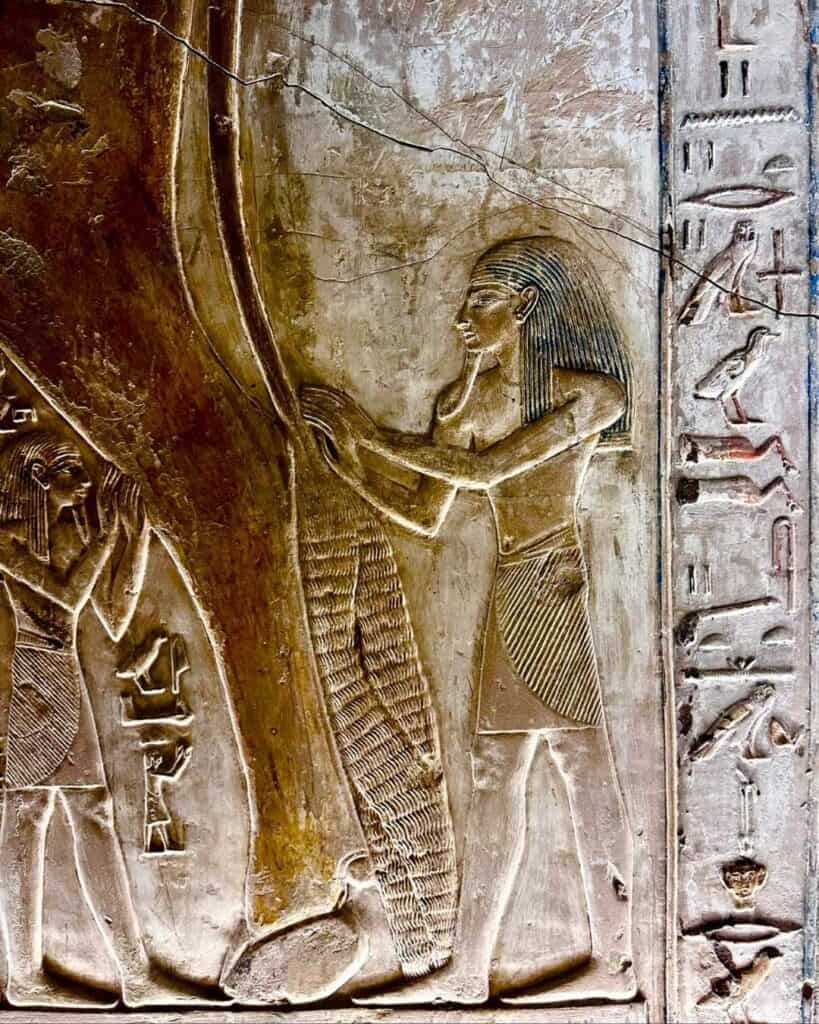
Dozens of bovine images encircle the base and sides of the formation. Joel Richardson, New York Times bestselling author of Mount Sinai in Arabia, identifies the imagery as Egyptian religious iconography rather than pastoral cattle art, and points to one comparison in particular: a scene from the tomb of Pharaoh Seti I showing a giant bull with worshippers underneath, arms raised.

Right: the same posture in the tomb of Pharaoh Seti I. Right photograph by Joel Richardson.
Compositions close to that scene appear among the carvings here.6 The animals on these rocks, on his reading, are Hathor and Apis. Hathor was the Egyptian mother-goddess of fertility, music, joy, and celebration, most often represented as a calf; Apis, her son, was a bull.7 Both cults were ordinary religion in Egypt through the four centuries Israel lived there, and at Sinai the people continued what they already knew.
What Exodus 32 Says About the Golden Calf and Aaron’s Altar
Moses was upon the mountain and the people ran out of patience. “Up, make us gods who shall go before us. As for this Moses, the man who brought us up out of the land of Egypt, we do not know what has become of him” (Exodus 32:1). Aaron collected their gold together and made a molten calf, and the people said, “These are your gods, O Israel, who brought you up out of the land of Egypt!” (32:4).
The word is עֵגֶל, egel, means a male calf, a young bull. Popular accounts reach for Hathor because the carvings at this site include such cattle, and that the animal Aaron cast as Apis.
“A Feast to the LORD”: Syncretism at the Foot of Mount Sinai
Aaron consecrated the idol. He built an altar in front of it and made a proclamation: “Tomorrow shall be a feast to the LORD” (32:5).
What did he think he was doing? The phrase in Hebrew is חַג לַיהוָה, chag la-YHWH, and chag is the technical term for Israel’s three pilgrimage festivals, here before the appointed covenant. Aaron presumed the vocabulary of Israel’s own worship and the covenant name of God and fastened both to an idol. The man who did that would shortly be Israel’s high priest.
What “Rose Up to Play” Means in Exodus 32:6
The next morning “they rose up early and offered burnt offerings and brought peace offerings. And the people sat down to eat and drink and rose up to play” (32:6).
That last verb is לְצַחֵק, l’tzacheq. It shares a root with Isaac’s name which English translators have treated lightly for four hundred years as “laugh” for the giggle of Sarah with the thought of having pleasure in her old age. Elsewhere in the Torah it carries a plainly sexual sense: Genesis 26:8 uses it for Isaac with Rebekah, in a scene that tells Abimelech at a glance they are married rather than siblings. Paul read it the same way, quoting this exact verse in 1 Corinthians 10:7, where he moves straight from “rose up to play” into the warning about sexual immorality for its three thousand falling in a single day.
Excavation in the precinct of Mut at Karnak has recovered a columned hall that Hatshepsut’s own inscription dedicates as a hall of drunkenness. Participants drank past the point of sociability to reach an altered state, and the object was to see the goddess. The excavator places the earlier hours of the night, the procession, the lamps, and the drinking, in the open court in front of the temple. The feast was old long before Israel saw it. A papyrus from Illahun, at the entrance to the Fayum, fixes it to a set day of the Egyptian year, and that papyrus was centuries older than the Exodus.8
A hymn from Medamûd describes the night from the inside. The goddess is called to a celebration where the lamps are lit and the dancing runs on in the dark, and the text says outright that the food of her desire is dancing. Her procession enters a hall named for inebriation, and the Egyptologist who published the hymn reads the night as ending in the sacred marriage of the goddess and the god who waits for her at the temple gate.9
That goddess was a cow, and the calf Aaron cast was a bull. Israel had been living in Egypt within a whole religious world, and they reached for it. Aaron made the idol, and the people knew how to keep the feast. With Moses returning he knew the sound was that of revelry, and when he came down and saw the calf and the dancing (32:19), he was looking at something his people had grown up with, going on at the foot of God’s mountain.
His response was immediate. “Moses’ anger burned hot, and he threw the tablets out of his hands and broke them at the foot of the mountain” (32:19). He burned the calf, ground it to powder, scattered it on the water, and made the people drink it. Deuteronomy 9:21 says where the dust went: into the stream that runs down from the mountain, past the Moses altar. Then came the reckoning: “Thus says the LORD God of Israel, ‘Put your sword on your side each of you, and go to and fro from gate to gate throughout the camp, and each of you kill his brother and his companion and his neighbor'” (32:27). Three thousand fell to the swords of the Levites. Afterward, “the LORD sent a plague on the people, because they made the calf, the one that Aaron made” (32:35).
Weeks earlier, on this ground, in front of this mountain, they had said: “All that the LORD has spoken we will do, and we will be obedient” (Exodus 24:7).
Is the Golden Calf Altar in Saudi Arabia Genuine? Addressing the Critics
The Saudi Deputy Ministry of Antiquities’ published position, set out in its 2002 survey of the al-Bid’ region, is categorical. There is no correlation, it states, between the cattle figures on and near Jabal al-Lawz and those worshipped in Egypt in the time of Moses, which the survey dates to around the thirteenth century BC, and the figures bear “absolutely no similarity to the Apis and Hathor bulls which were worshipped in Egypt during the Pharaonic period.”10
But the survey says that Cow worship was common in prehistoric Arabia; scenes of cow worship and idolized representations are commonly found in the Tabuk area; calf worship is mentioned in the Quran and spread through northern and southern Arabia.11 The same paragraph grants that this region’s rock art includes cattle worship. What it denies is any Egyptian connection, and it denies that in absolute terms. “Absolutely no similarity” is the language of a verdict. Anyone who has looked at an Apis stela and then at these boulders can see general correspondence in the heavy body, the horn treatment, and the human figures underneath. The resemblance is real, yet resemblance alone settles nothing.
“Bovine petroglyphs are found all over Saudi Arabia.” They are, in enormous quantity. A large team of rock art specialists surveyed al-Bid’, Jabal al-Lawz, Hisma and Tabuk in 1984 and registered 311 rock art and inscription sites, thousands of petroglyphs, and hundreds of cattle figures in varied styles from various cultural periods. In the stretch running south from Jabal al-Lawz to Umm Haifa alone, sixty-nine rock art sites were recorded.12 1,500 panels in the Bajda just eastward, so the carvings by themselves prove nothing about this mountain. They remove an objection. If this is Sinai, the plain in front of it should hold exactly what it holds. The carvings show that this area was associated with cattle imagery. Whether it hosted Israel is answered by a total confluence of features.
“Aaron built the altar himself. He could not have moved these boulders.”13 He did not need to. The massive formation is natural. Exodus 32:5 says he built an altar before the calf, an altar for offerings set on or in front of the pedestal that was already there. The outcrop supplied the height; Aaron supplied the idol and made an altar beneath it. And for Moses to see the calf from a distance as he descended (32:19), the thing had to stand above the crowd. This formation does that, and nothing else in the plain does.
“Moses would have destroyed the petroglyphs if they were idolatrous.” He destroyed the idol. The molten calf was burned, ground to powder, and cast into the water. The text records the destruction of the calf, not a systematic defacing of every carved surface in the valley. Much of this rock art may depict the livestock Israel brought out of Egypt (Exodus 12:38), drawn in the visual idiom the artists had learned there, and so not cultic in origin at all. On that reading the rebellion was staged among images that were already standing, which is why Aaron’s proclamation could pass as continuous with what the people were used to seeing.
“The petroglyphs could date to any period.” The survey gives three answers and they do not agree with one another. Painted figures it places in the Neolithic, between 5500 and 5000 BC. Petroglyphs of human and animal figures it places between 3000 and 1500 BC, Chalcolithic through Iron Age. The cattle figures of the al-Bid’ area it assigns to either the Nabataean or the Bronze Age period, two options lying two thousand years apart.14 It then says outright that the dating is relative and tentative, resting on cultural objects found near the rock art rather than on the art itself. Alison Betts, a specialist in Near Eastern rock art, is blunt about the method: absent art sealed by stratified remains or pigment subjected to microanalysis, dating rock art is guesswork, and proximity to a datable site tells you nothing.15 Bovine carvings, on her assessment, could run from the Late Neolithic to the Bronze Age. Nothing at this outcrop has been subjected to the analysis that would narrow the window.
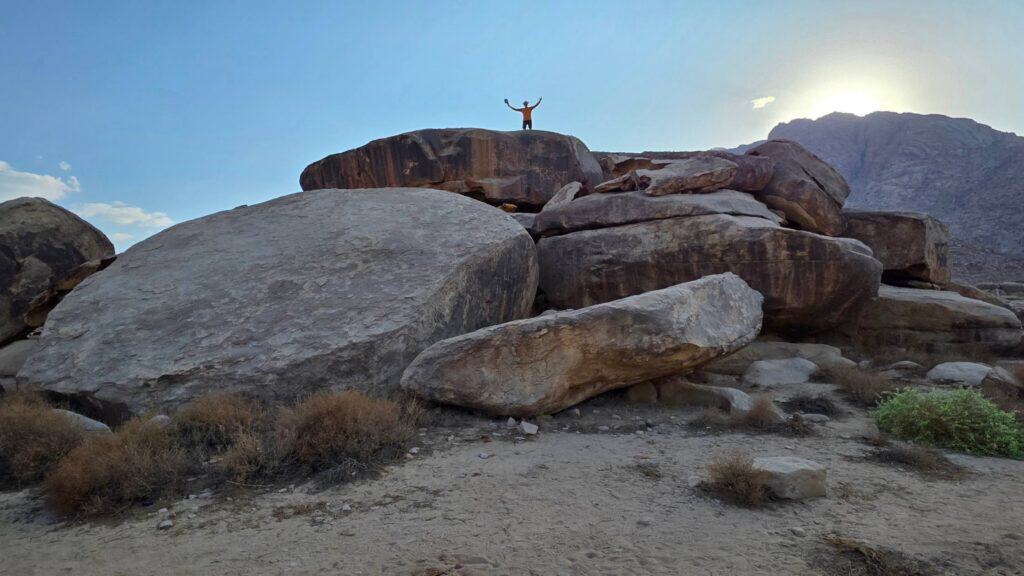
What stands in the plain is a natural elevated platform in front of the mountain, covered in cattle imagery that carries a strong Egyptian impression, standing prominently on the descent route in open ground with room around it for thousands of people.
And it is enclosed with fencing along with the field of standing stones three miles north that has every appearance of a burial ground.16 The ministry that published “absolutely no similarity” has run wire around the outcrop where the calf was raised, and around the ground where the dead of that day would lie.
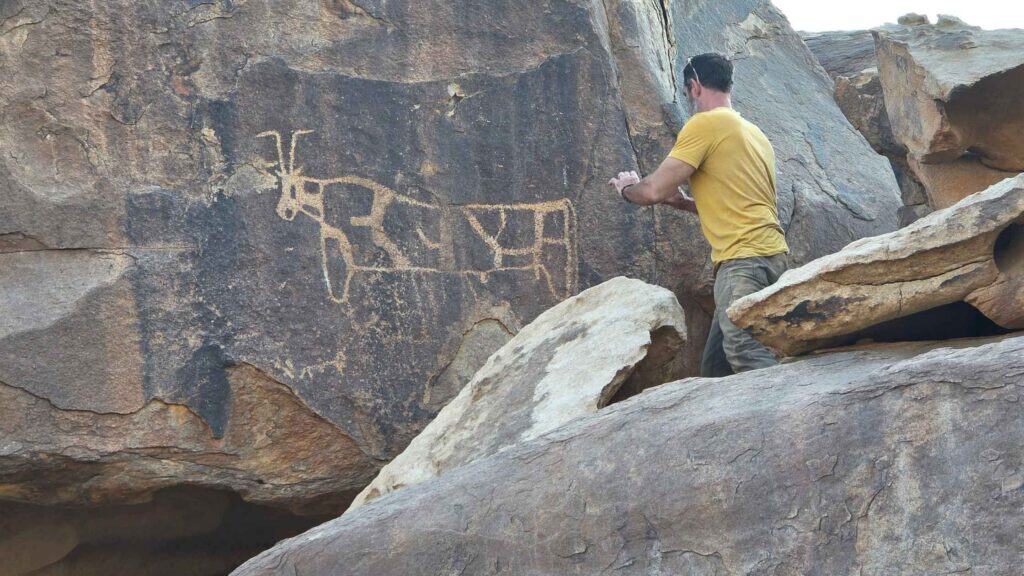
Standing at the Golden Calf Altar in Saudi Arabia
Nothing else on this plain exists as high as this outcrop having any level spot. From the foot of the mountain you can see the top of it, which is the sightline the account requires: Moses saw the calf and the dancing as he came near the camp, before he was close enough to be heard (Exodus 32:19). Walk to the bottom of the descent and you are standing where he stopped and looked.
Living Passages’ Exodus tours go into this area with experienced leaders who have worked the ground for years. We camp near the foot of the mountain and explore all its distinguishing features.
Notes
- Joel Richardson, Mount Sinai in Arabia: The True Location Revealed (2023 ed.), 108–13. ↩︎
- The fencing around the golden calf altar is attested by first-hand observation on the ground by Living Passages personnel. Richardson, 114, separately documents that Saudi archaeological authorities have fenced the cemetery roughly three miles east of the base of the mountain, and at 111–12 records “Keep Out” signage in the precinct. ↩︎
- Richardson, 108. ↩︎
- Sung Hak Kim, The Burning Bush (Seoul: Duranno, 2006), English manuscript translation, section on the golden calf altar. Kim gives 15–20 m across, raised 4–5 m by disordered stone, flat platform on top. ↩︎
- Richardson, 108. ↩︎
- Richardson, 110–13. ↩︎
- Richardson, 110. ↩︎
- Betsy M. Bryan, “Hatshepsut and Cultic Revelries in the New Kingdom,” in José M. Galán, Betsy M. Bryan, and Peter F. Dorman, eds., Creativity and Innovation in the Reign of Hatshepsut, Studies in Ancient Oriental Civilization 69 (Chicago: The Oriental Institute of the University of Chicago, 2014), 93–124. Available at https://www.academia.edu/11684028/Hatshepsut_and_Cultic_Revelries_in_the_New_Kingdom. ↩︎
- John Coleman Darnell, “Hathor Returns to Medamûd,” Studien zur Altägyptischen Kultur 22 (1995): 49-50. https://www.jstor.org/stable/25152711 ↩︎
- Abdul-Rahman al-Ansary and Majeed Khan et al., Al-Bid’: History and Archaeology (Riyadh: Ministries of Education, Antiquities and Museums, 2002), 78. ↩︎
- al-Ansary and Khan, 78. ↩︎
- al-Ansary and Khan, 80 (the 1984 reconnaissance: 311 rock art and inscription sites, thousands of petroglyphs, hundreds of cattle figures) and 47 (sixty-nine rock art sites south of Jabal al-Lawz to Umm Haifa). ↩︎
- Gordon Franz, “Is Mount Sinai in Saudi Arabia?,” Bible and Spade 13, no. 4 (Fall 2000): 109–10. https://biblearchaeology.org/is-mount-sinai-in-saudi-arabia/ ↩︎
- al-Ansary and Khan, 47 and 78. ↩︎
- Alison Betts, personal correspondence, quoted in Charles Whittaker, The Biblical Significance of Jabal al-Lawz (doctoral dissertation, May 2003), 98n215. https://jabalallawz.weebly.com/uploads/2/1/0/4/21048306/chuck_whittaker_jabal_al_lawz.pdf ↩︎
- Richardson, 114. ↩︎