Elijah’s Cave at Mount Sinai in Arabia: Why the Prophet Fled to Horeb
Why Did Elijah Go to Horeb, the Mountain of God?
Elijah came to Horeb straight from the victory on Carmel, and he came running for his life. The cave he was running to has become one of the sharper tests of where Mount Sinai actually stood, and the one on the eastern face of Jabal al-Lawz in Saudi Arabia fits the text in ways the traditional caves in Egypt do not.
On Carmel he had stood alone against four hundred and fifty prophets of Baal, called for fire, and watched it fall on the offering, the wood, the stones, and the water in the trench. The prophets of Baal were killed at the Kishon. The drought that had gripped Israel for three years broke that same afternoon, and Elijah outran Ahab’s chariot to Jezreel on foot (1 Kings 18). Then Jezebel sent him one message, promising him the death her prophets had just died, and the man who had faced down a nation ran.
He headed south out of Jezreel, through the kingdom of Judah, and left his servant at Beersheba before going on alone into the wilderness. Under a broom tree (retamah) he asked the LORD to take his life. An angel woke him twice with bread and water, and on the strength of that food he walked forty days and forty nights to Horeb, the mount of God (1 Kings 19:8).
He was going to the one place where God had spoken to Israel aloud, the mountain where the covenant was cut and the fire had come down. If there was anywhere left to go, it was there. Forty days was also the length of time Moses had spent on that same mountain, and the span the Gospels would later give to the testing of Jesus in the wilderness. Elijah was walking back to the beginning.
“The Cave”: A Definite Article in 1 Kings 19:9
The English loses something in the next verse. The ESV has Elijah coming “to a cave” and lodging there (1 Kings 19:9), and most other versions read the same way. But the Hebrew carries a definite article the English drops. The word is הַמְּעָרָה, ha-me’arah: The cave, not simply a Cave. The writer’s emphasis expected readers to see it particularly specified. First Kings 19 uses the same word me’arah for a cave or den, a hollow large enough to live in, as used of the cave at Machpelah and the cave at Adullam.
There is a second observation a reader who knows Hebrew grammar will supply on his or her own. Biblical Hebrew does not use the article only for things already mentioned. It also marks nouns that are definite by situation, the way English speakers say someone went to the hospital without naming one. On that reading, ha-me’arah means something closer to “the cave that was there,” and the article proves less than a proponent would like
That reading still leaves the text making three physical demands. Charles Whittaker, whose study of the mountain works through this passage in detail, reads the definite article together with the verbs of 1 Kings 19:11 and 13 as placing the cave on the mountainside rather than in the valley below.1 The demands the text makes are these.
It has to be a cave. Me’arah is not a crevice, an overhang, or a gap between two boulders. Hebrew has other words for those.
A man has to be able to live in it. The verb is vayyalen, from the root for lodging overnight, and it carries the sense of settling in rather than sheltering briefly. Elijah was not merely awaiting but had come to dwell.
It has to be on the mountain, positioned so that a man steps out of it onto the mountainside. This is the detail that does the most work and gets the least attention. In verse 11 the LORD tells Elijah to go out (etse) and stand on the mount. In verse 13 Elijah wraps his face in his cloak, and he goes out (vayyetse), and stands at the entrance of the cave. The same verb puts him in the same place both times. The cave mouth is the mountainside. A grotto in the valley floor at the foot of a peak does not satisfy that sentence.
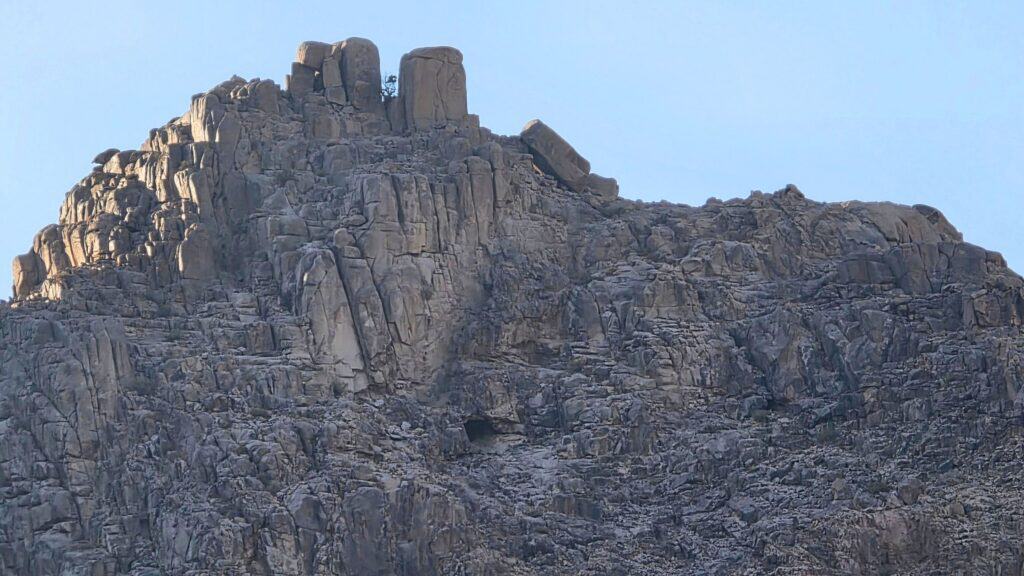
The Cave of Elijah on Jabal Maqla
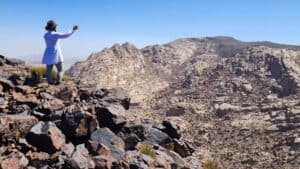
Jabal Maqla, named for its burnt appearance, has two main summits. The Greater (Maqla I) being farther and higher, called Sinai, is uniformly darkened while the Lesser (Maqla II) being nearer and lower, called Horeb, has a darkened top section only terminating with a distinct horizontal edge about halfway up from the (70-elders) plateau. The cave is just over the east ridge from that on the eastern face.
It is most obvious from below. Its elevation at about 6,050 feet, is roughly 1,080 feet above the valley floor where visitors camp, and about an hour and a half of steady climbing from the trailhead, which makes it the natural first objective of the ascent and a destination in its own right for people not attempting the summit.2
It is a true cave and not a crevice, which is the point the Hebrew keeps pressing. The entrance stands about fifteen feet high and twenty feet across, the floor runs some twenty feet back into the rock, and the ceiling drops from around fifteen feet at the mouth to the height of a standing man at the rear.3 The floor is rock, lumpy but level enough to sleep. This is a me’arah in the plain sense of the word, a hollow a man could live in, which is exactly what the text says Elijah did.
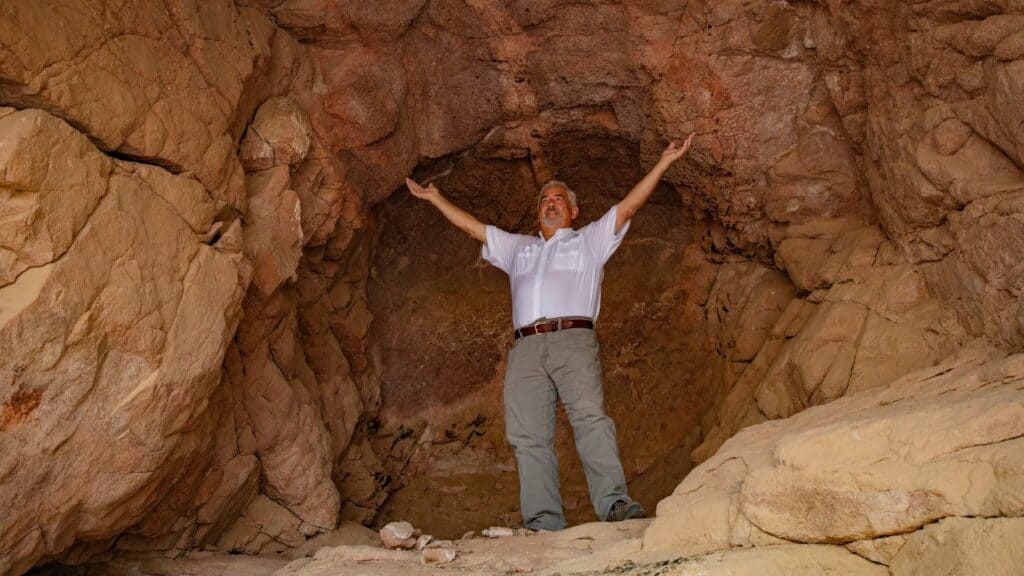
Higher up, among the tower boulders near the crest of the peak, a single almond tree holds on, above the cave and in view from its mouth. Almonds are not incidental in this range. Lawz, the name of the tall granite peak about four miles north, is the Arabic word for almond, and the almond is the tree Jeremiah is shown when the LORD tells him He is watching over His word to perform it, a play on shaqed, almond, and shoqed, watching (Jeremiah 1:11-12). The tree is neither ancient nor evidence of anything. It is simply there, keeping to the rocks above the cave, and it is worth knowing why the sight would have meant something to an Israelite.
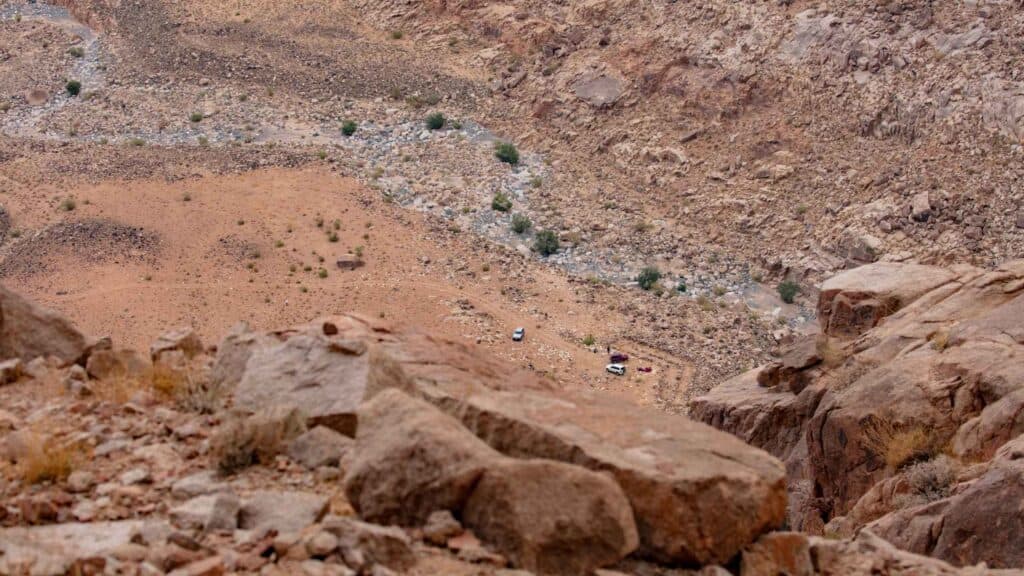
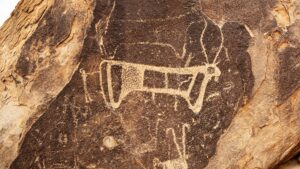
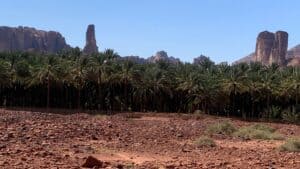
From the entrance the whole eastern valley opens below. That plain is where Israel encamped in front of the mountain (Exodus 19:2), and from the cave mouth a visitor can pick out both of the major structures at its edge: the altar identified as the one Moses built at the foot of the mountain, roughly nine hundred feet below the cave, and the enclosure at the base of the rock outcrop covered in bovine petroglyphs. Richardson describes making exactly that survey from the cave and then climbing down to walk the sites he had been looking at.4. That is the view Elijah would have had while he was at the cave.
The Objection: Every Mountain Has Caves
The strongest published objection to any of this comes from Jeffery Harrison, who does not accept the Arabian identification. His argument is short and fair. Caves are common in these desert mountains. The traditional peak has, in his words, plenty of “nooks and crannies” that could have sheltered a man.5 Finding a cave on a mountain in Arabia does nothing to establish that the mountain is Sinai.
He is right that a cave proves nothing on its own. No single feature at this site does. What a cave does is disqualify candidates that lack one. Harrison concedes that there is no cave on top of the traditional Mount Sinai in Egypt today, and his fallback is that a “nook or cranny” could have served. That fallback is precisely what me’arah and vayyalen rule out. Hebrew has vocabulary for such crevice and that was not used here.
The traditional site does have an Elijah location, and visitors who have been to St Catherine’s will know it. On the ascent of Jebel Musa, about 750 steps below the summit, there is a plateau known in Arabic as Farsh Iliya, Elijah’s Basin. The tradition placing Elijah there is from the fourth-century account of the pilgrim Egeria, and the monastery itself describes the small cave shelter as now incorporated into the altar of the chapel built over it, with a larger chapel dedicated to Elisha (who didn’t venture sinai) added beside it later.6 The traditional site names a second cave as well, a grotto beneath the small mosque near the summit, where tradition places both Moses’ forty days and the appearance to Elijah; but it is a hollow under a built structure at the peak, not a cave a man steps out of onto the mountainside as verses 11 and 13 require.7
The site on Jebel Musa was assigned. Byzantine monks identified the mountain first and then distributed the biblical events across its features, and the Elijah shelter was small enough that it had to be built into a chapel altar to be legible as anything at all. The cave on Maqla required no builder to mark it. It is large enough to live in, positioned on a face rather than in a basin, opening directly onto the mountainside as verses 11 and 13 require, and looking out over a plain wide enough to hold a nation.
The Lord’s Question at the Cave
The word of the Lord occurs to him inside the cave: “What are you doing here, Elijah?” (1 Kings 19:9). The Hebrew is four words, mah lekha poh, Eliyahu, a word-for-word rendering would be “What, to you, here, Elijah?” He is asking a man who walked forty days to explain himself, and Elijah does, in a statement he will repeat verbatim a few verses later not changing a syllable:
“I have been very jealous for the LORD, the God of hosts. For the people of Israel have forsaken your covenant, thrown down your altars, and killed your prophets with the sword, and I, even I only, am left, and they seek my life, to take it away.” (1 Kings 19:10)
He had said almost exactly this at Carmel: “I, even I only, am left a prophet of the LORD, but Baal’s prophets are 450 men” (1 Kings 18:22). And he said it there knowing what Obadiah had just told him to his face, that a hundred prophets of the Lord were alive, hidden by fifties in caves and kept through the drought (1 Kings 18:4, 13). But Elijah was the only one still standing in the open, willing to be seen. Whether those hundred were later hunted down the text does not say; Jezebel’s purge had not stopped.
What the complaint carries underneath it is not a wish to die but an appeal for God to act. Elijah has done his part at real risk to his life, and he has come to the mountain of the covenant. He wants the LORD to move against the house that hunted him. He had escaped the regime. Now he wants God to answer it. That is why he came to this mountain and no other. Ahab, who should have guarded the covenant, had married the daughter of the king of the Sidonians and built a house for Baal in Samaria (1 Kings 16:31-32); the throne that should have kept Israel faithful had become the engine of its apostasy. Elijah saw no successor and no continuation so he walked back to the place where the covenant was cut to ask that it be revived.
Wind, Earthquake, Fire, and the Still Small Voice (1 Kings 19:11-12)
The answer to Elijah’s speech is an instruction to go out and stand on the mount before the Lord.
And behold, the Lord passed by, and a great and strong wind tore the mountains and broke in pieces the rocks before the Lord, but the Lord was not in the wind. And after the wind an earthquake, but the Lord was not in the earthquake. And after the earthquake a fire, but the Lord was not in the fire. And after the fire the sound of a low whisper. (1 Kings 19:11-12)
English readers know it as the still small voice. The Hebrew, qol demamah daqqah, is stranger than either: a sound of thin silence, a voice made of quiet. It could only be heard by someone who had stayed put through everything that came before it. Elijah had just come from Mount Carmel, where God had been in the fire, spectacularly and publicly. Now, at the very mountain where God had once descended in fire and smoke to give the covenant to Moses (Exodus 19:18), God manifests these phenomena, wind and earthquake and fire, and makes a point of being in none of them.
There is a physical footnote to this passage that comes from the mountain itself; Todd Eaton, having invested years going the scripture wilderness paths and exploring these Mountains severally. Working across the valley toward the quarry of white stone saw along its south face a long diagonal stone that runs from high upon the mountain down to the valley, and reads it as the original ascent: the private way Moses only went up and came down. At the bottom, where that seam reaches the base and opens into the interior, a large volume of material has come down and spread out across the approach, obstructing what had been the natural way in. Eaton’s reading is that the rending of the rocks in 1 Kings 19:11 was the collapse into the south valley of the opposite white mountain’s north face, and that its effect was to scuttle that access to the summit behind the last prophet who came looking. The cave can be reached by its own path, independent of the way to the summit, so it is still reached today though the rent rocks fell across the old ascent,
The Commission: Hazael, Jehu, and Elisha
When Elijah his face wrapped in his mantle finally emerged, God asked the same question again and Elijah gave the same answer, word for word, yet God’s response was a commission rather than a comfort:
“Go, return your way unto the wilderness of Damascus. And when you arrive, you shall anoint Hazael to be king over Syria. And Jehu the son of Nimshi you shall anoint to be king over Israel, and Elisha the son of Shaphat of Abel-meholah you shall anoint to be prophet in your place.” (1 Kings 19:15-16)
Three anointings: a king over Syria, a king over Israel, and a prophet to succeed Elijah himself. Every one of them answers the despair that brought Elijah to the cave. He thought no king was worthy? God was about to install new ones on both sides of the border. He thought the prophetic line died with him? God appointed his successor by name, hometown, and father.
Then the correction to the count: “Yet I have seven thousand in Israel, all the knees that have not bowed to Baal, and every mouth that has not kissed him” (1 Kings 19:18).
He walked out with orders to establish a succession, and when he found Elisha plowing with twelve yoke of oxen, he threw his mantle over him and inaugurated a prophetic school that would endure for generations.
The Question the Cave Still Asks
Every traveler who climbs toward the Cave of Elijah is, in some sense, answering the same compulsion that drove the prophet south from Jezreel. Nobody is fleeing a Phoenician queen. But the underlying posture is familiar. People who travel thousands of miles to stand on the mountain of God are not casual tourists. Many of them carry some version of Elijah’s burden: the sense that the things of God have been abandoned by the surrounding culture, that the institutions meant to guard the covenant have become instruments of compromise, that faithfulness is a lonely and unrewarded business.
I, even I only, am left.
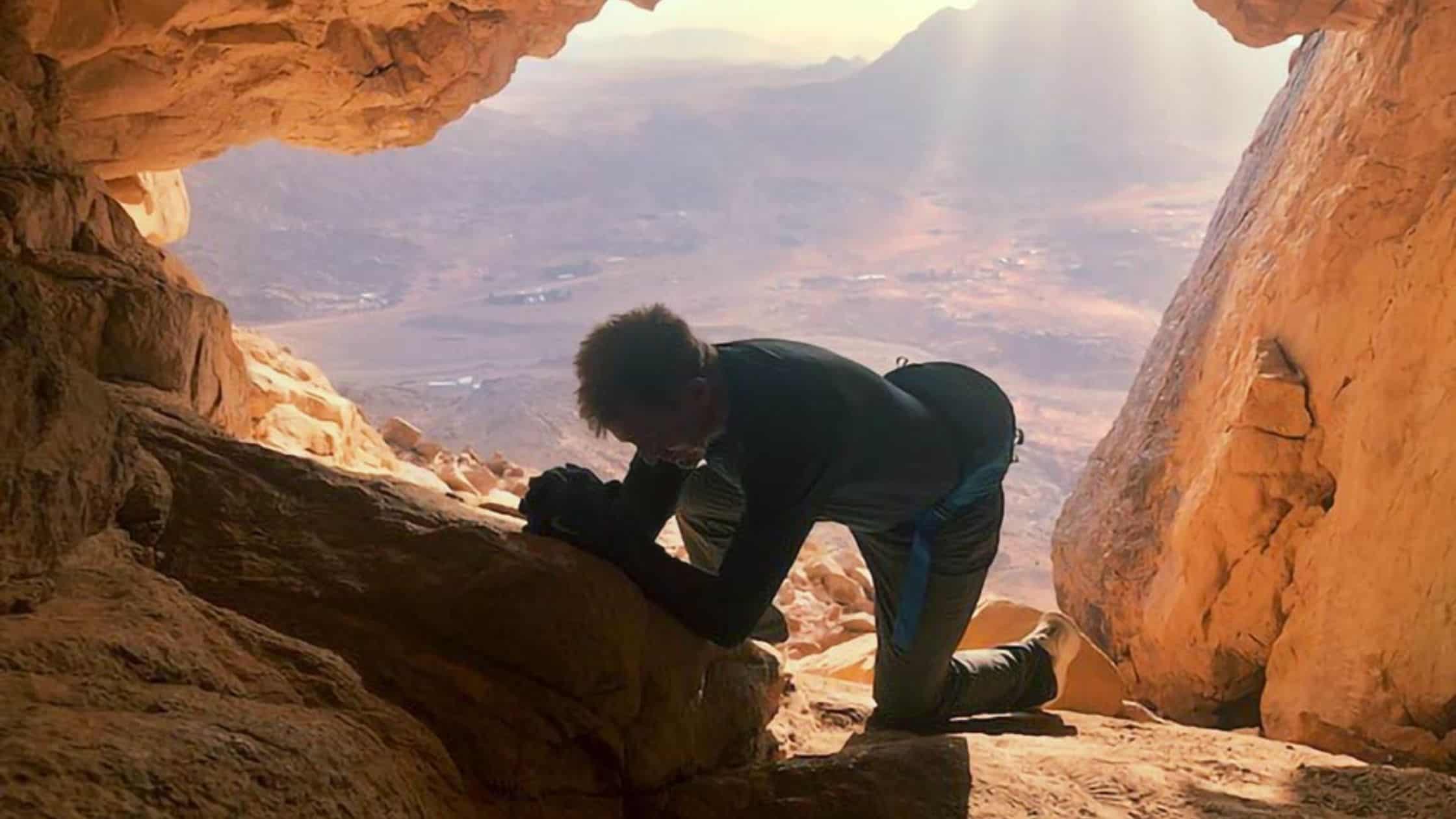
It is the private prayer of every believer who has looked at the state of the church, the state of the culture, and the state of their own exhaustion, and wondered whether anyone else still cares. Elijah’s cave still speaks because the conditions that drove him there have continued. And the answer God gave at the cave is the answer still on offer there: not in wind, earthquake or fire, but in the sound of thin silence, heard only by the one who has decided, with Elijah’s own obstinate resolve, to stay on the mountain until God speaks.
Visiting the Cave of Elijah
The cave is on the eastern face of Maqla Lesser, the nearer and lower of Jabal Maqla’s two main summits, in the Tabuk region of northwestern Saudi Arabia. The climb begins from the valley floor on the eastern side, where the plain and the altar sites are, and reaches the cave in roughly ninety minutes of steady ascent over loose rock among boulders.
There is no trail marker, no chapel, and no railing. An almond tree grows between to the boulders above, near the top of the first peak. From the entrance you can sit with your legs over the edge of the slope, which is what Elijah is doing in verse 13, and see the whole eastern plain.
Travelers can stand at that cave mouth and enter themselves therein on a Living Passages Tour to Saudi Arabia.
Notes
- Charles A. Whittaker, “The Biblical Significance of Jabal al Lawz” (diss., Louisiana Baptist University), May 2003, at his discussion of the Cave of Elijah, fns. 272-274 and Fig. 26. Whittaker develops the definite-article observation, the Keil/Exodus 33 connection, the cleft-versus-cave distinction, and the placement of the cave on the mountain from verses 11 and 13. https://jabalallawz.weebly.com/uploads/2/1/0/4/21048306/chuck_whittaker_jabal_al_lawz.pdf . ↩︎
- Elevation and timing from the site’s climbing register; the cave elevation of about 6,050 feet is corroborated by a logged GPS track of the descent from the cave to the Moses altar of 6,047 ft (5 February 2026). ↩︎
- Jim Caldwell, field examination of the cave, dimensions as reported in Charles A. Whittaker, “The Biblical Significance of Jabal al Lawz” (diss., Louisiana Baptist University), 134, citing Caldwell interview, 6 May 2002. ↩︎
- Joel Richardson, Mount Sinai in Arabia, 101. ↩︎
- Jeffery Harrison, as quoted and summarized in Whittaker, “Biblical Significance,” at his discussion of the cave (fn. 270). The wording of Harrison’s objection, including the “nook or cranny” phrasing, is drawn from Whittaker’s citation. ↩︎
- “Chapels on Mount Horeb: Cave of Prophet Elias,” Saint Catherine’s Monastery (official website), https://www.sinaimonastery.com/index.php/en/description/mount-horeb/cave-of-prophet-elias ↩︎
- See “Jebel Musa,” SeeTheHolyLand.net, https://www.seetheholyland.net/tag/jebel-musa/, and Todd Bolen, “Jebel Musa (Mt. Sinai),” BiblePlaces.com, https://www.bibleplaces.com/jebelmusa/, which notes the traditional cave beneath the mosque west of the summit chapel. ↩︎