AlUla in the Bible: Dedan, the Oasis of Traders, and the Jews Who Came After
More than two and a half thousand years before AlUla became Saudi Arabia’s showcase for the world, the prophet Ezekiel already knew the place by name. He called it Dedan, and he knew exactly what they sold there.1
The travel magazines have discovered AlUla only recently. They photograph the mirrored concert hall in the desert, the balloons over the sandstone, the floodlit tombs at night. What almost none of them mention is that the oasis under all that staging is one of the oldest named places in Scripture, a caravan town the prophets Isaiah, Jeremiah, and Ezekiel each addressed by name, and a place where, centuries later, Jewish families buried their dead and blessed their God in Hebrew letters carved into the rock.
This is the biblical story of AlUla. It also happens to be one of the most confusing corners of the map for a first-time visitor, because four different names get used for what looks like one destination. We will sort those out. First, the oasis itself, and the people the Bible said lived there.
Who Was Dedan in the Bible?
Dedan is not a minor name in Scripture, appearing more than a dozen times. The genealogies introduce Dedan twice, and the pairing is the same both times. In the Table of Nations, Dedan is a grandson of Cush: “The sons of Raamah: Sheba and Dedan” (Genesis 10:7). Then, generations later, Dedan surfaces again in the line of Abraham through Keturah: “Jokshan fathered Sheba and Dedan” (Genesis 25:3). Two different family trees, and in each one Dedan stands beside a brother named Sheba.
Sheba and Dedan were the two great trading peoples of the incense road, and they mark its two ends. Sheba was the kingdom of the far south, in what is now Yemen, the country of frankincense and myrrh whose queen came to test Solomon “with camels bearing spices and very much gold and precious stones” (1 Kings 10:2). Dedan sat astride the northern stretch of the road those goods traveled. Scripture keeps the two names together the way we would keep two familiar trading partners together, and the pairing becomes a kind of signature. Wherever you find Sheba and Dedan side by side in the Bible, you are reading about Arabian commerce and the caravans that ran it.
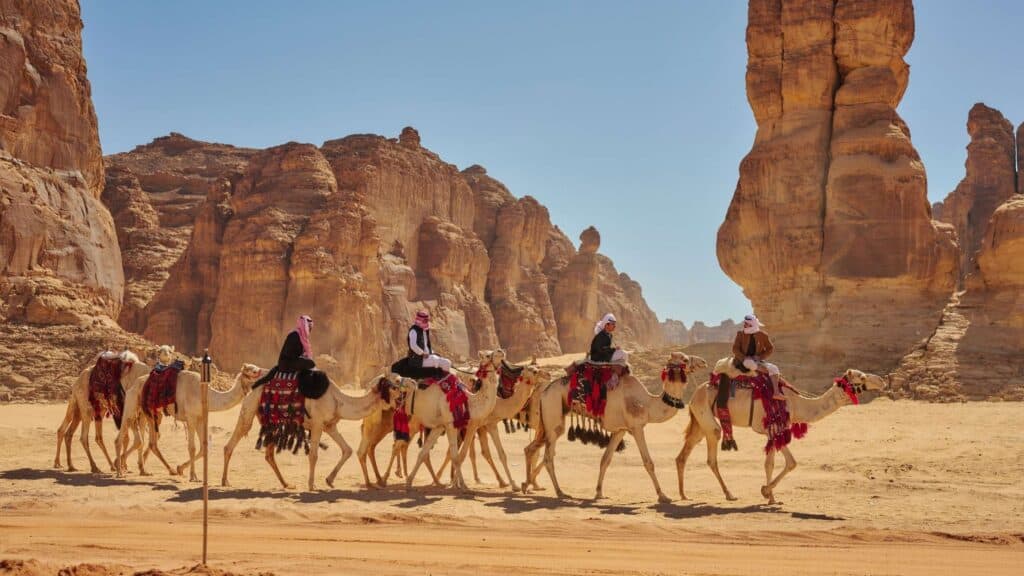
By the time of the writing prophets, Dedan is no longer a name in a family list. It is a working city with a reputation, and the reputation is wealth. Ezekiel, cataloging the trading partners of the great port of Tyre, records what came further up the road from Dedan:
“The men of Dedan traded with you. Many coastlands were your own special markets; they brought you in payment ivory tusks and ebony.” — Ezekiel 27:15
A few lines later he adds another Dedanite specialty, the fine textiles a caravan people would know: “Dedan traded with you in saddlecloths for riding” (Ezekiel 27:20). Ivory, ebony, and riding gear. This was a place that grew rich moving luxury goods across the desert, and the prophet expected his audience to know it.
Isaiah speaks of the same caravans out on the route, sheltering for the night in the scrub: “In the thickets in Arabia you will lodge, O caravans of Dedanites” (Isaiah 21:13). Jeremiah, delivering an oracle against neighboring Edom, warns the Dedanites to get clear of the coming judgment: “Flee, turn back, dwell in the depths, O inhabitants of Dedan!” (Jeremiah 49:8). The phrase “dwell in the depths” fits the geography as it is a country of deep sandstone canyons, and a caravan people knew where to hide in them.
When the Archaeological Institute of America devoted a feature to the site in 2021, its own writer noted that Dadan was “prominent enough to be recorded in the Old Testament book of Ezekiel as a trading outpost, and as the source of particularly fine saddle blankets.”2 A peer-reviewed study of the oasis inscriptions, published in the Proceedings of the Seminar for Arabian Studies, opens by identifying Dadan plainly as the place “known as Dedān in the Bible” and locates the city by these same verses: Ezekiel 27 for the trade, Ezekiel 38 for what comes later.3
Dedan on the Ground: A Vertical City at Al-Khuraybah
The ancient city the prophets called Dedan sits at a place now called Al-Khuraybah, in the AlUla valley. People had lived at the oasis as early as 2000 BC. It flourished as a city-state from around 900 BC, which places its rise within a century or two of the prophets who wrote of it, and it became the capital of two successive Arabian kingdoms.4
The first was the kingdom of Dadan, the local Arabian spelling of the same name. Around 549 BC the Babylonian king Nabonidus, the same king who spent a decade up the road at Tayma, campaigned into the region and killed the king of Dadan. We know this not from a later legend but from Nabonidus’s own monument, the Harran stela, which names these deeds.5 A second kingdom followed, known as Lihyan, which held the valley for centuries (thirteen kings) until the region passed around the turn of the era to a new power moving down from the north, the Nabateans.6
When you stand at Al-Khuraybah today, you see a field of tumbled stone nearly half a mile long. The current excavation, led by Jérôme Rohmer of France’s National Center for Scientific Research together with Saudi archaeologists from King Saud University, has reached only about five percent of the site, and what it has found points to a city that once rose several stories into the air. Foundations run six feet thick or more. Houses appear to have risen three and four levels, and as centuries of debris raised the ground, residents answered by building higher still. In one spot where locals had dug down twenty-five feet, the diggers could read the stacked, abandoned floors of the town like rings in a tree.7
So why was nothing left standing? For generations the people of the nearby town took cut stone from the ancient temples and houses to build their own. Then, in the early twentieth century, the Ottoman Hejaz Railway ran its line past the ruins, and workers harvested Dedan’s ancient blocks to shore up the tracks. The city Ezekiel knew of was carted off, pieces at a time, to hold up a train.8
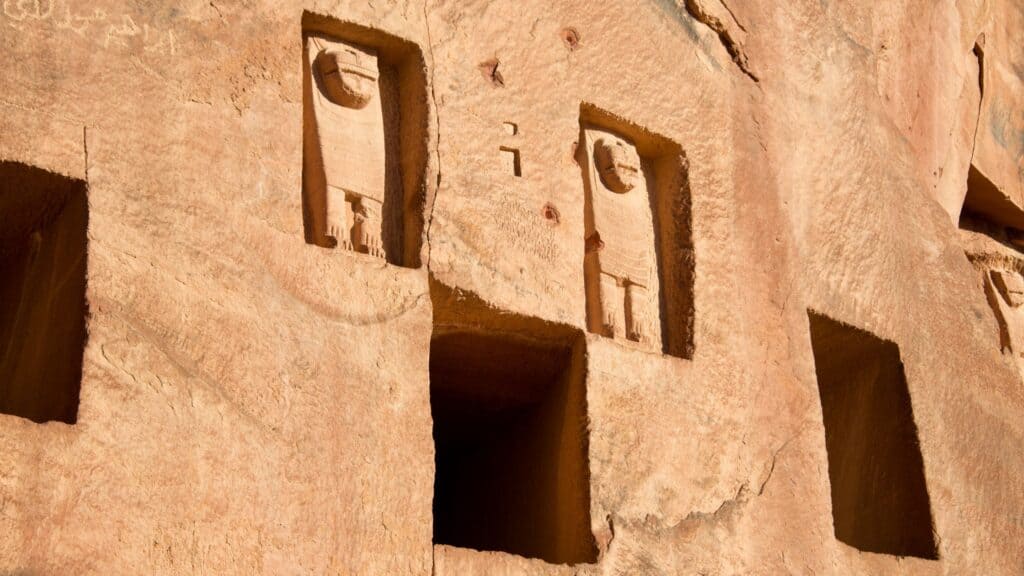
There is another detail that reaches back to Sheba. The southern incense traders from Yemen did not just pass through Dedan. They settled in. Archaeologists have found offerings the southerners left in their own script, and graves of a kind otherwise known hundreds of miles south in Yemen. One inscription even records a priest of the Minaean god Wadd, a deity of the southern kingdoms, making an offering to Dedan’s own local god.9 That is a foreign chaplain, resident in the oasis, keeping his own religion while honoring the host city’s. The two ends of the incense road, Sheba’s country in the south and Dedan in the north, met physically in this valley, in the goods, the gods, and the graves of the people who worked it.
That trade is documented far beyond the Bible. Assyrian records have the Sabaeans of the south sending aromatics and precious stones to Sargon II in 716 BC and to Sennacherib a generation later, and a Babylonian governor on the middle Euphrates reported intercepting a caravan of “the people of Tayma and Saba.”10 The Queen of Sheba’s gift to Solomon of spices, gold, and precious stones was not a fairy tale about one exotic visitor. It was the everyday cargo of this route.
Four Names, One Valley: AlUla, Dedan, Hegra, and Madain Saleh
Four names get thrown around for this stretch of desert, and they do not all mean the same thing. Two of them are actually the same site under different labels. One of them is the modern umbrella for the whole area. And one of them is the ancient biblical city we have just described.
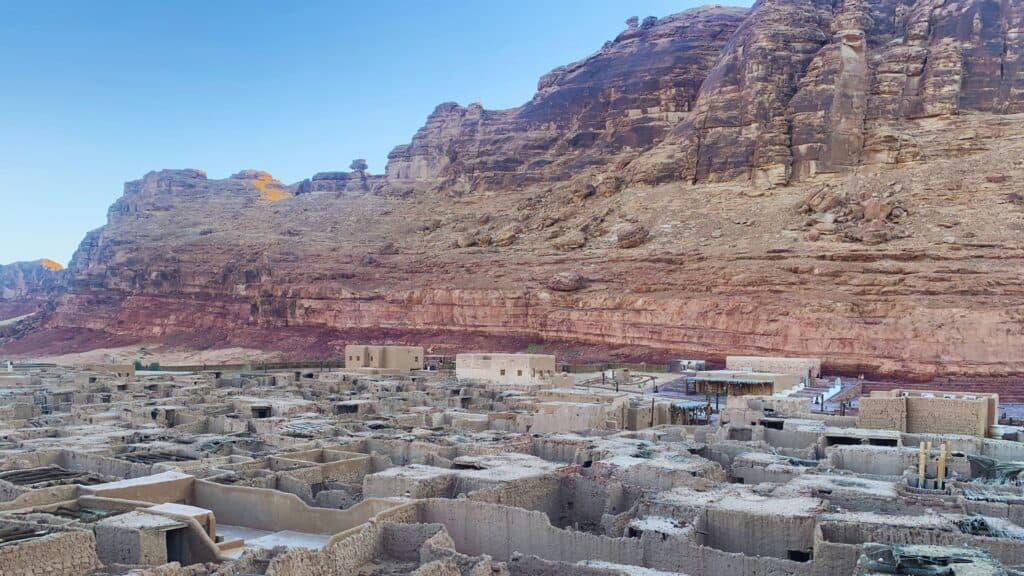
AlUla is the modern name (you will also see it written Al-Ula, with a hyphen, or Al Ula as two words, and in scholarly books as al-ʿUlā). It is a governorate and an oasis town in the Madina Region of northwest Saudi Arabia, and today it functions as the umbrella term for the entire valley and everything in it. When a travel article says AlUla, it usually means the whole destination: the old mud-brick town, the palm oasis, the archaeological sites, and the resorts.
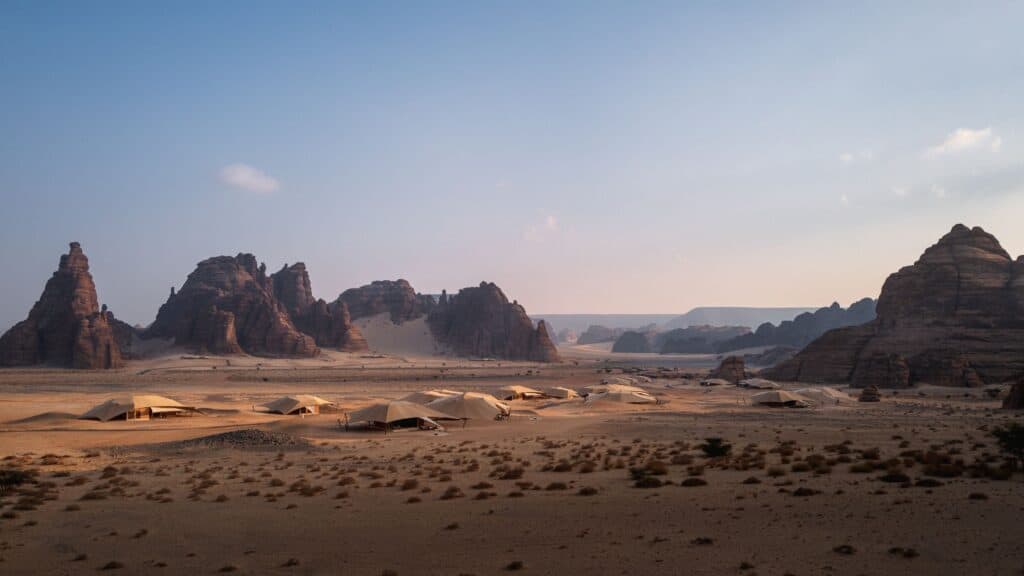
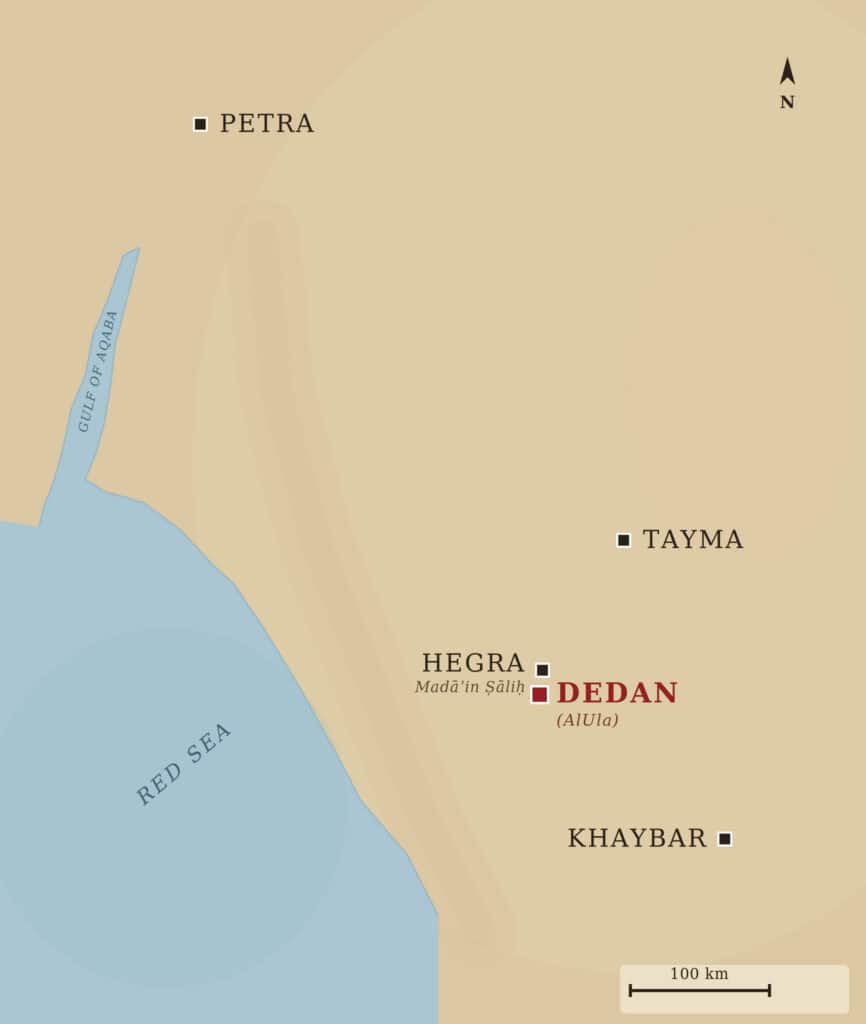
Dedan (Arabic Dadan) is the ancient biblical city, at Al-Khuraybah, toward the southern end of the valley near the modern town. This is the oasis referred to by Isaiah, Jeremiah, and Ezekiel. When you want the Old Testament layer of AlUla, this is the name you want. It is the oldest of the four and the only one that appears in Scripture.
Hegra (Arabic Al-Hijr) is the Nabatean city about fifteen kilometers north of Dedan.11 The Nabateans, the same people who carved Petra in Jordan, built Hegra as their southern capital around the turn of the era, roughly the first century BC into the first century AD. They cut more than a hundred monumental tombs into freestanding sandstone outcrops, tombs so similar to Petra’s that first-time visitors often mistake the photographs. In 2008, Hegra became the first site in Saudi Arabia to be named a UNESCO World Heritage Site.12
Madain Saleh is Hegra. Same city, different name. “Madain Saleh” is Arabic for “the Cities of Salih,” a name drawn from Islamic tradition, which associates the site with the prophet Salih and the people of Thamud, the “companions of al-Hijr” mentioned in the Quran. For most of the twentieth century the site was known to the world as Madain Saleh. The Saudi tourism authority has since revived the older classical name, Hegra, for the same ruins.
So the map sorts out like this. AlUla is the whole valley. Inside it, Dedan is the ancient biblical oasis to the south, and Hegra, also called Madain Saleh, is the later Nabatean city to the north. Two ancient cities, roughly fifteen kilometers apart, separated by about five hundred years, gathered today under one modern name.
Jabal Ikmah: The Library Carved in the Canyon
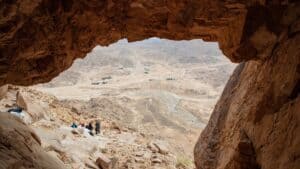
A short drive from old Dedan, a narrow canyon opens in the rock. Its walls are covered, ground level to well above head height, with inscriptions. Hundreds of them. This is Jabal Ikmah, and it has earned the nickname “the open-air library.”
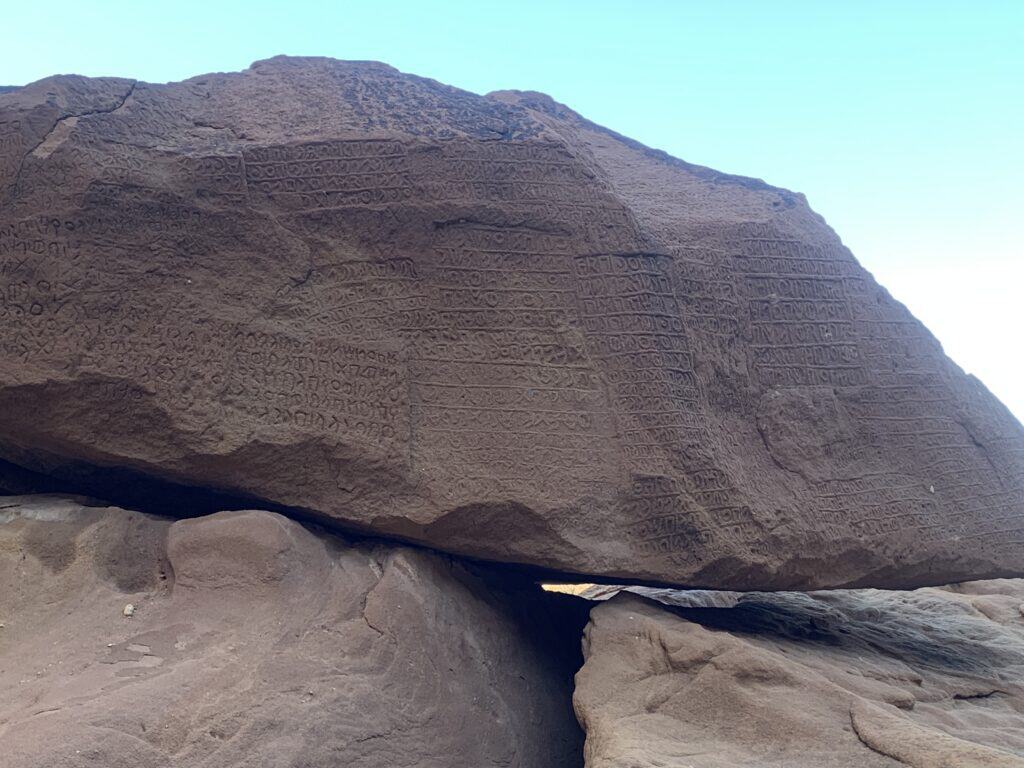
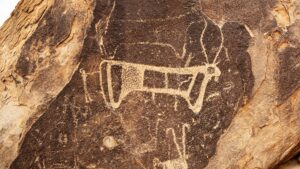
Dedan produced its own alphabet, a twenty-eight-letter script scholars call Dadanitic, and the oasis has yielded close to two thousand inscriptions in it. Most are graffiti, roughly fifteen hundred of them, which tells us that ordinary people here could read and write, not only kings and priests. Another four hundred or so are formal, monumental texts naming rulers or dedicated to the city’s gods.13 The canyon at Jabal Ikmah collects a full range: prayers, offerings, names, and the ordinary business of a literate desert people who wanted to be remembered. In 2023, UNESCO added Jabal Ikmah to its Memory of the World Register, the same list that holds the Gutenberg Bible and the Magna Carta.14
The High Places and the God of the Thicket
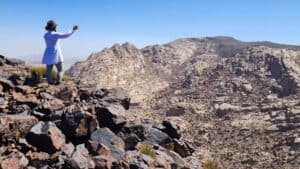
The people of Dedan worshiped up high. In the jagged mountains east of the city, archaeologists have traced a whole ritual landscape of cliff-top sanctuaries, reached by processional staircases cut into near-vertical rock and by stone bridges thrown across the chasms between peaks. Up there they built altars and set out incense burners and cisterns. The climb is so severe that the modern survey team had to bring in professional mountaineers to photograph the highest carvings. Looking at the smoothed rock faces the ancients had prepared as canvases for their inscriptions, one archaeologist guessed they “sent people on ropes to smooth the peaks,” and added that “the mortality rate must have been quite high.”15
A Bible reader will recognize the shape of this right away. Worship on the mountaintops, the “high places” that the Old Testament names again and again, was the standard religion of the peoples around Israel, and the thing the prophets spent centuries denouncing.
The god most of these inscriptions honor was named Dhu Ghabat, the patron deity of Dedan, invoked by name more than two hundred and fifty times in the oasis texts. He was the city’s own god, the one that set Dedan apart from its neighbors. The philologist María del Carmen Hidalgo-Chacón Díez, working through the inscriptions for Oxford’s corpus of ancient North Arabian writing, reads his name from the Arabic word for a thicket or woodland: “the one of the thicket.” She takes him for a god of vegetation, which fits a green, spring-fed valley set down in red rock.16 That is a striking phrase to meet here, because it is nearly the words Isaiah used for these same people: “In the thickets in Arabia you will lodge, O caravans of Dedanites.” The god of the Dedanites and the prophet’s word for their country both reach for the same image, the thicket in the waste.
Dhu Ghabat kept company with imported gods, and the guest list reads like a map of the ancient world’s trade. The same inscriptions name the Syrian goddess Atargatis, carried down from Hierapolis near Aleppo; Baʿal-shamin “the Lord of Heaven” of Canaan, which an Israelite prophet would have recognized and despised; and al-ʿUzzā, “the mightiest one,” a goddess who would still be worshiped at Mecca on the eve of Islam and is named in the Quran.17 The gods came from everywhere the caravans came from, which is the same thing as saying they came from everywhere. This was a religious crossroads centuries before it became a Jewish, Christian, and finally Muslim one.
The high places did not last. At some point the processional path was pulled down and the mountain sanctuaries were smashed, and the damage looks deliberate rather than the slow work of weather. Oxford researcher Michael Macdonald suspects it was the work of the monotheists who came later, Christians, Jews, and Muslims, stamping out the traces of the old pagan cult, though he is careful to call that “pure guesswork” for now.18 Whoever did it, the timing points to the same centuries in which a very different kind of believer was arriving in these oases and leaving a very different kind of mark.
The Jews of Arabia: Hebrew Names in the Northern Oases
Here the story takes a turn. Jewish communities lived in these northern Arabian oases, including AlUla itself, and even some of their names have been found.
The evidence was drawn together by Gary A. Rendsburg, professor of Jewish studies and history at Rutgers University, in an article for Biblical Archaeology Review in 2024.19 The picture he assembles from ancient inscriptions is of a Jewish diaspora that moved south into Arabia in the difficult centuries after Rome destroyed the Temple in AD 70 and crushed the Bar-Kokhba revolt of AD 132 to 135. When Jerusalem and then Judea was closed to Jews, some went north and west into the Roman world, some went east into Mesopotamia, and some, less famously, went south into Arabia. The oases of the northwest were among the places they settled.
At Tayma, the great oasis north of AlUla, a tomb inscription dated to AD 203 memorializes “Isaiah, the councilor, son of Joseph, chief citizen of Tayma.” Three of the four names in that short text, Isaiah, Joseph, and Amram, are Hebrew names from the Bible. The deceased sat on the city council; his father had served as the town’s leading citizen. A Jewish family had not merely arrived at Tayma but had risen to run it, and that took generations having been there.
At Hegra, the Nabatean city in AlUla, another tomb inscription from AD 356 names a chief citizen descended from a man called Samuel, and records a marriage that tied together leading families of both Hegra and Tayma. A well-preserved sundial from the same site, now in the museum in Istanbul, was donated by a man named Manasseh son of Nathan.
And at Dedan itself a French expedition more than a century ago recorded a set of inscriptions written in Jewish letters. Most are short, a name and a phrase, but they are unmistakable. One reads, in Hebrew, “Bless God.” Another offers a blessing to a man and to “Rabbi Jeremiah,” which puts that central Jewish title in use at a North Arabian oasis in roughly the fourth century. The names also show that these Jews had begun writing Arabic in Hebrew characters.
One last inscription, found along the caravan road between AlUla and Tayma, was carved by a man who noted the day he wrote it: “the day of the feast of the unleavened bread.” That is Passover. A Jewish traveler in the northwest Arabian desert, seventeen centuries ago, marked his memorial by the feast of his people.
These oases were not isolated cases. The same desert held Tayma, where a Babylonian king once withdrew for a decade, and Khaybar, a fortified oasis of date palms that was famously and heavily Jewish right up to the seventh century. By the time of Muhammad, Jewish tribes were a presence across the Hejaz, at Khaybar, at Yathrib (later Medina), and in the valleys between. The inscriptions Rendsburg gathers are the earlier chapter of the same story. They show us the diaspora arriving, generations before it became a community that would shape the religious landscape of seventh-century Arabia. The Jews of Muhammad’s Arabia did not appear from nowhere. Some of their ancestors had been living in oases like AlUla for four hundred years.
Dedan and the Last Days
When Ezekiel sees the armies of Gog amass against the land of Israel, a witnessing group speaks up, and the names are familiar:
“Sheba and Dedan and the merchants of Tarshish and all its leaders will say to you, ‘Have you come to seize spoil?'” — Ezekiel 38:13
Sheba and Dedan again, the two trading peoples, standing together at the edge of the final conflict. Many teachers read them here as the Arabian Peninsula, the commercial powers of the modern Gulf states, along with the merchants of the Sea, questioning the aggressor rather than joining him. For a visitor to AlUla the point here is simpler. The oasis carries a name that runs from the Table of Nations in Genesis all the way to Ezekiel’s vision of the last battle. Few places on earth are named across that whole arc of Scripture. Dedan is one of them.
What You Actually See in AlUla Today
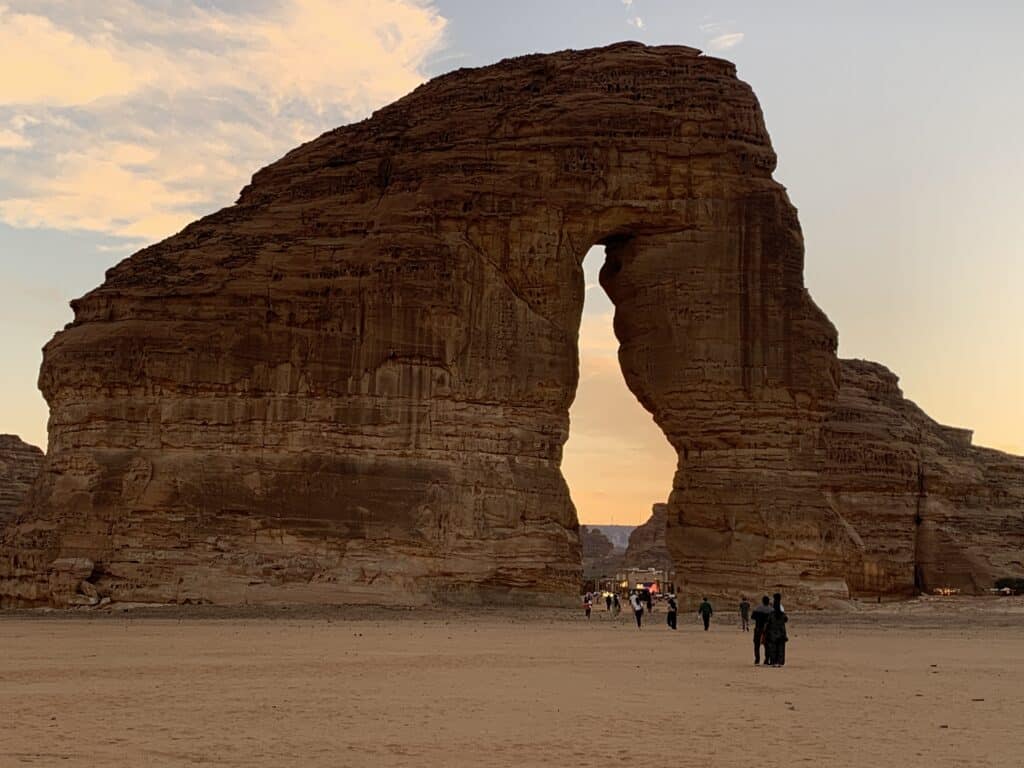
At Al-Khuraybah, old Dedan, you can look up at the tombs cut high into the cliff face and the excavated foundations of a civilization the prophets knew by name, a city that once stood several stories tall. A few minutes away, the canyon walls of Jabal Ikmah hold their thousands of inscriptions, and the ruined staircases still climb toward the smashed sanctuaries on the peaks. To the north, the great sandstone tombs of Hegra rise out of the desert floor, Nabatean funerary architecture almost untouched, quieter than Petra because far fewer people have come. Threaded among it is the palm oasis itself, still green, still watered, the reason anyone built here in the first place. And in the old town, mud-brick houses stacked against the rock mark where AlUla was still inhabited within living memory.
The prophets addressed this oasis when it was a living, trading, boasting city. Jewish families raised children and buried elders here when it was a Roman-era caravan stop. You can walk the ground where both of those things happened, in a single afternoon, with Ezekiel 27 in mind.
Explore Saudi Arabia with Living Passages
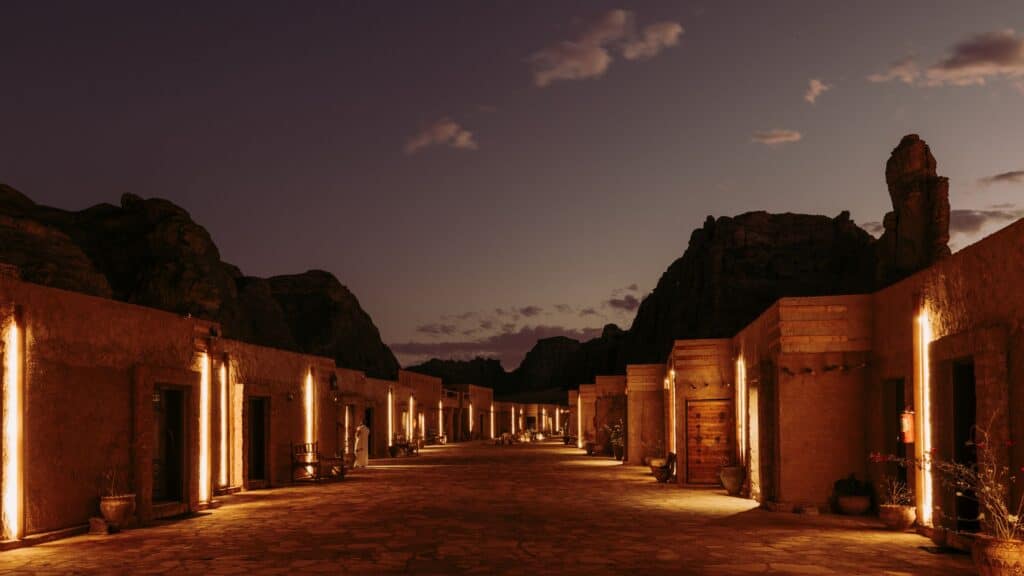
AlUla has numerous resorts now, against the same sandstone the Dedanites carved, so an evening here can be spent walking lantern-lit lanes rather than driving back to a city.
Living Passages guides biblically-focused groups through northwest Saudi Arabia. We are offering sites that have not been traditionally visited by Biblical tourism, from Jethro’s Midian and Jabal al-Lawz to Al Ula, Dedan, Tayma and Khaybar.
Notes
- Hebrew: דְּדָן ↩︎
- Andrew Curry, “The Lost World of Lihyan,” Archaeology 74, no. 2 (March/April 2021): 24–31. ↩︎
- María del Carmen Hidalgo-Chacón Díez, “The Divine Names at Dadan: A Philological Approach,” Proceedings of the Seminar for Arabian Studies 46 (2016): 125–135, at 125. The article opens by identifying Dadan (Dādān) as the oasis “known as Dedān in the Bible” and cites Ezekiel 27:20 for the Dedanite trade and Ezekiel 38:13 for the later association with the Sabaeans. ↩︎
- Curry, “The Lost World of Lihyan,” 26. ↩︎
- Hidalgo-Chacón Díez, “The Divine Names at Dadan,” 125, citing C. J. Gadd, “The Harran Inscriptions of Nabonidus,” Anatolian Studies 8 (1958): 35–92. ↩︎
- “Dedan,” Livius.org, for the span of the Dadanite and Lihyanite kingdoms (roughly late ninth/early eighth century BC through the first century BC) ↩︎
- Curry, “The Lost World of Lihyan,” 26–27. ↩︎
- ibid. 26. ↩︎
- Yemeni offerings and Yemeni-style graves at Dadan: Curry, “The Lost World of Lihyan,” 27. The priest of the Minaean god Wadd making an offering to the local god (inscription JSLih 49): Hidalgo-Chacón Díez, “The Divine Names at Dadan,” 131. ↩︎
- Hidalgo-Chacón Díez, “The Divine Names at Dadan,” 125 n. 1, drawing on Robert G. Hoyland, Arabia and the Arabs: From the Bronze Age to the Coming of Islam (London/New York: Routledge, 2001), 38–39. ↩︎
- “Dedan,” Livius.org. ↩︎
- UNESCO World Heritage Centre, “Hegra Archaeological Site (al-Hijr / Madāʾin Ṣāliḥ),” inscribed 2008 as Saudi Arabia’s first World Heritage Site, https://whc.unesco.org/en/list/1293/. ↩︎
- The Dadanitic script (twenty-eight letters) and inscription counts: Curry, “The Lost World of Lihyan,” 30 (“The Writing on the Wall”). Hidalgo-Chacón Díez, “The Divine Names at Dadan,” 125, likewise reports about 2,000 Dadanitic inscriptions and graffiti. ↩︎
- https://www.unesco.org/en/articles/jabal-ikmah-alula-secures-memory-world-status ↩︎
- Curry, “The Lost World of Lihyan,” 28–29, 31. ↩︎
- Hidalgo-Chacón Díez, “The Divine Names at Dadan,” 125, 128. ↩︎
- ibid. 126–129. ↩︎
- Curry, “The Lost World of Lihyan,” 31. ↩︎
- Gary A. Rendsburg, “Jews of Arabia,” Biblical Archaeology Review, Fall 2024. Web summary: Marek Dospěl, “Jews in Pre-Islamic Arabia,” Bible History Daily, Biblical Archaeology Society, October 6, 2024, https://www.biblicalarchaeology.org/daily/people-cultures-in-the-bible/jews-in-pre-islamic-arabia/. This section draws throughout on Rendsburg’s collection of the inscriptions. ↩︎