Jews of Khaybar: Four Traditions, One Desert Mystery
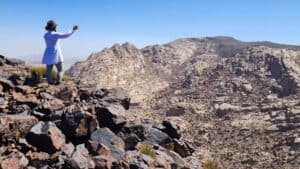
Ninety-five miles north of Medina, off the main road into the lava fields of the Hejaz, the ruins of a fortified Jewish city rise above an oasis of date palms. The locals call the largest height Jabal al-Yahud, the Mountain of the Jews. At its summit are the remains of Qamus, the citadel that was once the seat of Jewish power in northwestern Arabia. The site has been called the Masada of Arabia, and the comparison is apt: Khaybar was a stronghold, and its fall to the army of Muhammad in 628 AD ended a Jewish presence in the Hejaz that had already been ancient for centuries.
The site sits on the highway that runs between Medina and Tabuk, with Medina to the south and Al-Ula another two hours to the north. For the modern traveler, Khaybar lies squarely on the corridor that runs up through the Nabataean tombs of Hegra. For the ancient Jewish community that lived there, the same corridor connected them south to Medina, north to the trade routes of the Levant, and west to the volcanic highlands that rise above the Red Sea.
How ancient that community was, no one is quite sure. Khaybar’s Jewish presence is one of the genuine mysteries of late antique history. The people who lived there were known throughout pre-Islamic Arabia as accomplished farmers, metalworkers, and silk weavers. In the time of Muhammad the province held seven fortresses, of which Qamos, built by the chief Ibn Huqaiq, was the strongest.
Even the name is contested ground. The Arab geographers, among them Yaqut, derived Khaybar from a Hebrew word meaning fortress.1 The nineteenth-century Jewish scholar Solomon Judah Loeb Rapoport heard something older in it, as we will see below. Two etymologies, two histories, and difficulty in choosing between them.
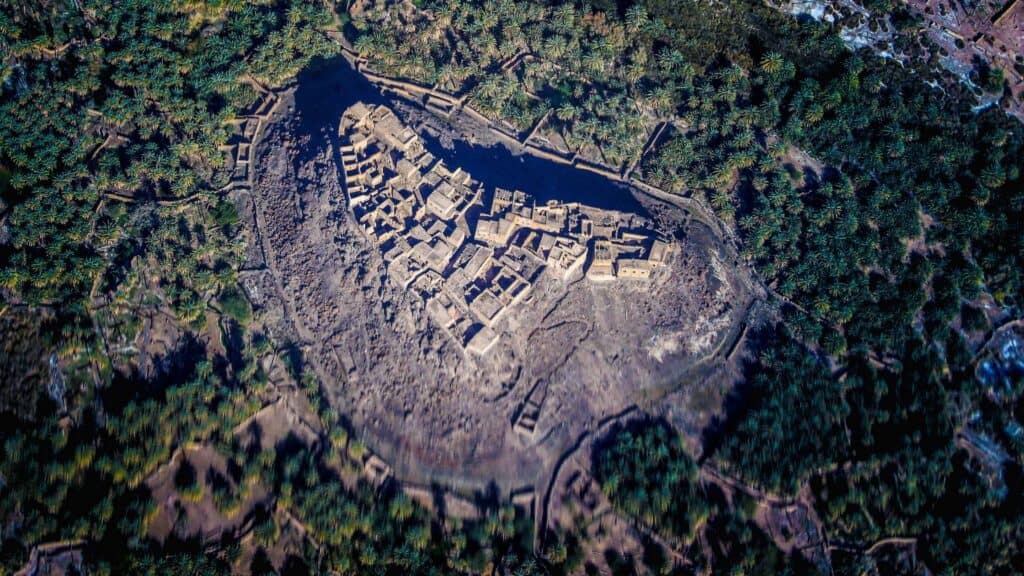
Below the citadels, the oasis was fed by an elaborate system of dams and channels cut into the volcanic soil. The most imposing of them still stands thirty kilometers to the south: the Sadd al-Bint, the “dam of the daughter,” a wall of black basalt some thirty meters high and two hundred long, plastered on its upstream face to hold back the rains.2 Its builders are disputed, with dates proposed from the pre-Islamic centuries to the early Islamic period, and one persistent tradition crediting Sabaean engineers who moved north after the failure of the great dam at Ma’rib.
The great rampart surrounding the oasis is older still, dated by recent archaeological survey to the Bronze Age, between roughly 2250 and 1950 BC, more than a thousand years before any plausible Jewish arrival.3 The Jews of Khaybar inherited a walled oasis, and much of its waterworks, from hands other than their own. What is not disputed is that Jews were among those cultivating the oasis in the centuries before Islam, and that by the seventh century they had been there long enough that no one remembered when they came.
The Two Priestly Tribes: Banu Nadir and Banu Qurayza
Before considering when the Jews of Khaybar arrived, it is worth pausing on who they understood themselves to be. The Banu Nadir were one of the leading Jewish tribes of the city then called Yathrib, now Medina, and they claimed descent from Aaron. The eleventh-century Andalusian historian Ibn Hazm recorded them in his Jamharat Ansab al-Arab as direct patrilineal descendants of the biblical high priest.4
Their kindred tribe, the Banu Qurayza, made the same claim, and Ibn Ishaq, the earliest biographer of Muhammad, traces the Qurayza genealogy back through Aaron to Abraham.5 Together the two tribes were known by a single nickname in pre-Islamic Arabia: al-Kahinan, the Two Priestly Tribes.6
The nickname belonged first to Medina. It came to Khaybar by way of catastrophe. In 625, after their break with Muhammad, the Banu Nadir were expelled from Yathrib and sought refuge among their coreligionists at Khaybar, where they held property and family ties, and where their leaders soon dominated the oasis. Three years later Muhammad’s army followed them there. So when we speak of the priestly tribes at Khaybar, we are speaking of a community whose final chapter was written in exile, defending a refuge that was itself already ancient.
That nickname is the most striking piece of evidence preserved about these tribes, because it is not a later reconstruction. It is a name they carried in their own time, recognized by their Arab neighbors, and remembered in the historical sources of traditions that otherwise agree on very little. A community calls itself priestly. Its neighbors agree. Its historians, centuries later, still record the claim.
What no source can tell us with certainty is when these priests, or the ancestors who would become these priests, arrived in the Arabian desert. Several traditions survive, and the dates they propose span well over a thousand years.
The Tradition of a Mosaic-Age Arrival
The earliest claim reaches back to the time of Moses, though it is worth saying plainly at the outset that no reader will find it in the Torah. There is no expedition to Yathrib in the books of Moses, no Amalekite prince spared, no army banished to Arabia. This is not Scripture but an origin story, one the Arab genealogists and the Hejazi Jewish communities themselves told about their own beginnings, preserved in the tenth-century anthology Kitab al-Aghani of Abu al-Faraj al-Isfahani.7
According to the account, Moses dispatched an Israelite army to expel the Amalekites from the land of Yathrib and commanded that none be spared. The army carried out the campaign but spared the life of an Amalekite prince and returned to Palestine with him. By the time they returned, Moses had died, and his successors judged that the army had violated the command. They were excluded from the community and returned to Yathrib, where they settled permanently. 8
A related strand, preserved in Shi’a sources, holds that the Banu Nadir descended from priests who migrated to the Hejaz in the generations after Aaron, so that the claim of Aaronic descent is not metaphor but genealogy, and the priestly community was in Arabia because its ancestors never left the wilderness where their forefather first served.
These are the traditions most readily dismissed by modern historians, who note the absence of contemporary attestation and the tendency of medieval chroniclers to project biblical figures back into local landscapes. Yet this is also the origin story with the longest documented life in the communities most concerned to remember it, and it has variants.
Further Arabic traditions place the Israelite settlement of Yathrib under Joshua, under Saul during the campaign against the Amalekites, and under David, who in one account took refuge in the Hejaz during Absalom’s rebellion.7 The variants disagree on the generation. They agree only on the underlying claim, that a Jewish presence in northwestern Arabia was very old, older than anyone could document, reaching back in local memory toward the beginnings of Israel itself.

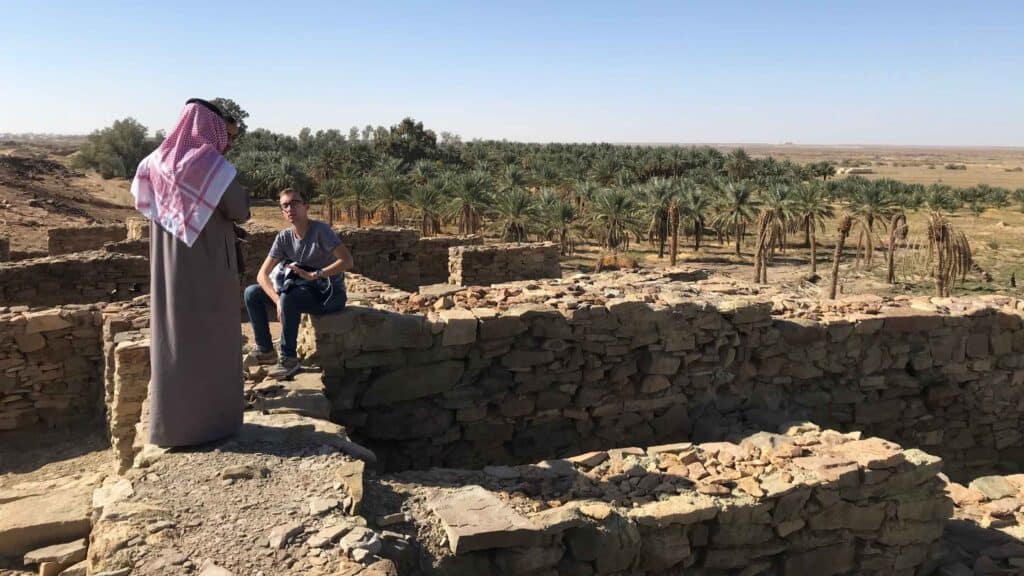
“Khaybar – deserted houses” by Hardscarf, via Wikimedia Commons, [CC BY-SA 4.0] <https://creativecommons.org/licenses/by-sa/4.0>
The Lost Tribes Tradition
A different memory was preserved on the Jewish side, though it comes to us wrapped in legend. The only medieval Jewish traveler to write of Khaybar, Benjamin of Tudela, journeying east from Spain in the 1160s and 1170s, described great and independent Jewish communities deep in the Arabian desert, at Tayma and Khaybar, ruled by their own princes of the line of David, warring alongside their Arab allies, subject to no Gentile power, and still sending questions of religious law to the exilarchs in Baghdad.9
Benjamin almost certainly never went there. His account of everything beyond Baghdad is second-hand, his populations run to the hundreds of thousands, and his geography scatters these desert kingdoms vaguely between Shinar and Yemen rather than in the Hejaz where the real Khaybar lies. What he recorded is not the oasis but the legend of the oasis: the story, which spread across the Jewish world after Khaybar’s fall and endured into modern times, that its people survived in the desert as a free nation of warriors.
The genealogy belongs to that legend, and Benjamin reports it carefully as hearsay, neither affirming nor denying it. “People say,” he writes, that the men of Khaybar belong to the tribes of Reuben, Gad, and Manasseh, whom Shalmaneser king of Assyria carried into captivity.10 Those are the Transjordanian tribes, the two and a half who settled east of the Jordan and were the first taken by Assyria in the eighth century BC. It is a striking thing to have been said, because it remembers different tribes entirely from the ones the Islamic genealogists named.
The Muslim sources preserved a priestly community of Levi through Aaron; the Jewish legend preserved a warrior remnant of Reuben, Gad, and Manasseh, children of the Assyrian exile who wandered south rather than north. Neither has been verified, and the second is legend by Benjamin’s own admission. But that two such different memories attached themselves to the same desert oasis is itself part of what makes Khaybar so hard to read. Even the stories disagree about who these Jews were.
The Babylonian Exile Tradition
A third tradition places Jewish settlement at Yathrib and the neighboring oases in the wake of the Babylonian destruction of the First Temple in 586 BC. The Jewish Encyclopedia records it in careful terms: Jews may have settled in the Hejaz after the sack of Jerusalem by Nebuchadnezzar, arriving, it is probable, in successive waves of refugees over the centuries that followed.11 The Hejazi Jews themselves, later Islamic tradition held, claimed that several of their tribes settled the oases of northwestern Arabia after Nebuchadnezzar dispersed the population of Judah. The tradition has the advantage of historical plausibility, and Jewish refugees fleeing Nebuchadnezzar’s armies would have had every reason to seek defensible desert oases beyond the reach of Babylonian power.
As it happens, the desert did hold a Babylonian connection in exactly this period, though a royal rather than a Judean one: the last king of Babylon, Nabonidus, abandoned his capital and spent ten years based at the oasis of Tayma, moving among Dadan, Fadak, Khaybar, and Yathrib.12 Whether Judean exiles followed the same roads into the same oases is what the tradition asserts and the record cannot yet confirm.
The most influential modern Jewish scholar to address the question located a specific family within this migration. In an 1824 essay in the Hebrew journal Bikkure ha-‘Ittim, Solomon Judah Loeb Rapoport proposed that the Jews of Khaybar were descendants of Jonadab ben Rechab, the Rechabite leader of Jeremiah 35, whose family had been commanded to live as tent-dwelling nomads in fidelity to their forefather’s word. Rapoport further identified the name Khaybar with Heber, the Kenite chieftain of Judges 4, and traced the community back through the Kenites to the family of Moses’ father-in-law, the priest of Midian, making the settlement of Khaybar less an exile than a return.
The Jewish Encyclopedia, surveying all the options eighty years later, judged Rapoport’s the most probable hypothesis, noting also that the Jews of Khaybar were reported to have had no contact with Jewish communities elsewhere and to have been entirely ignorant of the Talmud, which fits a community that departed Judah before the rabbinic period began.13 The biblical and theological weight of the Rechabite reading runs deeper than a survey can accommodate; we take it up in a companion piece.
The Roman Destruction Tradition
The final tradition is the latest and, for many historians, the most concrete. After Titus destroyed the Second Temple in 70 AD, and again after Hadrian’s expulsions following the Bar Kokhba revolt in the 130s, Jewish refugees scattered in every direction. Jewish tribes fleeing Roman Palestine settled wherever they found springs and green land, and Tabuk, Tayma, Wadi al-Qura, Fadak, and Khaybar all came under Jewish cultivation in this period, while the Banu Qurayza and Banu Nadir settled Yathrib.14
Al-Isfahani’s Kitab al-Aghani likewise preserves the memory that Jews arrived in the Hejaz in the wake of the Jewish wars with Rome. And the twelfth-century biographical dictionary of al-Sam’ani records an ancestor of the Banu Nadir named al-Nadir who migrated from Judea to Arabia, a name possibly derived from the Hebrew Ha-Nazir.15
Of the surviving options, this is the one that requires the least explanation. Jewish refugees from first- and second-century Palestine ended up across the Mediterranean and the Near East, from Cyrene to Babylon. Khaybar would have been a logical destination: defensible, fertile, and far enough from Roman authority to offer real refuge.
What Cannot Be Resolved
The traditions cannot all be true in their simplest forms. But it is also possible that every tradition preserves a fragment of something real. Khaybar was an oasis on a trade route, and trade routes attract layered settlement. A community that began with one wave of arrivals could absorb later refugees who brought their own genealogies and their own memories of departure. The Banu Nadir’s claim of Aaronic descent could coexist with a Transjordanian remnant and with Rechabite nomads and with Judean refugees of Rome, each wave settling behind the same Bronze Age walls, each keeping its own account of how it came to be there. The community could be older than the latest tradition and younger than the earliest, with the truth distributed across the centuries rather than fixed at any single point.
What the sources will not give us is the kind of resolution modern historians prefer. There is no founder’s inscription. There is no datable artifact tying any tribe of Khaybar to a Levitical lineage, or to any other. The rampart around the oasis predates every plausible Jewish arrival and was certainly built by someone else. The earliest historians who recorded the traditions were writing six hundred years or more after the events they describe, and the one Jewish eyewitness account we possess contradicts them on the central genealogical question.
What survives is the fortress, the cemetery, the name of the mountain, and the memory of a community that called itself priestly and was recognized as priestly by its neighbors. The question of how the children of Aaron came to live a few days’ journey from the mountain where their ancestor first served as high priest is one that Khaybar does not answer for us.
Living Passages guides biblically-focused groups through northwest Saudi Arabia. We are offering sites that have not been traditionally visited by Biblical tourism, from Jethro’s Midian and Jabal al-Lawz to Al Ula, Dedan, Tayma and Khaybar.
Notes
1. Jewish Encyclopedia (1901–1906), “Khaibar.” The entry gives the seven fortresses, names Qamus and its builder Ibn Huqaiq, records the geographer Yaqut’s derivation of “Khaybar” from a Hebrew word meaning “fortress,” and describes the Banu Nadir’s flight from Yathrib to Khaybar. https://www.jewishencyclopedia.com/articles/9296-khaibar
2. On the Sadd al-Bint (also Sadd al-Qusaybah), see Shirley Kay, “Some Ancient Dams of the Hejaz,” Proceedings of the Seminar for Arabian Studies 8 (1978): 68–80, and the summary in the Madain Project. The dam’s date is unsettled; the Sabaean attribution rests on local tradition connecting the region’s water management to settlers who arrived after the collapse of the Ma’rib dam in Yemen. https://madainproject.com/sadd_al_bint_(khaybar_dam)
3. Guillaume Charloux, Shadi Shabo, Guillaume Chung-To, et al., “The ramparts of Khaybar: Multiproxy investigation for reconstructing a Bronze Age walled oasis in Northwest Arabia,” Journal of Archaeological Science: Reports (2024), DOI 10.1016/j.jasrep.2023.104355. The Khaybar Longue Durée Archaeological Project dates the rampart, originally some 14.5 km long with 180 bastions, to 2250–1950 BCE; it had gone undetected until this survey. A free version is available through the CNRS open archive. https://cnrs.hal.science/hal-04386852
4. On Ibn Hazm’s placement of the Banu Nadir as patrilineal descendants of Aaron, see the summary in the Banu Nadir entry, with reference to his Jamharat Ansab al-Arab. The Jamharat itself is not available in English translation. https://en.wikipedia.org/wiki/Banu_Nadir
5. Ibn Ishaq, Sirat Rasul Allah, trans. Alfred Guillaume as The Life of Muhammad (Oxford University Press, 1955), which traces the Qurayza genealogy through Aaron to Abraham. Digitized copies of Guillaume’s translation are available at the Internet Archive. https://archive.org/search?query=Guillaume+Life+of+Muhammad+Ibn+Ishaq
6. Jewish Encyclopedia (1901–1906), “Banu al-Nadir,” which records that the tribe was chiefly composed of priestly families and that it and the Banu Qurayza were together styled “Alkahinan,” the Two Priests. https://www.jewishencyclopedia.com/articles/2454-banu-al-nadir
7. Jewish Encyclopedia (1901–1906), “Medina,” which records the Amalekite-displacement traditions and their variants (settlement under Moses, with reference to the Kitab al-Aghani; under Joshua; and under David during Absalom’s rebellion). https://www.jewishencyclopedia.com/articles/10545-medina
8. Sayyid Abul Ala Maududi, introduction to Surah al-Hashr, Tafhim al-Qur’an, which reports the Hejazi Jews’ own claim, citing the Kitab al-Aghani, to have settled Yathrib in the time of Moses. https://alim.org/quran/tafsir/maududi/surah/59/0
9. Benjamin of Tudela, The Itinerary, trans. Marcus Nathan Adler (1907); the Arabia section describes the Jewish communities of Tema and Khaybar, their Davidic princes, and their warring independence. Benjamin’s material beyond Baghdad is generally regarded as second-hand; the standard reference literature holds that he probably did not travel into Arabia and that this portion of the Itinerary contains much legendary matter. Adler’s translation is digitized at the Internet Archive. https://archive.org/search?query=Benjamin+of+Tudela+Adler+Itinerary
10. Benjamin reports the Reuben-Gad-Manasseh lineage as hearsay in the same Arabia section of the Itinerary (see note 9): “People say that the men of Kheibar belong to the tribes of Reuben, Gad, and Manasseh, whom Shalmaneser, king of Assyria, led hither into captivity.” On the wider medieval and modern afterlife of this material as the “legend of Khaybar,” a Jewish warrior-kingdom in the desert, see Liran Yadgar (UCLA), who lectured on “The Legend of Khaybar, A Jewish ‘Kingdom’ in the Arabian Desert.” https://international.ucla.edu/cnes/event/13395
11. Jewish Encyclopedia (1901–1906), “Medina”: “Jews may have settled in the Hijaz after the sack of Jerusalem by Nebuchadnezzar; and it is probable that they came in successive colonies.” The more specific claim that the refugees settled Wadi al-Qura, Tayma, Yathrib, and Ayla is widely repeated in later tradition but difficult to trace to a single early source, and is best treated as tradition rather than documented history. https://www.jewishencyclopedia.com/articles/10545-medina
12. Michael Lecker, “Medina [ancient Yathrib],” Thematic Dictionary of Ancient Arabia (online edition, 2023), DOI 10.60667/tdaa-0082. Citing the Harran inscriptions (Gadd 1958), the entry records that Nabonidus travelled for ten years from his seat at Taymāʾ among Dadān, Fadak, Khaybar, Yadīʿ and Yathrib. The evidence attests a Babylonian royal presence in these oases in the mid-sixth century BC; it does not by itself document Judean settlement there.
https://ancientarabia.huma-num.fr/dictionary/definition/medina
13. Jewish Encyclopedia (1901–1906), “Khaibar,” which judges Rapoport’s the most probable supposition (S. J. L. Rapoport, Bikkure ha-‘Ittim, 1824, p. 53): that the Jews of Khaybar descend from Jonadab ben Rechab, that they settled there after the destruction of the First Temple, that they were ignorant of the Talmud, and that Rapoport identified “Khaybar” with “Heber” the Kenite. https://jewishencyclopedia.com/articles/4206-chaibar-arabia
14. Maududi, introduction to Surah al-Hashr, Tafhim al-Qur’an, which treats the post-70 AD Roman expulsions as the established history behind the Jewish settlement of Ailah, Tabuk, Tayma, Wadi al-Qura, Fadak, Khaybar, and Yathrib. https://alim.org/quran/tafsir/maududi/surah/59/0
15. On al-Sam’ani’s account of an ancestor named al-Nadir who migrated from Judea, with the name possibly derived from the Hebrew Ha-Nazir, see the summary in the Banu Nadir entry. Al-Sam’ani’s Kitab al-Ansab is not available in English translation. https://en.wikipedia.org/wiki/Banu_Nadir
Explore Saudi Arabia with Living Passages
Living Passages has been guiding biblically-focused groups through Saudi Arabia since tourism officially opened up to the country in 2019. We are offering new sites that have not been traditionally visited by Biblical tourism, inlcuding Al Ula (Dedan), Khaybar and Tema.