Priest of Midian – Jethro’s Tombs Near Mt. Sinai

“And Moses was content to dwell with the man, and he gave Moses his daughter Zipporah “
The Priest of Midian – Jethro’s Tombs Still Standing in Saudi Arabia
By Jennifer Bartlett
Though they all approach Him differently, what unites the top three religions in the world is the God of Abraham. To observant Jews He is the holy Author of the Torah through the prophet Moses. Christians see Him as the One who came as a Man in fulfillment of the words of the Prophets: Emmanuel, God with us. Muslims see Him as the “Best of the Judges” (Sura 7:87)[1] and the One who rewards the faithful. Additionally, adherents of these belief systems all acknowledge the fact that the father-in-law of Moses – a man with multiple names – was a priest of Midian who served the God of Abraham.
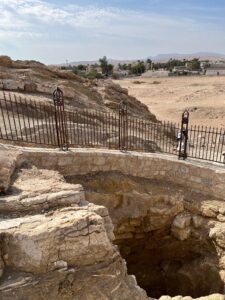
Moses Encounters Jethro’s Daughters at the Well
First called “Reuel” in Exodus 2:18, this “friend of God,” as his name or title means,[2] is introduced as “the priest of Midian [who] had seven daughters.”[3] They had come to a well to give their father’s flock some water (v. 16), but they encountered other shepherds who drove them away (v. 17). They were saved by “an Egyptian” who delivered them “out of the hand of the shepherds and even drew water for [them] and watered the flock” (v. 19) Though not of Egyptian descent, this brave gentleman likely was dressed in Egyptian garb, and his act of chivalry impressed the girls’ father, who urged them to “‘call him, that he may eat bread.’ And Moses was content to dwell with the man, and he gave Moses his daughter Zipporah” (vv. 20-21).
Reuel Renamed to Jethro
Reuel is mentioned again in the next chapter of Exodus, where it is reiterated that he is both the priest of Midian and the father-in-law of Moses, but this time he is called “Jethro” (Ex. 3:1), meaning “his excellence.”[4] This name is also used repeatedly in Exodus Chapter 18, with even more reminders that he is Moses’ father-in-law and the priest of Midian. Upon hearing of the miraculous means by which God delivered the Israelites from Egypt, Jethro makes the profound declaration, “Now I know that the Lord is greater than all gods” (Ex. 18:11).
Jethro’s Conviction of Monotheism
This sounds like an epiphany. Although Jethro, a Midianite, was a descendant of monotheistic Abraham, he seems to have lived in a polytheistic culture, and this encounter with Moses was a pivotal moment in his understanding of YHWH’s superiority over all other gods. The Quran, which calls Jethro “Shu,’aib” (meaning “the one who guides to the right path”[5]), describes him preaching to his fellow Midianites, urging them to forsake their idolatry and dishonest trading practices, and instead worship the God whom Moses worshipped (Sura 7).
In response to Moses’ account of God’s great acts in Egypt, “Jethro, Moses’ father-in-law, brought a burnt offering and sacrifices to God; and Aaron came with all the elders of Israel to eat bread with Moses’ father-in-law before God” (Ex. 18:12).
Jethro’s Godly Priesthood
Although he was not an Israelite, Jethro’s assertion and offerings demonstrate that his priesthood was now dedicated solely to the God of Moses. His act of worship reverberates forward in time through the prophet Isaiah:
And the foreigners who join themselves to the Lord, to minister to him, to love the name of the Lord, and to be his servants… their burnt offerings and their sacrifices will be accepted on my altar; for my house shall be called a house of prayer for all peoples. (Isaiah 56:6-7)
Unfulfilled Prophecy of Midian
In a prophecy yet to be fulfilled, Isaiah includes in his list of worshippers those in Midian:
A multitude of camels shall cover you, the young camels of Midian and Ephah [a son of Midian[6]]. They shall bring gold and frankincense, and shall bring good news, the praises of the Lord. (Isaiah 60:6)
Although Exodus 18 doesn’t specifically mention these precious commodities, gold and frankincense likely were among Jethro’s offerings, as these were valued fare along the camel-traversed Midianite trade route and were appropriate for the God of Moses 3500 years ago. These were also among the precious gifts brought by the Magi from the East 2000 years ago, and they are likely to be brought again at a time yet future, when all the nations of the world will honor Him.
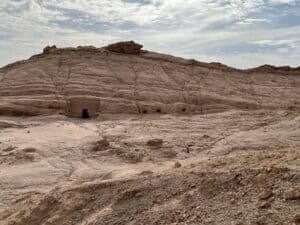
Visiting Jethro’s Tombs Today
This site, known locally as Mugha’ir Shu’ayb-the Cave of Jethro-is traditionally identified as the burial place of Jethro along the western edge of the ancient city of Midian. The location itself tells an important story. First, the area is marked by an abundance of caves. In the ancient Near East, caves were often reserved for the burial of prominent and respected individuals. Jethro was regarded as a man of status and influence among the people of Midian, making this setting consistent with his standing.
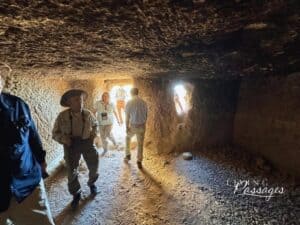
Second, ancient sources confirm that cave habitation was common among the Midianites. Flavius Josephus notes this in Antiquities of the Jews (Ant. I.xv.1), using the term “troglodytis,” meaning cave dwellers. Though the Midianites were primarily nomadic, living in tents, they also used nearby caves-especially during the intense summer heat. The natural terrain of this region lends itself easily to cave construction, explaining their prevalence at this site. The caves visible today were originally carved as living spaces. Over time, many were repurposed-first as granaries and later as tombs. During a later historical phase, particularly between 300 BC and AD 106, several of these tombs were reshaped in the distinctive style of the Nabateans. Centered in Petra, the Nabatean civilization left behind a recognizable architectural signature, and that same carved style can still be observed in the caves associated with Jethro’s tombs.
Evidence & Verification of Moses’ Well Location
Even one of the Saudi archaeologists involved in the 2002 rebuttal acknowledged that respected Islamic and Arab historical sources identify this location as the Well of Moses. An early Arabic biographer describes the site in clear terms:
“At the coast of the Qulzum Sea (the Gulf of Aqaba) lies the city of Midian, which is larger than Tabuk. Inside the town was the well from which Moses (peace be upon him) drew water for the livestock of Shu’aib (Jethro).” This identification is not limited to ancient texts alone. Local inhabitants have referred to this location as the Well of Moses for generations, preserving the tradition through oral history.
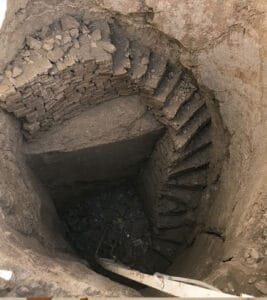
A Saudi archaeological survey of the region further highlights the site’s long-standing importance. The study notes that Magharat al-Bid’ (the well of al-Bad) was consistently maintained and restored by Muslim rulers and governors throughout every period of Islamic history. This sustained care was due to the well’s vital role as the primary water source for the al-Bid’ oasis and for pilgrim caravans traveling through the region. As stated by Dr. Abdul Rahman al-Tayyib al-Ansary in Al-Bid’ History and Archeology (Kingdom of Saudi Arabia, Ministry of Education, 2002, p. 33), the historical, religious, and practical significance of the site ensured its preservation over centuries.
Come see the land of Jethro in Midian (now called Al Bad’) and Moses’ Well in Saudi Arabia with Living Passages! Our Saudi Arabia expeditions visit these sites as well as the Real Mount Sinai, the Split Rock of Moses, the Red Sea Crossing, Oasis of Elim, and Oasis of Tema.
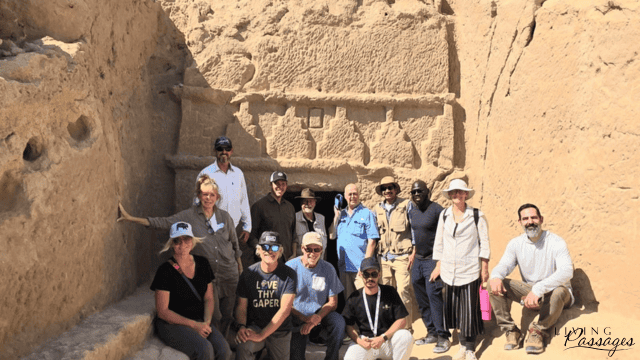
Living Passages arranges customized Christian travel arrangements for the Bible scholar and their participants that can reach into areas of scripture that are generally overlooked. Call us to plan your next expedition at 208-765-8500. Explore Our Biblical Expeditions HERE
References:
[1] M. H. Shakir, ed., The Quran (Medford, MA: Perseus Digital Library, n.d.), Sura 7:104-105.
[2] 7467. רְעוּאֵל Reʿûwʾêl, reh-oo-ale´; from the same as 7466 and 410; friend of God; Reüel, the name of Moses’ father-in-law, also of an Edomite and an Isr.:-Raguel, Reuel. James Strong, A Concise Dictionary of the Words in the Greek Testament and The Hebrew Bible (Bellingham, WA: Logos Bible Software, 2009), 109.
[3] All Scripture references are from The Holy Bible, English Standard Version (Crossway, 2001) unless otherwise indicated.
[4] 3503. יִתְרוֹ Yithrôw, yith-ro´; from with suffix; his excellence; Jethro, Moses’ father-in-law:-Jethro. James Strong, A Concise Dictionary of the Words in the Greek Testament and The Hebrew Bible (Bellingham, WA: Logos Bible Software, 2009), 54.
[5] https://blog.muslimandquran.com/story-of-prophet-shuaib-a-s-shuaib/#
[6] “The sons of Midian were Ephah, Epher, Hanoch, Abida, and Eldaah” (Genesis 25:4, ESV).