
Joseph’s Storehouses Found in Egypt
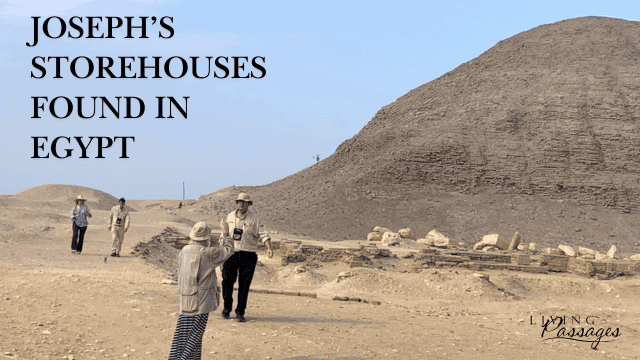
"So when the famine had spread over all the land, Joseph opened all the storehouses and sold to the Egyptians, for the famine was severe in the land of Egypt. "
History of Joseph, Jacob's Son
The story of the Exodus in the Bible begins in the sands of Egypt. Joseph was the son of Jacob (later named Israel) and Rachel. Jacob had 12 sons among 4 women but Joseph was his favorite. His brothers became jealous of his father’s favoritism towards Joseph so they decided to sell him into slavery. Joseph was eventually sold in Egypt to Potipher, one of Pharaoh’s officials (Genesis 37:36).
The Lord was with Joseph and gave Joseph success in everything he did. This gained Potipher’s trust and confidence in Joseph and he entrusted him with everything he owned. But after Potipher’s wife falsely accused Joseph of attempting to sleep with her, Joseph was sent to the king’s prison, where he stayed for some time. Even in prison, the Lord was with him and gave him success, allowing the warden to put Joseph in charge of everything in the prison (Genesis 39:22).
Joseph Interprets Pharoah’s Dreams
Joseph was blessed by God with the gift of dreams and dream interpretation since he was a young man (he was 17 when he received a dream he would rule over all the land). While he was imprisoned, he interpreted the dream of Pharaoh’s chief cupbearer while the cupbearer was temporarily thrown in prison. Later on, Pharaoh had dreams he could not understand. The cupbearer remembered Joseph’s gift and told Pharaoh about him. Joseph then interpreted Pharaoh’s dreams which was a prophecy from God that there would be seven years of prosperity and seven years of famine (Genesis 41:25-27).
Joseph Becomes Pharoah’s Vizier
After Joseph had shown the Lord being with him and revealing His plan through Joseph’s dream interpretations, Pharaoh believed Joseph was the most discerning and wise in all the land. Therefore, Pharaoh put Joseph in charge of his palace and all his people. Only Pharaoh would be greater than Joseph with respect to the throne (Genesis 41:39-41).
At 30 years old, Joseph became Pharoah’s vizier, 13 years after the Lord gave him the prophetic dream of this. This is a great reminder to us as believers to have patience with the Lord’s timing when He has called us to something. Also, when you are faithful to the Lord and His commandments, as Joseph did, He provides and follows through on His promises.

Stela Near Joseph's Storehouses in Egypt
Seven Years of Prosperity and Seven Years of Famine
During the seven years of prosperity/plenty, Joseph collected all the food and grains that were in abundance in the land of Egypt and stored it in the cities. “In each city, he put the food grown in the fields surrounding it. Joseph stored up huge quantities of grain, like the sand of the sea; it was so much that he stopped keeping records because it was beyond measure.” Genesis 41:48-49
After the seven years of prosperity had ended, the seven years of famine began, just as Joseph said. There was famine in all other lands except Egypt, where they had food storage due to Joseph’s work. People cried to Pharoah for food, and he directed them to Joseph. "So when the famine had spread over all the land, Joseph opened all the storehouses and sold to the Egyptians, for the famine was severe in the land of Egypt. And all the world came to Egypt to buy grain from Joseph, because the famine was severe everywhere.” Genesis 41:56-57
Visiting the Remaining Storehouses in Egypt
In our recent Egypt Christian tour with Frank Turek, we walked through the desert where some of the remains of Joseph’s storehouses stand to this day. These storehouses are located about a hundred kilometers, or 62 miles, southwest of Cairo, the capital of Egypt. Thousands of storehouses of grain have been discovered that Joseph built during the seven years of plenty.
The desert landscape is dotted with mound-like structures resembling moguls on a ski slope—these are the remains of storehouses that have collapsed over time. Originally constructed from mud bricks, these storehouses had structures built on top with two additional underground levels beneath. In total, approximately 3,000 storehouses were built in this area, and at nearly 3,900 years old, most have now caved in due to their great age.
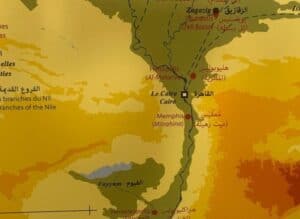
Map of Joseph's Canal in Fayum, Egypt
“Joseph’s Sea” Canal Discovered Next to Storehouses
While visiting the storehouses, Frank and the Living Passages travelers explored a canal that historical evidence suggests was built by Joseph himself. Known from ancient times, this waterway was originally called "Joseph's Sea." The canal is part of a massive 180-mile irrigation project that extended from the Nile River into this region, with multiple branches distributing water throughout the area. Joseph engineered this system in preparation for the coming famine, creating an agricultural zone capable of producing food and providing water for large populations while also facilitating grain storage.
The 180-mile canal from the Nile River up to this area took 1,000 days to build. And this whole area now is known as El-Fayam, which means 1,000 days. In Hebrew, 'Yam' means day and 'Elef' means 1,000 days. This linguistic connection, along with the ancient tradition of calling the canal "Joseph's Sea" dating back to the time of the pharaohs, aligns closely with the biblical account of Joseph's time in Egypt.

Frank Turek at Joseph's Canal in Egypt
Pyramid With Amenemhat III Stamped Bricks
Adjacent to the canal stands a mud brick pyramid whose origins remained mysterious until 1968, when a Polish archaeological team discovered bricks stamped with the name Amenemhat III. That name meant to the invisible God. Amenemhat III was the last of the three Pharaohs under which Joseph served way back in the 12th dynasty of Egypt, approximately 1800-1900 B.C.
Later on, the Greeks used this as a place to bury their dead because there were a thousand storehouses above the ground and two sets of thousands below the ground. So archaeologists discovered mummies, about 300, in this area, but they were from the Greek period after Alexander the Great came here. When you go back much further, 1600 years prior, you learn that the canal and the pyramid and the storehouses originate with Joseph of the Bible.
As Frank and the travelers explored more of this area, they noticed the pyramid from 4,000 years ago was made of mud and straw bricks. A mud brick pyramid indicated that the king of Egypt did not consider himself God. The pharaohs considered themselves God. And the pharaohs would build their pyramids out of stone, normally limestone and or granite. But someone who didn't think he was a God, just the king of Egypt, would build his pyramid out of mud brick and straw, an indication that Joseph was in charge of building this.

Bedouin Famine Stela in Egypt
Bedouin Stela Found Near Storehouses
Further evidence of the famine has been discovered near the storehouses including this Bedouin Stela limestone inscription depicting emaciated people with evidence of a famine in the land. This stela was discovered by the Egyptian Antiquities Service in 1940 and is now on display at the Imhotep Museum near the remains of Joseph's storehouses. They would have traveled into Egypt to buy food from Joseph and his storehouses.
Few Egypt Bible tours go and see these places and artifacts, but Living Passages aims to take travelers to unique and relevant locations that deepen your understanding of scripture.

Living Passages arranges customized Christian travel arrangements for the Bible scholar and their participants that can reach into areas of scripture that are generally overlooked. Call us to plan your next expedition at 208-765-8500.


