
Paul’s First Sermon at Pisidian Antioch: The Correlation to Caesar Augustus

"Now Paul and his companions set sail from Paphos and came to Perga in Pamphylia. And John left them and returned to Jerusalem, but they went on from Perga and came to Antioch in Pisidia. "
Paul's First Sermon at Pisidian Antioch, Turkey
By Sarah Eaton
The Yalvaç Museum in modern Turkey houses an extraordinary artifact: fragments of Augustus Caesar's Res Gestae Divi Augusti - "The Deeds of the Divine Augustus." What we know of the text comes from stone copies that were carved and displayed in various parts of the Roman Empire. This was ancient propaganda at its finest: Augustus' own carefully curated account of his military victories, political achievements, and divine honors. The inscriptions functioned as a permanent public sermon with Augustus narrating salvation-by-empire, stability-by-rule, peace-by-sovereignty. The full text can be read here.
What makes this particular inscription in Yalvaç Museum so fascinating is that it comes from Pisidian Antioch, the Roman colony where the Apostle Paul preached his first recorded sermon (Acts 13:14-52). It was preached in a synagogue to a mixed audience of Jews and Gentiles. Paul’s claims invert Augustus’ logic at every critical point.
“Now Paul and his companions set sail from Paphos and came to Perga in Pamphylia. And John left them and returned to Jerusalem, but they went on from Perga and came to Antioch in Pisidia. And on the Sabbath day they went into the synagogue and sat down. After the reading from the Law and the Prophets, the rulers of the synagogue sent a message to them, saying, “Brothers, if you have any word of encouragement for the people, say it.” Acts 13:13-15
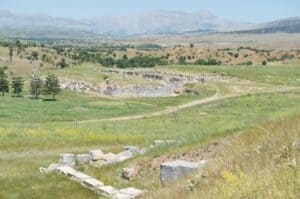
Byzantine Basilica at Pisidian Antioch
View from the theatre toward the Byzantine basilica at Pisidian Antioch, built above the synagogue where Paul preached his first recorded sermon. Photo by Dosseman, CC BY-SA 4.0, via Wikimedia Commons.
Ceasar Augustus’ Boast in Res Gestae
Augustus' Res Gestae is a masterpiece of imperial self-promotion. Written in the first person, it catalogs his conquests, the offices he held, the temples he built, the games he sponsored, and the honors bestowed upon him by a grateful empire. The opening sets the tone: "At the age of nineteen, on my own initiative and at my own expense, I raised an army..."
This wasn't a mere autobiography, but a kind of theology that would attempt to usurp the truth as the Gospel reveals it to us. Augustus had transformed himself from Octavian, a ruthless warlord of civil war, into the semi-divine father of a new golden age. The Res Gestae codified that transformation, turning military might and political power into evidence of divine favor.
Copies were inscribed on bronze pillars and temple walls across the empire, including at Pisidian Antioch - a Roman colony explicitly founded to project imperial power into the difficult terrain of central Anatolia.

Pisidian Antioch, Turkey Map
The fragments from Pisidian Antioch indicate that the Augustan inscription was publicly visible in the city Paul entered. Very few archaeological sites allow us to anchor early Christian preaching so precisely against the physical remains of Roman ideological power. Pisidian Antioch is one of them.
Paul’s Humility in Suffering Vs. Augustus Prideful Propaganda
Now imagine Paul, perhaps a decade or so after his visit to Pisidian Antioch, writing his second letter to the Corinthians. Some "super-apostles" have been challenging his authority, and he finds himself forced into the uncomfortable position of defending his credentials.
What follows in 2 Corinthians 11:18-12:13 is one of the most extraordinary passages in ancient literature. Scholars call it Paul's "fool's speech." Look at what Paul catalogs as his "achievements":
"Five times I received at the hands of the Jews the forty lashes less one. Three times I was beaten with rods. Once I was stoned. Three times I was shipwrecked; a night and a day I was adrift at sea; on frequent journeys, in danger from rivers, danger from robbers, danger from my own people, danger from Gentiles, danger in the city, danger in the wilderness, danger at sea, danger from false brothers; in toil and hardship, through many a sleepless night, in hunger and thirst, often without food,[a] in cold and exposure." (2 Cor 11:24-27)
This is *anti-*Res Gestae. Where Augustus boasts of conquests, Paul lists beatings. Where Augustus catalogs honors, Paul inventories humiliations. Where Augustus proves his divine status through power, Paul insists his weakness is precisely the condition for divine power: "When I am weak, then I am strong" (12:10).
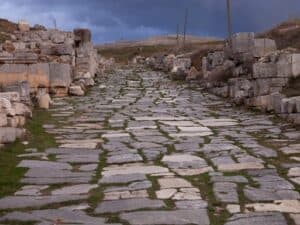
Remains of cobblestone road in Pisidian Antioch
A street in the ruins of Pisidian Antioch near present-day Yalvaç, Turkiye.
Paul’s Missionary Journey - A Radical Inversion
Paul knew exactly what he was doing. His words were spoken into a city whose identity had been shaped by Augustus’ own authorized story of the world. At Pisidian Antioch itself, he would have encountered the visible evidence of Roman power - the monumental architecture and perhaps the Res Gestae inscription as well.
And he thoroughly inverted it all.
In the Greco-Roman world, suffering was shameful. Weakness was failure. Power, honor, and glory were self-evidently good. Paul's "boasting" in his sufferings would have sounded insane - or subversive. Probably both.
But that's precisely the point. The gospel Paul preached at Pisidian Antioch centered on a crucified Messiah - ultimate weakness, ultimate shame by Roman standards. His own "Res Gestae" simply embodied the same upside-down logic: God's power perfected in human weakness, divine glory revealed through human suffering.
Visiting the Roman Colony of Pisidian Antioch in Turkey Today
Today, you can visit the Yalvaç Museum and see Augustus' words carved in stone on one of our Footsteps of Paul or Seven Churches of Revelation expeditions. During our Bible tours to Turkey, you can walk the ruins of Pisidian Antioch and trace the outlines of imperial power - the colonnaded streets, the temple platforms, the aqueducts that brought Roman civilization to Anatolian highlands. On our Christian travel to these sites, you will see the military road that was built by Augustus and would have been the road Paul walked on in Galatia, between Lystra, Pisidia, and Perge.
But Which Testimony Proved More Enduring?
Today, Augustus’ empire is dust and his temples are ruins. The divine honors he claimed are historical curiosities. But Paul's letters written in weakness, circulated among nobodies, and promoting a crucified ‘criminal’ as Lord became the foundational documents of a movement that outlasted that empire and will outlast the empire present when Messiah returns.
This kind of historical irony is exactly what makes biblical archaeology so compelling - when you can stand where ancient texts intersect with ancient power and see how a ragged band of Jesus-followers gradually turned the world upside down. Join us on our upcoming Christian tours to Turkey and beyond to experience these connections firsthand.

Living Passages arranges customized Christian travel arrangements for the Bible scholar and their participants that can reach into areas of scripture that are generally overlooked. Call us to plan your next expedition at 208-765-8500.
Related Articles


