The Chariot Without a Charioteer: Sinai Petroglyphs and Exodus 14
The Lure of Serabit el-Khadim
Most of what brings scholars to Serabit el-Khadim is on top of the mountain. The Temple of Hathor sits at the summit, surrounded by the proto-Sinaitic inscriptions that Flinders Petrie first documented in 1905 and that Dr. Douglas Petrovich has argued, on a reading still debated in the field, may name Joseph’s children. The temple itself is rich with pharaonic inscription, including a relief of Amenemhat III (the pharaoh of Joseph’s era in conventional biblical chronology) offering to the Hathor court at the site. The site is worth the time and effort it takes to walk it properly. But what about the Sinai petroglyphs nearby?
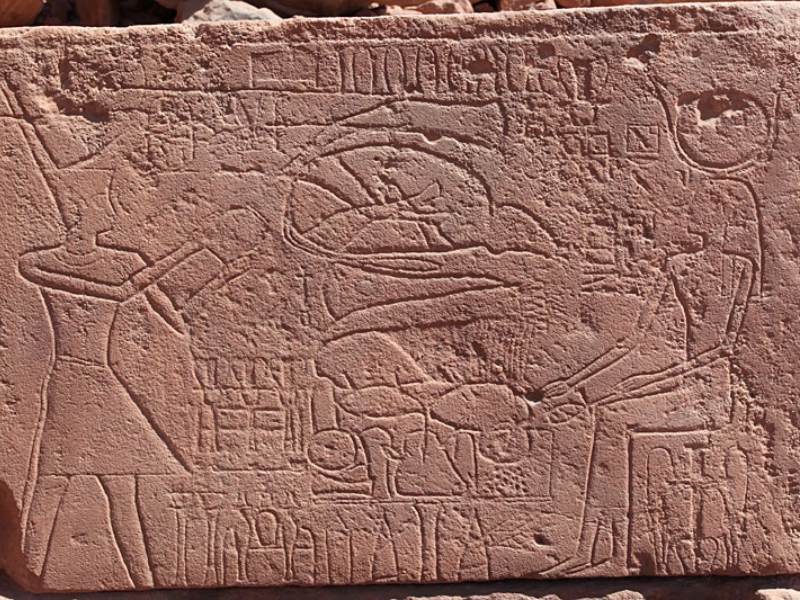
Amenemhat III, the pharaoh of Joseph’s era, offers to Hathor at Court P of the temple.
Image: Amenemhat III offering to Hathor, Court P, Temple of Hathor, Serabit el-Khadim. Photo: Roland Unger, CC BY-SA 3.0, via Wikimedia Commons.
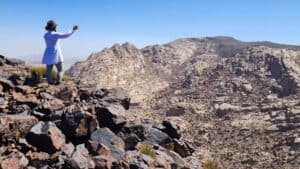
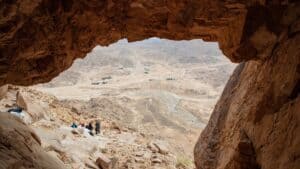
About five kilometers north of the temple, on a high vantage point overlooking the ancient Gharandal-Ayla road that connected the Gulf of Suez to the Gulf of Aqaba, there is a separate site that almost no one talks about. The local name is Gebel el-Mokaber, and I was there recently in the company of one of the most senior archaeologists working in South Sinai.
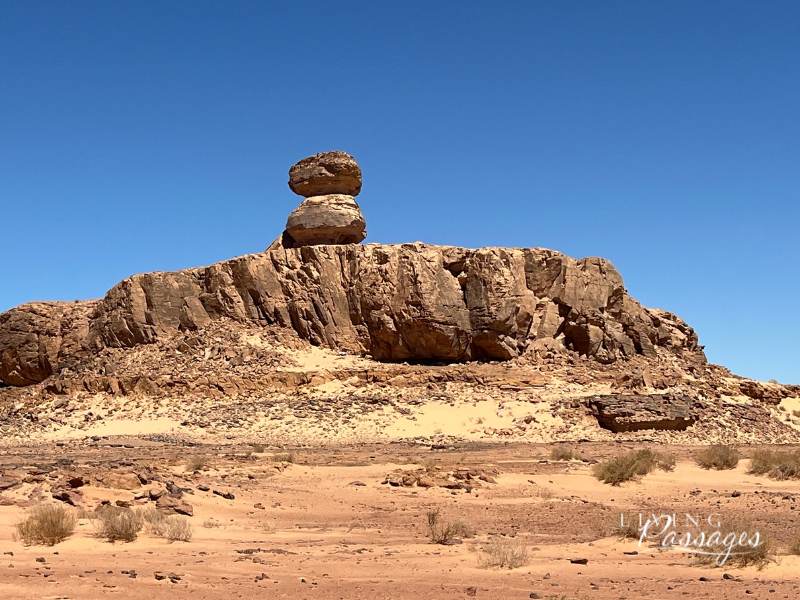
My expert guide that day was Dr. Mustafa Nour El-Din, former general supervisor of antiquities for South Sinai and co-author of the recently published academic study of this site in the Saudi journal Adumatu. He has spent more than thirty years on the ground in the Sinai. The chariot scenes at Gebel el-Mokaber are documented in his paper, but the paper is in Arabic and circulates in academic libraries, not in pastors’ studies. As far as we are aware, this is the first time these inscriptions are being described in English for a biblical-traveler audience.
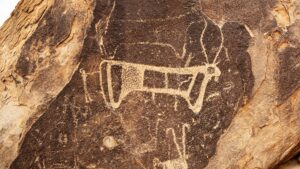
There are six chariot scenes carved into the rock. Three are clustered together on one face, and three are isolated elsewhere on the outcropping. Dr. Nour El-Din was candid that the execution is schematic, done by “notching and tapping” rather than careful incision. What makes the site significant is not the quality of the carving but the subject and the location. Chariot iconography in Egypt belongs on temple walls and royal monuments as commissioned art for pharaohs.
As Dr. Nour el-Din states in his book on Serabit el-Khadim: “These petroglyphs seem strange, out of place in this hostile environment.” Chariots do not normally appear as graffiti on a desert boulder, six scenes in one place, on the open ground between Egypt and the wilderness route to the east. Some Egyptian-style chariot graffiti is attested elsewhere across the Sinai, the Negev, and northwestern Arabia, mostly along the trade and military corridors. What is unusual about Gebel el-Mokaber is the cluster: six chariot scenes on one outcropping, none of them at the nearby temple, on the passage between the gulfs.

Several chariot scenes are clustered on this rock face and this is said to be the oldest one.
Dating the Petroglyphs is Hard
As Dr. Nour el-Din’s academic paper admits, these petroglyphs are difficult to date with precision, but he offers two professional readings. The first is that the carvings relate to the twelfth-century BC campaign of Ramesses III into Sinai and Arabia, evidenced by a Ramesses III inscription at Wadi al-Hamr roughly twenty kilometers from Gebel el-Mokaber. The second is that they were made later, by local inhabitants or caravan travelers during the period when overland trade across Sinai was active, somewhere in the late first millennium BC or early first millennium AD. Both readings place the carvings within the long span of Egyptian military and caravan traffic that moved through this corridor across the entire biblical period. The Exodus is one event within that traffic.
The Chariot without a Driver
The most unusual of the six chariot scenes is the one we want to point at. As we discussed them at the site, Dr. Nour El-Din described what he was seeing in his own words: “A chariot without a charioteer, drawn with two horses, and four men around, in front of the chariot — like sinking, or in the water. Or maybe a ritual dance.”
He offered two readings and neither was claimed with certainty. But the first reading of these particular Sinai petroglyphs is the one that stops a biblically literate traveler in the road. View the short video here: The Sinai Chariot Petroglyphs.
What happened in Exodus 14?
Exodus 14 narrates the departure of the Hebrews across the Red Sea escaping their Egyptian pursuers. It describes Pharaoh’s chariots and his horsemen following the Hebrews into the sea, and the waters rushing back upon them.
“The waters returned and covered the chariots and the horsemen; of all the host of Pharaoh that had followed them into the sea, not so much as one of them remained” (Exodus 14:28, ESV)
The picture the Bible provides is chariots, horses, and men all going down together. A petroglyph of a chariot with its horses still attached, no driver in it, and four men around it with arms raised as if sinking in water, is the image Exodus gives us. Dr. Nour El-Din offered the ritual-dance alternative with appropriate professional caution, but it is hard to picture. Four men dancing before a stationary chariot whose horses are still in the harness, with the driver missing from his post, does not seem to be a natural composition for a ritual. It is, however, a natural composition for a record of catastrophe: a vehicle stopped in mid-motion, its driver gone, its team still bound to it, witnesses or survivors around.
Of course, we are not the archaeologists, and not in a position to settle the discussion. Dr. Nour El-Din’s published readings of these Sinai petroglyphs are professional readings made by a specialist who knows this ground better than anyone. However, we stood in front of this chariot scene with him, and his own first description of what he was seeing was a chariot without its driver, sinking in water.
It is worth being careful about what the rock could be a record of. Gebel el-Mokaber sits well inside the western Sinai mining and trade zone, and none of the major proposed routes for the Exodus itself — whether the northern route past the Bitter Lakes, the central route to Nuweiba, or the southern route to the Strait of Tiran — pass directly by this Gebel. So if these carvings are in any way related to the events of Exodus 14, they may not be the work of people who watched the sea close on the Pharoah’s army. They could be the work of people in the Sinai who heard what had happened, or who saw the aftermath, or whose ancestors had been told by Egyptian survivors what they had seen. The “road” below Gebel el-Mokaber was a corridor of Egyptian movement across many centuries. News traveled it. Memory traveled it. What gets carved into stone on a route like that is what the people on the route were thinking about.
Other interpretations remain possible. The carver may have had no connection to the Exodus events at all, and may have been recording an Egyptian battle scene he had seen or heard about elsewhere. What we are willing to say is that this rock sits above a road that Egyptian military and caravan traffic used for most of the biblical period, that there are six chariot scenes on it, and that one of them shows the image Exodus gives us. Stone survives in the Sinai.

Rhonda Sand at Gebel el-Mokaber and Dr. Mustafa Nour el-Din at the at the camp at the base of Serabit el-Khadim,
where Living Passages groups stay during expeditions.
Visiting Serabit el-Khadim and its Environs
Three of Living Passages’ private expeditions next year include Serabit el-Khadim and the surrounding Sinai petroglyph sites. We bring small groups, with the right permissions, with guides who know the ground, and we walk these places carefully and slowly. The famous Hathor temple on the hilltop and the ancient turquoise mine are part of every visit. So also this rock above the road, five kilometers to the north, where what the people on this road were thinking about is still in the stone.
If you would like to bring a group, we would be honored to talk with you.
— Rhonda
Sources:
Mustafa Nour El-Din and Islam Sami, “An Analytical Study of Rock Carvings from Mount Al-Mukaber in South Sinai,” Adumatu 40 (January 2026), pp. 71–84.
Mustafa Nour El-Din Serabit elkhadim and its archaeological environs, 2026.