The Bricks at Pithom Have No Straw
Standing On the Slavery Site of Exodus 1:11
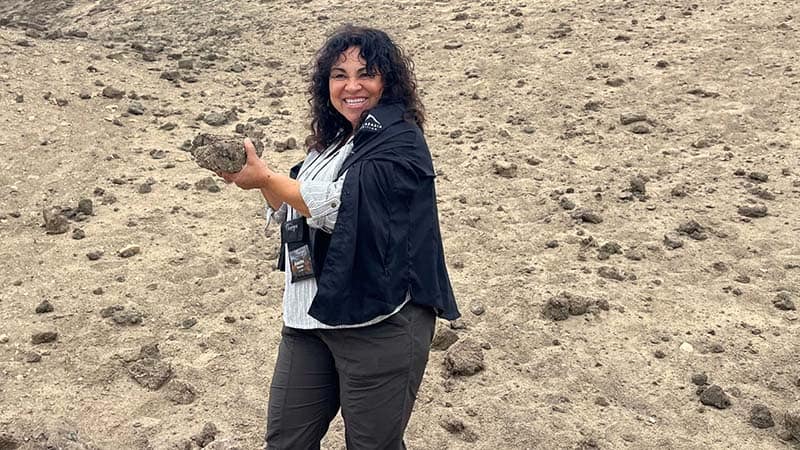
The wind moves across a low brown rise about sixty miles east of Cairo, and our group of travelers stops walking. The guide, an archeologist and Egyptologist, Mido, has bent down to pick up a piece of broken brick. He turns it in his hand and looks up.
“100% here who made this one was one of the Israelites,” he says. “We are not only walking where they were. We are holding their sweat and their power and their blood in our hands.”
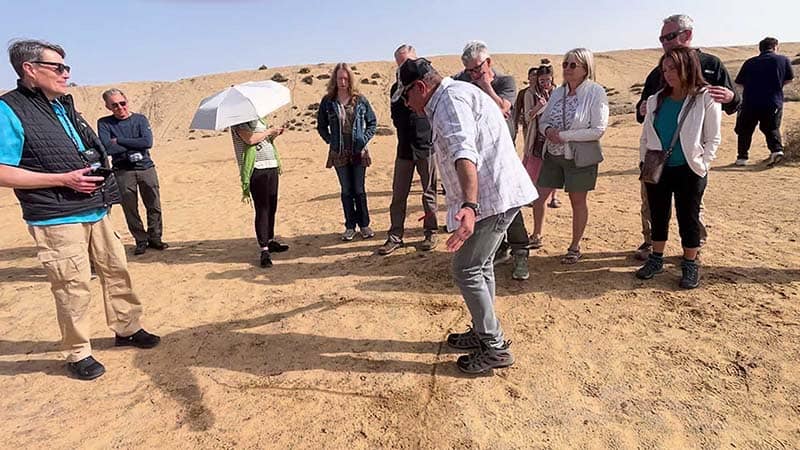
These are rarely visited sites connecting the two, Tell el Retabeh and Tell el-Maskhuta.
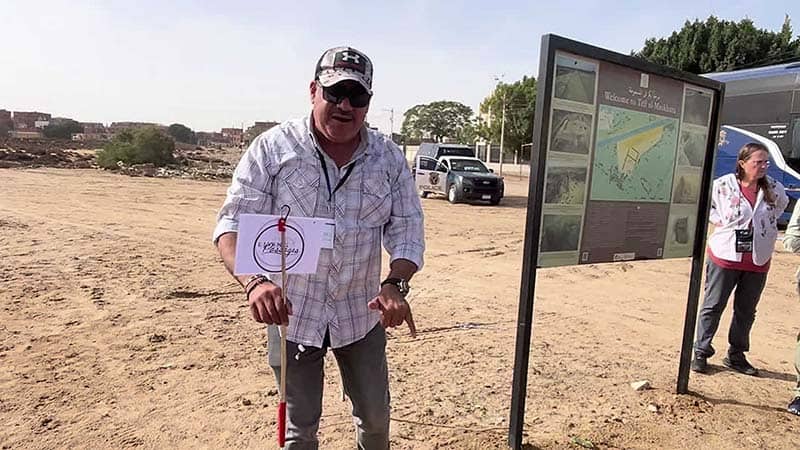
The Egyptians who run the Ministry of Tourism and Antiquities have planted a welcome sign at the perimeter that, in English and Arabic, names the place: a huge archaeological site in the Wadi Tumilat, an ancient city called Tjeku, identified by the Ptolemy II–era Pithom Stela as one of two locations the Hebrew Bible calls Pithom. Retabeh and Mashuta are about nine miles apart, and the most defensible reading of the evidence is that the city of Pitom named in Exodus 1:11 was a complex straddling both tells along the Wadi Tumilat, the valley that has always been Egypt’s eastern doorway. The two sites have been somewhat interchangeable, but both have a similar history with the Hebrews, with Tel el-Mashuta being the strongest candidate for Succoth and Tel el Retabeh the strongest candidate for Pithom, both occupied by the Hebrews at the time of the Exodus, as the population swept through on their way out of Egypt.
What Exodus 1:11 Actually Says
Therefore they set taskmasters over them to afflict them with heavy burdens. They built for Pharaoh store cities, Pithom and Raamses. (Exodus 1:11, ESV)
Two cities. Both store cities, meaning grain warehouses and provisioning depots on Egypt’s eastern frontier. Both built by forced Israelite labor. One of them, Pi-Ramesses, lies buried beneath the modern village of Qantir, its city center invisible under farmland and homes. The other, Pithom, is here, fenced and accessible, mostly ignored by the standard Egypt itinerary, and full of mud brick that was made by hand by slave labor.
The Egyptian name was Per-Atum, meaning House of Atum, after the creator-god worshiped at this corner of the Delta. The stones still bear that original name. A broken granite block lying on the ground, photographed by our tour group, carries the hieroglyphs that spell Per-Atum. The Hebrew scribes heard that word and wrote it down as Pithom.
The Strawless Bricks
The real evidence here is not the inscription. It is the brick itself.
A few chapters after the forced labor begins, Exodus 5 records Pharaoh’s escalation. The Hebrew foremen had come to him asking permission for their people to go three days into the wilderness to sacrifice to the Lord. Pharaoh’s answer was to make the work harder.
You shall no longer give the people straw to make bricks, as in the past; let them go and gather straw for themselves. But the number of bricks that they made in the past you shall impose on them, you shall by no means reduce it. (Exodus 5:7-8, ESV)
Sun-dried mud brick is normally made with chopped straw or chaff worked into the wet clay. The straw binds the matrix, prevents cracking, and lets the brick hold its shape under load. Bricks made without straw are weaker, slower to dry, and prone to crumbling. Imposing strawless brick production on the same daily quota was a punishment with engineering teeth, and Exodus 5:12 records the consequence: “So the people were scattered throughout all the land of Egypt to gather stubble for straw.”
At the Tell, our guide stops at one of the exposed brick masses, gestures at its composition, and tells the group what he sees:
“Behind me here is something very unique that we can point to, and that is a storehouse that was made with bricks that contained no straw. You would never make bricks without straw unless you didn’t have any straw. That points us directly back to the Israelites, who were forced by Pharaoh to first find straw, and then they had to find reeds, and then they couldn’t, they ran out of material, so they just made bricks out of pure mud. Here we have one of the storehouses made of bricks without straw. This is one of the locations that we could point directly to that the Israelites were here in Egypt.”
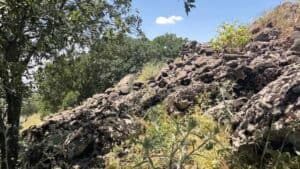
The bricks have eroded over thirty-five centuries. Wind, water, and time have weathered the surfaces into rough mounds, but the cross-sections still show the original composition.

The Enclosure Wall and What It Guarded
The most visible architectural feature, especially visible at the Maskhuta site is a massive enclosure wall, roughly 300 meters long and 200 meters wide. The Egyptian government signage on site marks its outline and the foundation of the temple of Atum in one corner of the compound. This is the temple that gave the city its name. The Hebrew Pithom is the Egyptian Per-Atum, House of Atum, and the foundation of that god’s house is still in the ground at the corner of the wall the Israelites built.
A store city is, by definition, a fortified granary. The Egyptian Ministry of Tourism and Antiquities sign at the site describes Maskhuta as “the door-lock” of the eastern frontier. The store cities held grain reserves, provisioned military expeditions moving east toward the Sinai and the Levant, and controlled the corridor in and out of Egypt.
The labor required to build a 300-by-200-meter walled compound out of hand-formed mud brick is enormous. It is the kind of multi-generation public works project that filled the Egyptian economy of the New Kingdom. The wall is still standing.
The Well, and How They Cleaned the Water
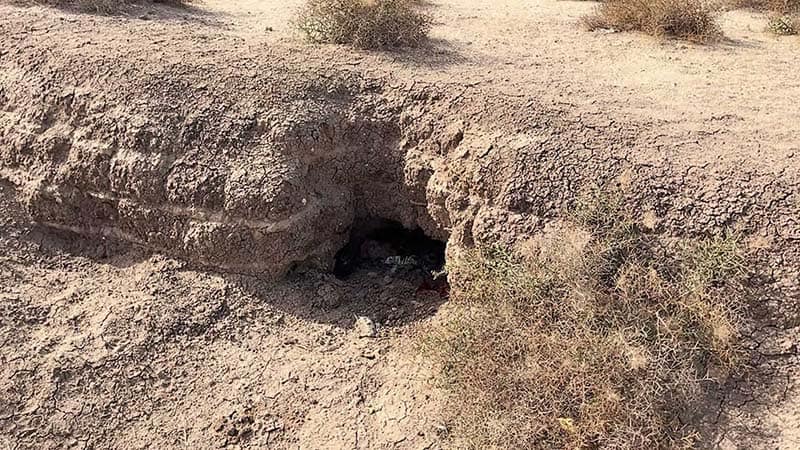
At the Maskhuta site specifically, the apparent compound and the ground gives way to a vertical shaft and a well system. Mido pauses the group here to explain how it worked. The Nile branch ran past the city, but you could not drink straight from it. The water came thick with silt. So the Egyptians dug a well a few hundred feet back from the watercourse and let the soil between the river and the shaft filter the water clean. By the time it reached the well it was clear enough to use.
This is the kind of engineering detail that brings the slavery account into focus. The Israelites at Pithom were not breaking rocks for the sake of cruelty. They were building functional infrastructure, water systems, defensive walls, grain magazines, all on a frontier whose entire purpose was to control the eastern road. Both Maskhuta and Retabeh are on the canal system.
The Passover Detail Hiding in the Ground Plan
When Mido explains who occupied Maskhuta after the Exodus, he flags something travelers might miss.
“We still have some people living here. Who are those people? The Egyptians. Because we know, on the night of the Passover, the Egyptians and the Israelites were living in the same neighborhood. That’s why they needed to have the blood mark by the entrance of their doors. If only the Israelites were living here, they wouldn’t need a blood mark. They needed a blood mark when one Egyptian house was next to one Israelite house. That’s why they put the blood mark.”
The Passover narrative in Exodus 12 includes the famous instruction:
“The blood shall be a sign for you, on the houses where you are. And when I see the blood, I will pass over you, and no plague will befall you to destroy you, when I strike the land of Egypt” Exodus 12:13, ESV
The text presumes a residential geography in which Hebrew and Egyptian homes were interspersed. Pithom, as both a working store city and a settled population center with continuous Egyptian occupation after the Exodus, fits exactly that geography. The blood on the doorposts was a sign that distinguished one house from the next house, not one neighborhood from another neighborhood.
What Visitors Actually See
The sites are not pristine and it is not landscaped. The tells rise out of agricultural fields and small village construction. Modern Egypt has grown up to the perimeter. Plastic litter blows against the walls of the storehouses. There is no gift shop, no walking path, no audio tour.
For most travelers, that is the wrong kind of site. This is not the Egypt of postcards. It is the Egypt of Exodus 1. The biblically literate traveler stands at Pithom and Succoth and reads what is in his Bible against what is under his feet.
Why Most Egypt Tours Skip It
Standard Christian tour itineraries in Egypt move from Cairo to Giza to Luxor and then south along the Nile. Retabeh and Maskhuta are in the wrong direction. These sit east of the Delta, on the road toward Suez, off the main tourist circuit. The sites that draw the heaviest traffic in Egypt are the architectural set pieces of pharaonic glory, the pyramids and the temples and the Valley of the Kings. Pithom is the architectural set piece of slavery, and slavery does not sell tickets the way pyramids do.
This is what is left of one of Pharaoh’s store cities. The bricks are still there. The wall is still there. The name is still legible on the stone.
“We are not only walking where they were. We are holding their sweat and their power and their blood in our hands.” —Mido, our Egyptian guide
Walk the Eastern Delta with Living Passages
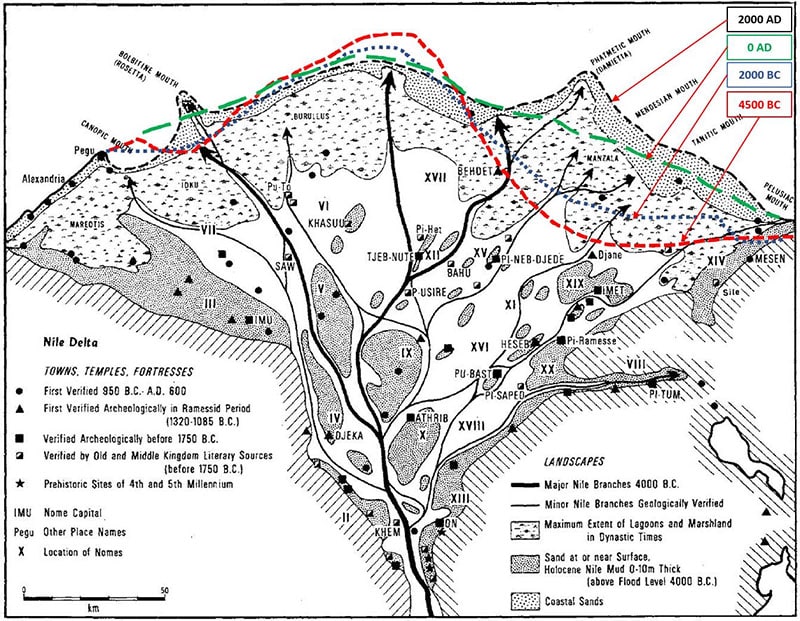
Living Passages has been guiding biblically-focused groups through Egypt for years, and our Egypt itineraries include sites most standard tours overlook. Walking the ground at Tell el-Maskhuta, exploring the Wadi Tumilat corridor where the Hebrews built Pharaoh’s store cities, and standing at the biblical encampments of Pithom and Succoth — this is the Egypt of Exodus 1, taught on the ground by knowledgeable guides like Mido.