King Abgar’s letter to Jesus: Edessa’s ancient Christian claim
How a small Syriac kingdom in what is now southeastern Turkey may have been among the first on earth to believe.
A kingdom on the edge of the Syrian desert became Christian while Rome was still feeding believers to the lions. It kept in its royal archives a letter its kings believed Jesus had written by his own hand, and its churches would in time venerate a portrait of Christ said to have been painted from life, by a man who had stood in his presence.
All this was recorded by a serious historian, preserved by an ancient church, and they belong to a place you can still walk through today: Edessa, capital of the kingdom of Osroene, now the Turkish city of Şanlıurfa. We traveled there with author Joel Richardson and the story he brought back is well known to the Eastern Church but one of the strangest and most overlooked chapters by modern Protestants.
The city of the prophets
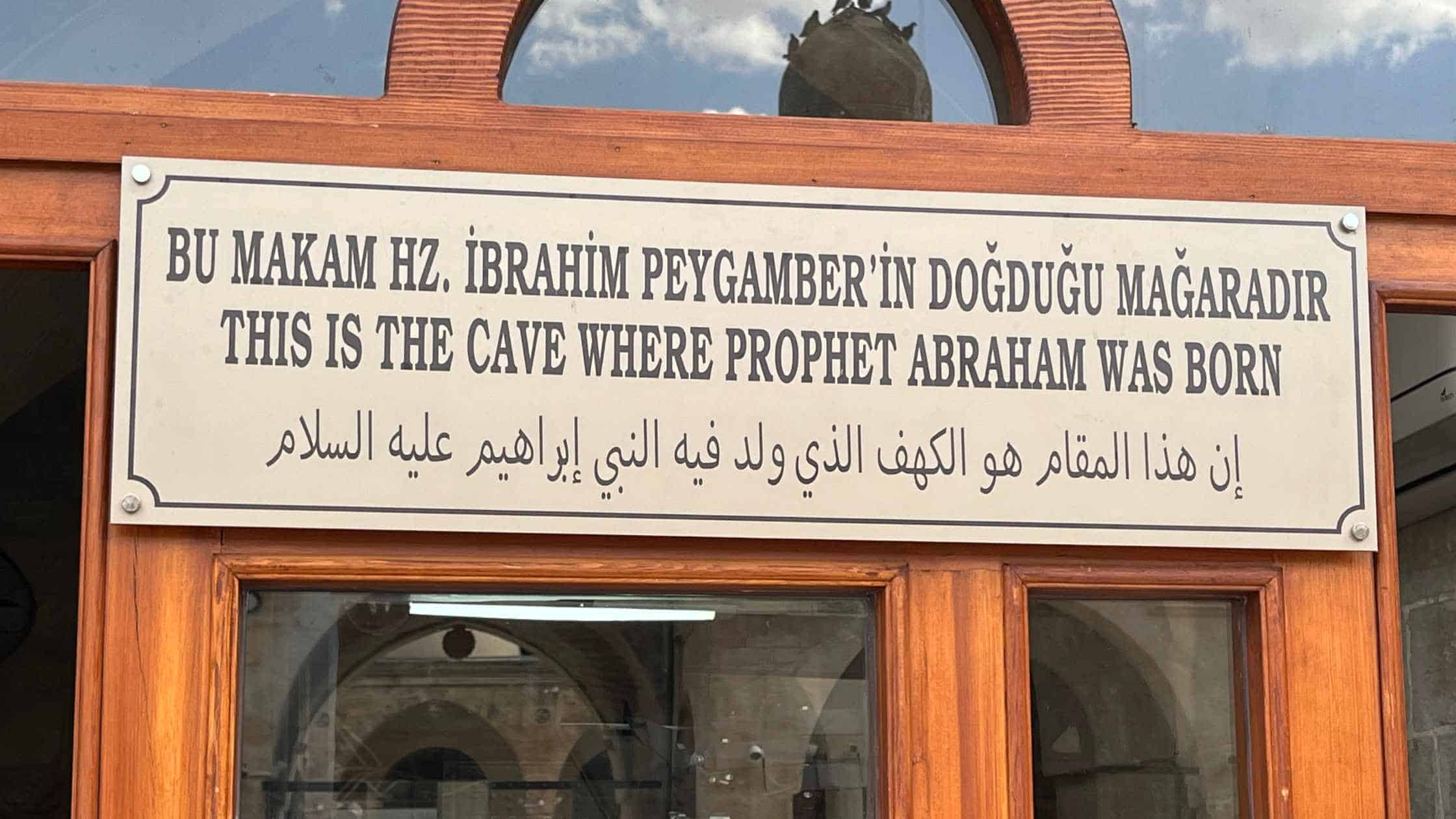
Şanlıurfa is the kind of place where biblical and ancient history are layered on top of one another. It is widely called “the city of the prophets,” woven through with both Christian and Muslim memory. Local tradition holds that Abraham was born here, and Joel is careful about that one: “whether that’s true or not,” he says, the connection is old and deeply felt.
ell el Retabeh and Tell el-Maskhuta.
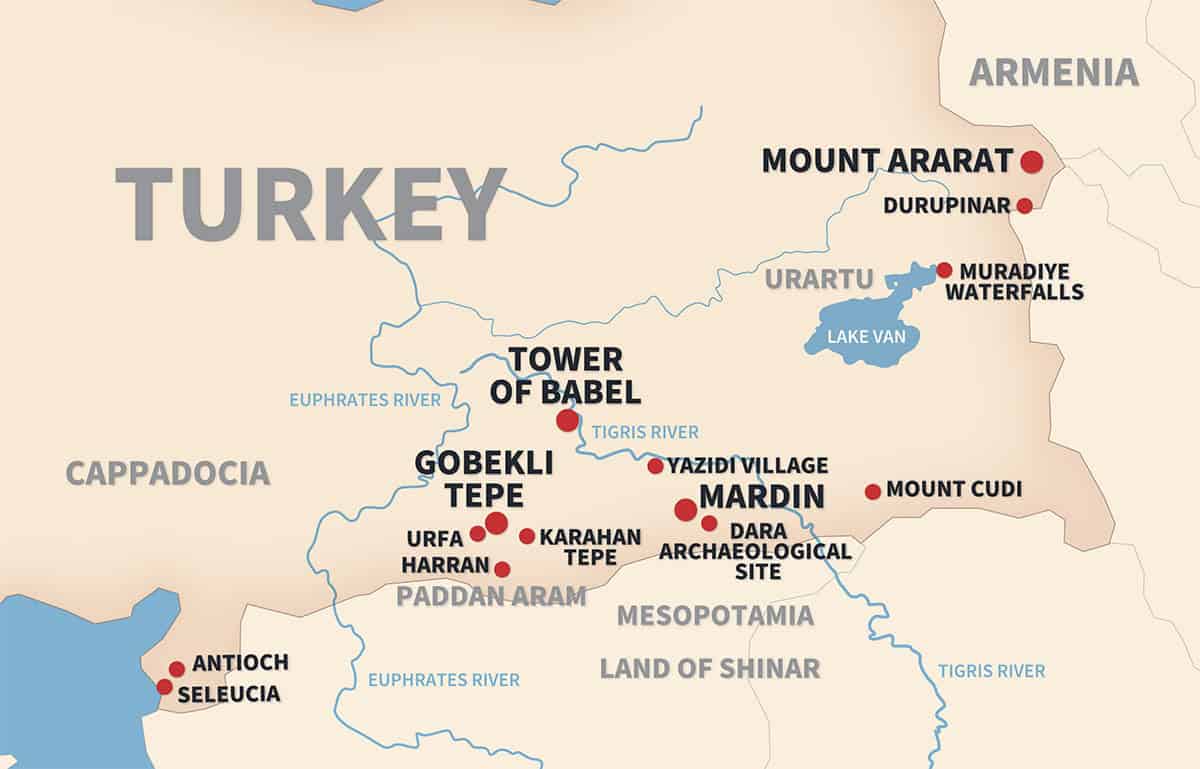
The connection that rests on firmer ground lies just to the south. Forty-four kilometers from Şanlıurfa sits the village of Harran, identified with the biblical Haran of Genesis, the region Scripture also calls Paddan-Aram and Aram-Naharaim. This is where Terah settled with his son Abram on the road from Ur toward Canaan (Genesis 11), and it is where Jacob came a generation later to his uncle Laban, worked fourteen years, and met Rachel and Leah at the well (Genesis 28 through 29).
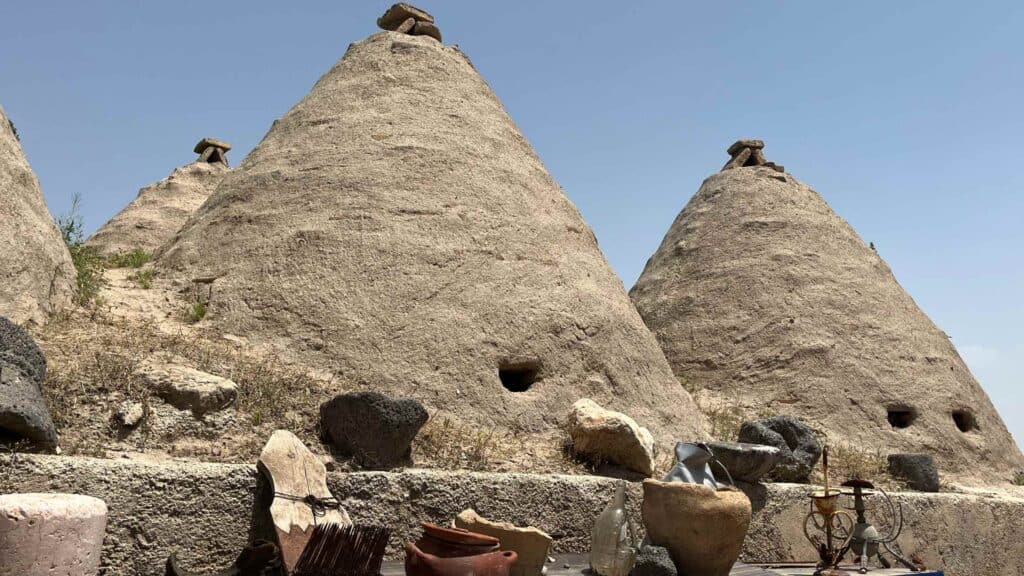
Traditional “beehive” houses located in Harran, Turkey. Constructed primarily of mud, clay, and straw without the use of wood, they are designed to stay cool in the summer and warm in the winter.
That detail matters for the story, because it answers an obvious question: how did a king this far north ever hear of a healer in Galilee? As Joel pointed out to our travelers, we tend to picture this region as impossibly remote from the Holy Land, and it simply was not. “The borders of Solomon’s kingdom come pretty close,” he noted, and the patriarchs themselves had lived in this very country. News from Judea could and did travel here. Edessa was firmly rooted in Semitic language and culture. Its people spoke Syriac, a dialect of the Aramaic that Jesus and his disciples spoke, so a Galilean and an Edessene would have understood one another.
The kingdom of Osroene
Osroene was founded around 132 BC and endured for roughly five centuries, until Rome absorbed it in the third century AD. It was a buffer state, wedged between two great powers, the Roman Empire to the west and the Parthian Empire to the east, and it survived by playing one against the other. Its ruling house, the Abgarid dynasty, was Arab in origin and Aramaic in culture, and most of its kings carried the name Abgar or Ma’nu.
The Abgar at the center of our story is Abgar V, called Ukkama, “the Black.” According to the tradition, he reigned at the time of Jesus, and he was gravely ill with a sickness no physician could touch (some suggest it was leprosy).
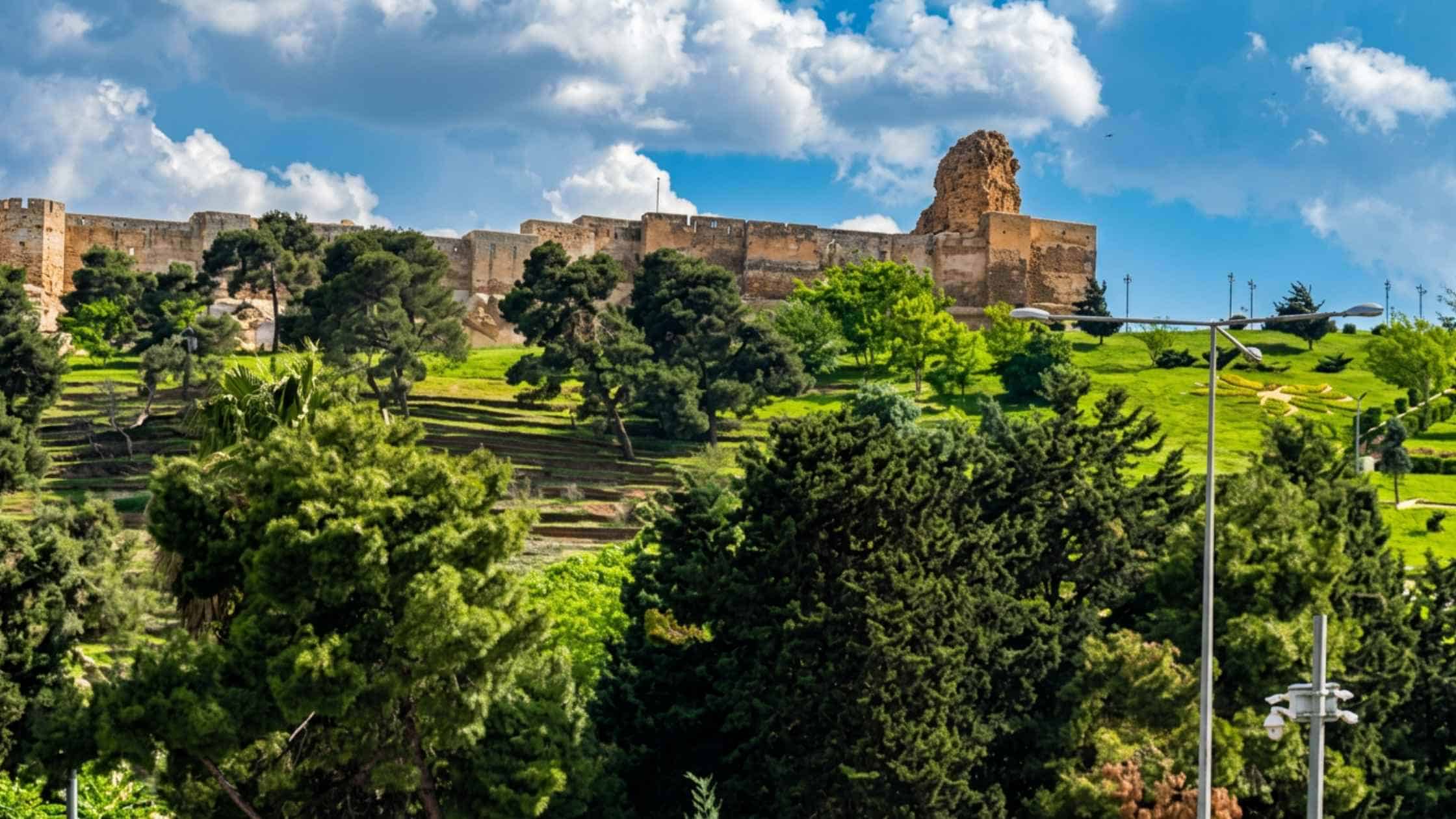
The Şanlıurfa citadel. This hill is the acropolis of ancient Edessa.
The letter and the reply
Our oldest account comes from Eusebius of Caesarea, the fourth-century bishop often called the Father of Church History. In Book One, chapter thirteen of his Ecclesiastical History, Eusebius tells the story and makes a striking claim: he says he found the documents in the public archives of Edessa and translated them himself, word for word, from the Syriac.
Joel offers an honest word about Eusebius before we lean on him. Yes, Eusebius was Constantine’s man, and Protestant readers in particular are sometimes wary of him. But on a matter like this he is functioning less as a theologian and more as an archivist. “He’s conveying history,” Joel says, “as much as he’s gathering the traditions that we had in the fourth century.” He preserved what was in front of him.
What was in front of him was a short letter from a desperate king. Abgar had heard of cures worked “without drugs or herbs,” of the blind seeing and the lame walking and the dead rising, and he drew a careful conclusion. Either Jesus was God come down from heaven, he wrote, or the Son of God doing the works of God. In King Abgar’s letter he begged Jesus to come and heal him. Then, in a touch that reads as oddly human across two thousand years, he added a kind of refuge clause: he had heard the authorities in Judea meant Jesus harm, and he had a city, small but safe, where Jesus would be welcome to stay as long as he needed.
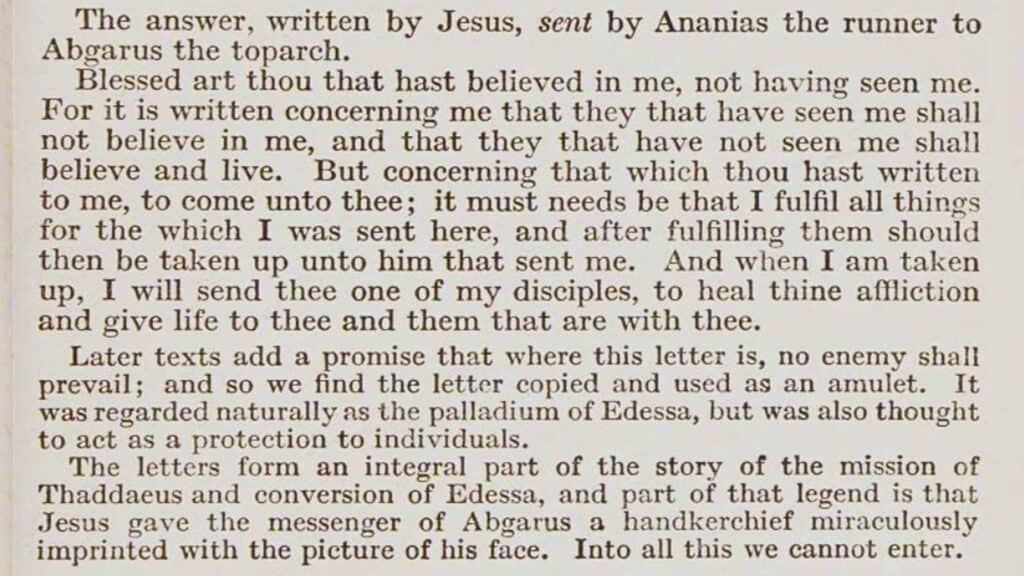
The reply attributed to Jesus is the only such tradition in all of church history, a letter said to be from the Lord’s own hand. He declines the journey. His work in Judea is not finished, and when it is, he must return to the One who sent him. But he makes a promise: he will send a disciple to heal the king. And he opens with a line that has stayed with readers ever since: “Blessed are you who believed in me not having seen me.” For anyone who knows the Gospels, that sentence resonates. It carries the same cadence as the words Jesus would later speak to Thomas in John 20: “Blessed are those who have not seen and yet have believed.” Whatever one concludes about the letter’s origin, it does not sound foreign to the voice in the Gospels.
The healing of a kingdom
The promise, the tradition says, was kept. After the resurrection and ascension, the apostle Thomas sent a man named Thaddeus, known in Syriac as Addai and counted among the seventy disciples, to Edessa. There Addai healed and preached, and word reached the palace that the promised messenger had come.
When Abgar received him, the king was healed, and he was not the last. The account describes Addai healing many in the city and teaching them the gospel openly: the coming of Christ, his humility, his crucifixion, and his resurrection. A kingdom, in other words, was brought to faith.
The thread runs naturally eastward from here. Thomas is remembered as the great apostle to the East, and the Syriac church traces much of its origin to this mission. While Paul and others carried the gospel west into the Greek and Roman world, the same gospel ran east into Mesopotamia and Persia, into a vast and vibrant Christian world that most Western believers have never been taught to see.
Have you wondered about traveling to Eastern Turkey to see some of the ancient biblical sites? Fill out the form to be contacted about upcoming Eastern Turkey tours.
What a careful reader should know
Here we owe our readers candor, because this is exactly where a thoughtful skeptic will press, and rightly so. By the early sixth century, the Decretum Gelasianum listed the correspondence between Jesus and Abgar among writings to be set aside as apocryphal. Earlier still, both Augustine and Jerome doubted that Christ had written any letter at all, reasoning that a genuine epistle from the Lord would have been known and treasured everywhere. Scholars have also noticed that the reply leans on language from the Gospel of John, a text written after the life of Christ, and that the wording reflects the second-century Gospel harmony known as the Diatessaron (a combination of the four gospels into one text, in Syriac). Taken together, these point to a legend that took shape around the middle of the third century rather than a document from the first.
So we say it plainly, as Joel Richardson also does: the letters are not proven authentic. Yet notice how far they traveled. Jesus’s reply carried a promise to watch over the city so that no enemy could prevail against it, and in time that single line turned the letter into a blessing carved over doorways across the Christian world. A marble door lintel unearthed at Ephesus during the Austrian excavations around 1899, now kept in Vienna, bears the text in Greek, and similar copies survive from the city gate at Philippi in Greece to sites across Anatolia, a grotto near Edessa, and a Coptic tomb as far south as Nubia. These inscriptions date from the fifth and sixth centuries, long after the events they record, so they testify not to the authenticity of a first-century exchange but to something else worth pausing over: how deeply this letter had taken hold of ordinary believers, who set it above their own thresholds in the hope that the protection promised to Edessa might rest on their homes as well.
The claim that survives
Set the letters aside entirely, and Edessa still holds one of the strongest claims of any kingdom on earth to have embraced Christianity early and deeply. Many historians associate the real Christianization of Edessa not with the legendary Abgar V but with Abgar VIII, known as Abgar the Great, who reigned from 177 to 212 AD. The faith spread significantly in his city during his reign, and Osroene is frequently named as a candidate for the first state whose royal house adopted the Christian faith, perhaps around the year 200. If that holds, Edessa would have believed roughly a century before Armenia’s official conversion in 301, and well before the empire of Rome itself turned.
Historians are honest that the dating and the degree are debated, and some even suspect that the romantic story of Abgar V was told later, in part, to give this early conversion a founding memory worthy of it. That is a fair caution. But it leaves the central fact standing rather than removing it: Syriac Christianity is genuinely ancient, genuinely important, and genuinely first or nearly first in the field. The legend grew up around a real and remarkable thing.
This is why the Syriac tradition is so precious. Cut off from the Greek and Latin West by language and geography, the Syriac churches tended to preserve a Christianity close to its Semitic and apostolic roots. To this day, in monasteries of eastern Turkey and northern Iraq, there are Syriac manuscripts that have never been translated into modern English, held and guarded by monks who care more for the faith than for the attention of scholars. Some of these communities still trace their founding to the apostle Thomas himself.
The painting and the image
One more thread deserves mention. A later and foundational Syriac document, the Doctrine of Addai, written down in roughly the fourth or fifth century, expands the story and adds a new detail: that a member of the king’s delegation, the archivist and royal painter, looked upon Jesus and painted his likeness with fine pigments, carrying it home to Abgar.

If we follow that tradition forward it changes shape. The painting made by human hands becomes, in time, a miraculous image not made by hands, the famous Mandylion of Edessa, akin in some ways to the Shroud of Turin and venerated in icons across both the Eastern and Western churches. Here too a careful reader holds the historical claims lightly. What is not in doubt is the depth and antiquity of the devotion that these stories carried.
Why this is our story too
You do not have to be Eastern Orthodox or Catholic for any of this to belong to you. For many today, church history runs straight from the book of Acts to the present day, with two thousand years left dark in between. But the church was alive in every one of those years, spreading across a world far wider than the one most of us have known. The kingdom of Edessa is part of that inheritance. Its memory of a sick king who wrote toward Jerusalem in hope, of a disciple who came east with healing in his hands, of a Semitic people who heard the gospel in nearly the language Jesus spoke and believed, is a memory worth recovering.
Whether or not King Abgar’s letter, or the reply he received, are genuine, the larger thing is not in question. The gospel went east, early and far, and it took deep root in this corner of the ancient world. That much is undeniable. And it is, as Joel would say, really, really cool.
Living Passages travels through this region, where layers of biblical and early church history stand within view of one another, from Harran and the country of the patriarchs to the streets of ancient Edessa. We will next journey to eastern Turkey in June 2027.
Let us know you are interested in our 2027 Eastern Turkey tour: Join the Interest List!
Sources and further reading
- Eusebius of Caesarea, Ecclesiastical History, Book 1, chapter 13, the earliest account of the Abgar correspondence and the mission of Thaddeus (Addai) to Edessa.
- The Doctrine of Addai (the Teaching of Addai), a Syriac document of roughly the fourth to fifth century that expands the legend and introduces the image of Christ.
- Decretum Gelasianum (the Gelasian Decree), which by the early sixth century classed the letters of Jesus and Abgar among apocryphal writings.
- M. R. James, The Apocryphal New Testament (Oxford, 1924), for an English text of the letters as given by Eusebius, pp. 476-477.
- J. B. Segal, Edessa: ‘The Blessed City’ (Oxford, 1970), a standard scholarly history of the kingdom. https://archive.org/details/segal1970edessa01
- The Ephesian Abgar Inscription, a fifth or sixth century Greek text on a marble door lintel from the harbour quarter of Ephesus, now in the Ephesos Museum in Vienna and published in Die Inschriften von Ephesos; one of several surviving stone and amulet copies of the letter used as a protective blessing, alongside examples from Philippi, Anatolia, the region of Edessa, and Nubia.
- Sebastian Brock, “Eusebius and Syriac Christianity,” and Sidney H. Griffith, “The Doctrina Addai as a Paradigm of Christian Thought in Edessa in the Fifth Century,” for the scholarly assessment of the tradition and its dating. https://hugoye.bethmardutho.org/article/hv6n2griffith.html
- Genesis 11 and 28 through 29 for the biblical Haran (Paddan-Aram), identified with Harran near Şanlıurfa.
Teaching content drawn from Joel Richardson, “I Visited the Forgotten Kingdom” and from his remarks to our travelers in Turkey.