Paul’s First Missionary Journey in Turkey: Visiting Iconium, Lystra, and Derbe

“Now at Iconium they entered together into the Jewish synagogue and spoke in such a way that a great number of both Jews and Greeks believed. “
Visiting the Turkey Sites that Paul’s First Missionary Journey Began
In Acts 14, Paul and Barnabas pushed deep into the Roman province of Galatia. They were preaching in synagogues, healing the sick, narrowly escaping death, and planting churches that would last centuries. The cities they walked through are locatable places in what is now central Turkey, and we’re visiting them.
This is the stretch of Paul’s first missionary journey where he was mistaken for a god, then stoned and left for dead, then got up and walked to the next city. The archaeological sites that mark these events range from a living city of 1.4 million people (Konya, ancient Iconium) to a tell in a wheat field (Lystra, near Hatunsaray) to a mound whose location scholars got wrong for seventy years (Derbe). A 2024 excavation at Lystra has just begun uncovering what lies beneath, including a basilica that almost certainly grew from what Paul planted here.
If you’re tracing Paul’s footsteps through Turkey, this corridor through ancient Galatia is where the journey gets visceral.
Iconium: A City Still Buried Beneath Konya
Paul and Barnabas arrived in Iconium after a roughly 90-mile (145 km) journey from Pisidian Antioch where Paul had just delivered his first recorded sermon in a synagogue packed with both Jews and Gentiles. They were following an ancient road that ran from Ephesus on the Aegean coast through Sardis, Pisidian Antioch, and Iconium, then continued southeast through Lystra and Derbe to the Cilician Gates and on to Tarsus and Syrian Antioch. It was a major artery connecting the Mediterranean world to the east. Paul would follow it as far as Derbe, then stop, with the road to his hometown of Tarsus stretching out ahead of him.
The city is now called Konya, home to about 1.4 million people and the sixth-largest city in Turkey. Ancient Iconium lies beneath Alaeddin Hill, a park in the city center where layers dating to the third millennium BC have been partially excavated but never fully uncovered. The Iconium Paul preached in is still down there, under the grass and the Seljuk-era mosque.1
What visitors can see today are modest ruins and St. Paul’s Church, built in 1910 with a Gothic-style façade, a depiction of the Last Supper, and a small congregation that still gathers for worship. It is the only functioning church in Konya.2
The Konya Archaeological Museum holds stone inscriptions mentioning each of the three cities Paul visited in this stretch of his journey: Iconium, Lystra, and Derbe. The Iconium inscription is a second-century Greek text honoring a Roman procurator named Julius Publius. The Lystra inscription was found on a hill believed to be the site of ancient Lystra, a connection the inscription itself confirms by naming the city. The Derbe inscription did something more consequential: it moved a city. More on that below.
Paul and Barnabas stayed in Iconium “for a long time, speaking boldly for the Lord” (Acts 14:3, ESV), performing signs and wonders, until a plot to stone them forced their hand. They fled south to Lycaonia (vv. 5–7).
Lystra: From Worship to Stoning
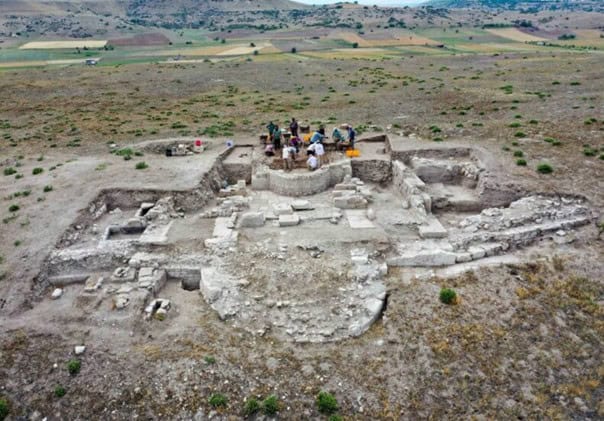
Lystra today is a tell near the village of Hatunsaray, about 21 miles south of Konya, with a spring named for St. Paul and a few architectural fragments scattered nearby. Until recently, the site had never been excavated. That changed in 2024, when a team from Necmettin Erbakan University uncovered a 30-meter basilica on the mound, believed to be the city’s main church. There was evidence of gold-gilded ceilings and richly decorated walls.3
Somewhere beneath the site almost certainly lies a temple to Zeus,4 because it was here that the crowds mistook Paul and Barnabas for gods. Paul had healed a man crippled from birth, and the response was immediate: “‘The gods have come down to us in the likeness of men!’ Barnabas they called Zeus, and Paul, Hermes, because he was the chief speaker. And the priest of Zeus, whose temple was at the entrance to the city, brought oxen and garlands to the gates and wanted to offer sacrifice with the crowds” (Acts 14:11–13).
Paul and Barnabas refused the worship and pointed the crowd to the “living God, who made the heaven and the earth and the sea and all that is in them” (v. 15). The adoration did not last. Jews who had traveled more than a hundred miles from Antioch and Iconium “persuaded the crowds, they stoned Paul and dragged him out of the city, supposing that he was dead” (v. 19).
The man they stoned was not the same Saul who had once held the coats of Stephen’s executioners. The transformation, and the inscription that may explain why his name changed at all, is its own story: From Saul to Paul. But it was this Paul, the one Barnabas had vouched for and traveled with, who lay outside the gates of Lystra while the disciples gathered around him.
Derbe: The Inscription That Redrew the Map
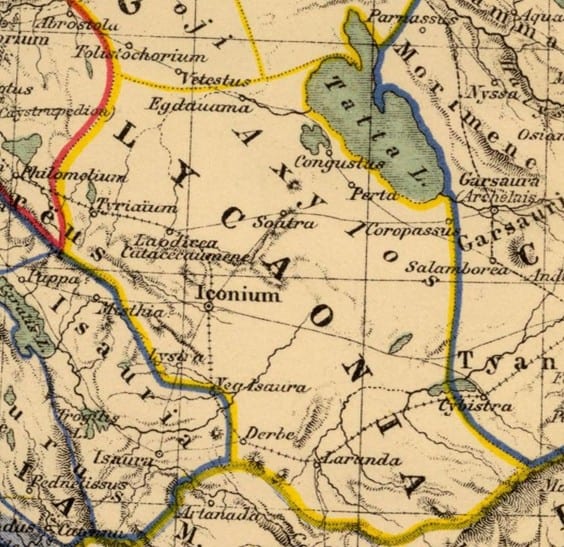
The next day, Paul got up and walked to Derbe (v. 20). That sentence is easy to read past, but it should stop you. He had been stoned and left for dead the day before.
The Bible tells us only that Paul and Barnabas “preached the gospel to that city and had made many disciples” (v. 21). Derbe was, by all accounts, the one stop on this journey where nobody tried to kill them. A fourth-century tombstone found in the area mentions a bishop named Michael, evidence that what Paul planted there kept growing for centuries.5
For almost seventy years, scholars had placed Derbe at a site near Karaman called Gudelisin. In 1956, Michael Ballance found an inscription bearing the city’s name at Kerti Hüyük, about 30 miles east of where everyone had been looking. That single stone forced them to redraw the map. It now sits in the Konya Archaeological Museum alongside the Iconium and Lystra inscriptions, three pieces of carved rock confirming for visitors to biblical sites in central Turkey that the cities Paul walked between were real and locatable.
The Road Back
From Derbe, the road continued east to Tarsus, Paul’s hometown, but he did not take it. He turned around and walked back through every city that had tried to kill him (Lystra, Iconium, Antioch), “strengthening the souls of the disciples, encouraging them to continue in the faith” (vv. 21–22), appointing elders, and building something intended to outlast his own presence.
Somewhere on that return trip through Lystra, he may have met a young man named Timothy (Acts 16:1–5; 2 Tim 3:11). The person who would become such a trusted partner in ministry came from the town that had stoned him and left him for dead in Acts 14. theater likely constructed during the Hellenistic period.
It was the last time Paul and Barnabas would travel together. Within a chapter, a sharp disagreement over John Mark would split them apart (Acts 15:39). Barnabas sailed home to Cyprus. Paul chose Silas and kept walking. But the churches they planted on this road, and the elders they appointed on the walk back, outlasted the partnership that built them.
Join us in following Paul’s footsteps in Turkey!
Explore Our Biblical Expeditions HERE
Frequently Asked Questions
Where is ancient Iconium located today? Ancient Iconium lies beneath Konya, the sixth-largest city in Turkey, with a population of roughly 1.4 million. The archaeological layers — some dating to the third millennium BC — are buried under Alaeddin Hill in the city center. They have been partially excavated but never fully uncovered. What Paul preached in is still down there.
Can tourists visit the biblical sites of Lystra and Derbe? Both are accessible but require some effort. Lystra is a tell near the village of Hatunsaray, about 21 miles south of Konya, with a spring named for St. Paul and scattered architectural fragments. Active excavations began in 2024. Derbe is identified with Kerti Hüyük, a mound about 30 miles east of Karaman. Neither site has formal visitor infrastructure, so guided tours are strongly recommended.
What was discovered in the 2024 Lystra excavation? A team from Necmettin Erbakan University uncovered a 30-meter basilica on the mound believed to be ancient Lystra, with evidence of gold-gilded ceilings and richly decorated walls. It is thought to be the city’s main church — likely built over, or near, the site where Paul preached after being stoned and left for dead in Acts 14.
How did archaeologists confirm the locations of these cities? Through inscriptions. The Konya Archaeological Museum holds three stone inscriptions — one naming Iconium, one naming Lystra, and one naming Derbe — that anchor each city to a specific physical location. The Derbe inscription, found in 1956 at Kerti Hüyük, was particularly consequential: it moved the accepted location of the city nearly 30 miles east of where scholars had been looking.
Did Paul really walk back through cities that tried to kill him? According to Acts 14:21–22, yes. After reaching Derbe, the easternmost point of the journey, Paul turned around and retraced his route through Lystra, Iconium, and Pisidian Antioch, strengthening the churches and appointing elders in each one. He did not take the easier road east to his hometown of Tarsus. He went back.
Is there a functioning church in Konya (ancient Iconium) today? Yes. St. Paul’s Church, built in 1910 with a Gothic-style façade, is the only functioning church in Konya. It contains a depiction of the Last Supper and maintains an active congregation, a quiet continuation of what Paul began there nearly two thousand years ago.
Where can I see the Lystra and Derbe inscriptions? All three inscriptions — Iconium, Lystra, and Derbe — are held at the Konya Archaeological Museum. Visiting the museum alongside the field sites gives the journey a satisfying coherence: you see the stones that confirm the cities, then you stand on the ground where Paul stood.
References:
- Alaeddin Hill excavations: Turkish Historical Society, 1941; ongoing excavation and visitor center project by Konya Metropolitan Municipality.
- Dr. Carl Rasmussen, “St. Paul’s Church,” Holy Land Photos (https://holylandphotos.org/browse.asp?s=1,3,8,21,58&img=TCSCKYKY31), 2026.
- “New Archaeological Discoveries at Lystra,” Arkeonews, October 8, 2025; “Excavation work at Türkiye’s Lystra brings ancient artifacts to light,” Daily Sabah, September 1, 2024.
- “Footsteps of Paul: Acts 14, Lystra & the Linden Tree,” YouTube (https://www.youtube.com/watch?v=o2lHIyv2r_0&list=PLCaBz_NhYH3F1wgr5Nf1Jrisno_qgUXoF&index=4), 2020.
- Dr. Carl Rasmussen, “Derbe,” Holy Land Photos (https://holylandphotos.org/browse.asp?s=1,3,8,21,56), 2026.