Dara, the Ancient City Called Resurrection
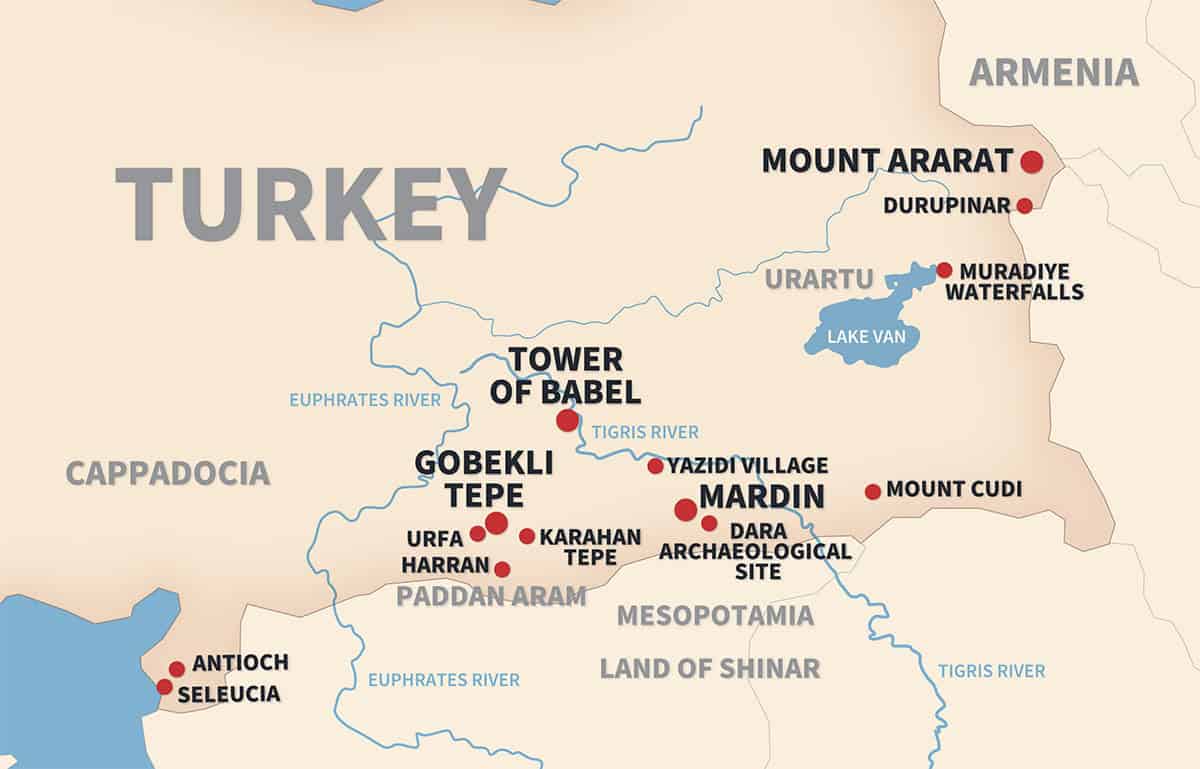
Twenty miles southeast of Mardin there is a ruined city that everyone calls Dara. That was the local name, the one that stuck, and it is what the road signs say today.
Its official name was Anastasiopolis.1
The emperor who built it was Anastasius, and emperors named cities after themselves. But Anastasius is not a neutral name. It comes from ἀνάστασις, anastasis, the ordinary Greek word for resurrection, built from ana, “up,” and the verb histēmi, “to stand.” A standing up again. It is what the Greek church calls what happened on Easter morning, and the church over the tomb in Jerusalem is the Anastasis to this day. Christian parents gave their children the name for that reason.2
So the formal name of this place was Resurrection City.
It never caught on. Everyone went on calling it Dara, and when Justinian rebuilt the walls a generation later and renamed it Iustiniana Nova, that did not stick either. But the name was given, and anyone who read it in Greek knew what it said.
And out in the quarries on the western edge of that city, above the door of a rock-cut tomb, someone carved the resurrection of the dead.
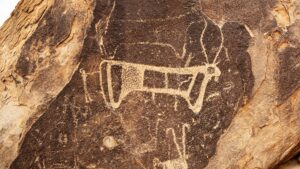
The carving is over seventeen feet wide. Fifteen hundred years of wind off the Mesopotamian plain have taken the right-hand half of it down to a suggestion, but the left half is legible. A man in a long tunic and a knotted cloak strides down a slope, the cloak billowing out behind him. His right arm, broken below the elbow now, reaches toward a heap of bones. Out of the middle of that heap rises the front edge of a stone coffin, and standing on top of it are two small figures, upright, alive. Around the man’s head are four winged shapes. In the upper right corner, a hand comes out of heaven between two arcs of sky.
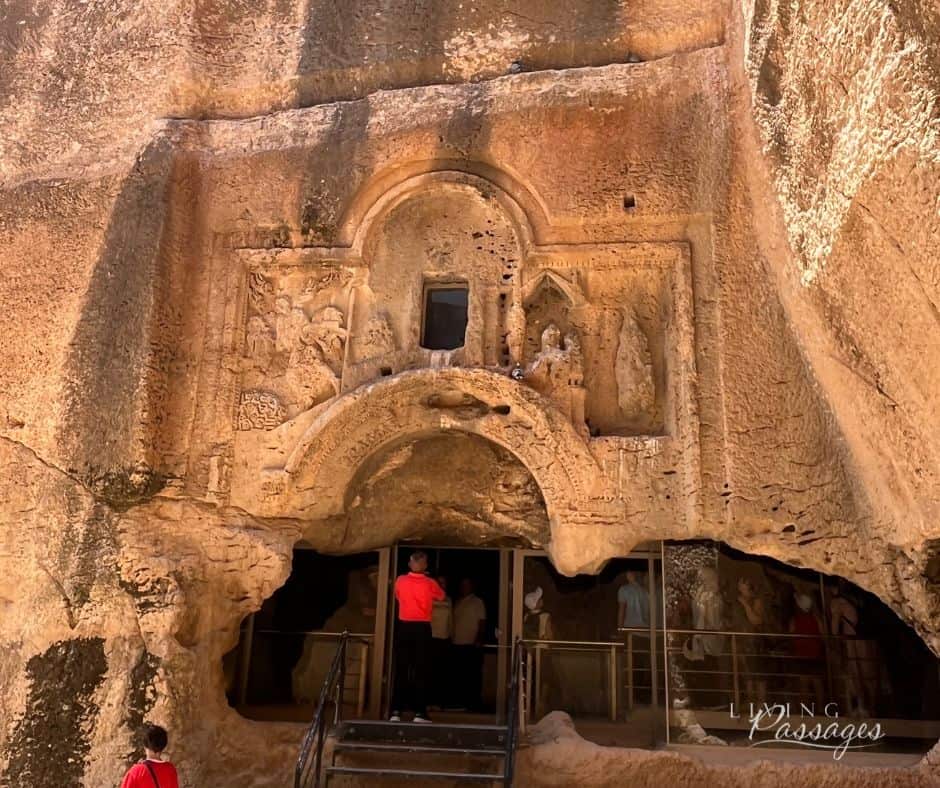
The first Westerner to describe it, a traveller named Fletcher in 1850, wrote it down as “a collection of skulls and bones, over which winged figures were hovering.”3
It is Ezekiel 37. The valley of dry bones, the four winds, and the hand of the Lord, carved above a chamber that would go on to hold the bones of thousands of people.
The hand of the Lord was upon me, and he brought me out in the Spirit of the Lord and set me down in the middle of the valley; it was full of bones. And he led me around among them, and behold, there were very many on the surface of the valley, and behold, they were very dry. And he said to me, “Son of man, can these bones live?” And I answered, “O Lord God, you know.”
— Ezekiel 37:1–3
Of course, Anastasius did not choose his own name, and he built this place because he had lost Nisibis and needed a fortress, not to make a statement about the body after death. The convergence is an accident going several layers deep.
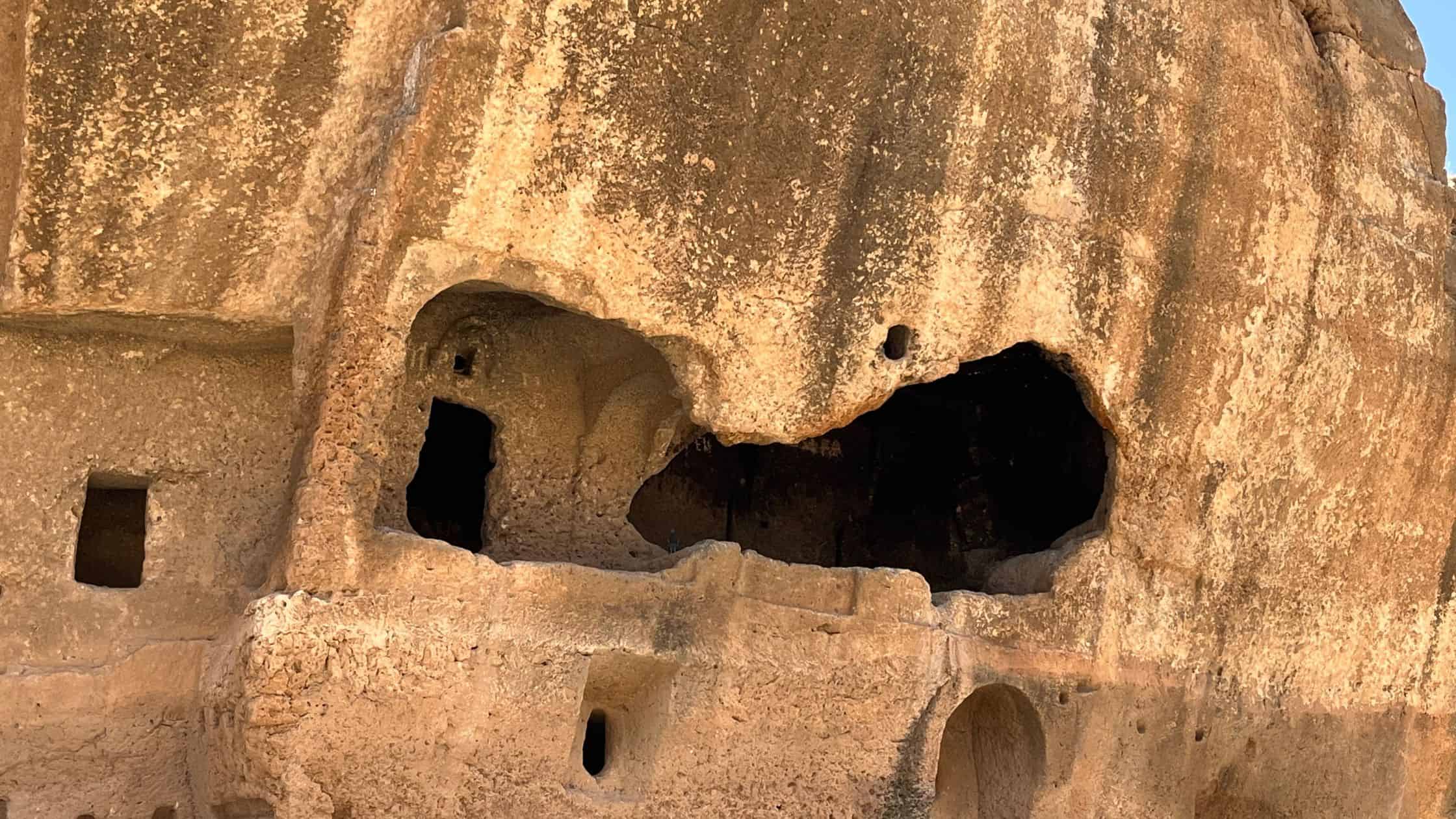
What is Dara, and why is it out here?
Dara was built as an answer to a defeat.
In AD 363 the Emperor Julian died on campaign in Persia. His successor Jovian, cut off and desperate, bought his army’s passage home by ceding five provinces and the city of Nisibis. Nisibis was not a minor loss. It was the great Christian city of the eastern frontier, the see of Jacob of Nisibis, and the home of Ephrem the Syrian, the finest poet the Syriac church ever produced. When the treaty took effect the Christians were given time to leave. Ephrem walked west to Edessa and never went back.4
For nearly a century and a half Rome had no fortress on this stretch of frontier. Then, after another Persian war, the Emperor Anastasius I ordered one built, quickly. Between roughly 505 and 507 a fortified city went up on a low hill some twenty-five kilometres west of the Nisibis Rome had lost.5 It was named Anastasiopolis but everyone kept calling it Dara.
That date is notable because early Christians read the six days of creation as a template for history: six thousand years, then the Sabbath. The idea runs through Barnabas, Irenaeus, Hippolytus and Lactantius. The only question was what year it currently was, and the chronographers disagreed, because they counted from different dates for creation. 5509 BC on one reckoning, 5500 on another, 5492 on a third. That puts the six-thousandth year at AD 492, or 500, or 508.6
Anastasius reigned from 491 to 518. Every major Christian reckoning of the year 6000 fell inside his reign, and Dara went up in 505–507, which on the last of them left two or three years on the clock. Marlia Mundell, who published the carving, notes that the city was founded “at precisely the expected time of the Second Coming, A.M. 6000,” by an emperor who would mark the millennium, in a region where oracular tradition flourished.7
As an aside, we note that the Jewish count is nowhere near six thousand: this year is 5786, and A.M. (‘Anno Mundi’) 6000 falls around 2240 by that count. The framework is shared, and Sanhedrin 97a has the same scheme. What differs is the arithmetic, because early Christians counted from the Septuagint, whose Genesis genealogies run some fifteen centuries longer than the Hebrew.8
Nothing arrived. The church later settled on the reckoning that put the deadline in 492, safely past by the time anyone adopted it. But Dara was founded in the shadow of a date that mattered.
The city was never quiet. Anastasius’ builders worked so fast the walls began to fail, and Justinian rebuilt them a generation later, raising the inner circuit to about sixty-five feet. According to Procopius he also had his engineers reroute the stream that fed the city underground, so a besieging army could be denied water.9
In 530, on the plain outside these walls, a young general named Belisarius won the victory that made his name.
In 573 the Persians took the city. The siege ran for months and ended in a week of hand-to-hand fighting, the combatants, in the phrase of a chronicler of the time, “like harvest men… mowing and smiting one another like ears of corn.”10 The city filled with corpses. The bodies were thrown into the river and stuffed into the cisterns. When the news reached Constantinople it is said to have broken the Emperor Justin II’s mind.
Dara returned to Rome in 591, fell again in 605, was recovered by Heraclius, and passed to the Arab conquest in 639. After that it stopped being a fortress and became what it is now: a village called Oğuz, whose houses are built out of the city’s own stones.
What makes this carving different?
You will find the Dara relief mentioned in a few places: the Ministry of Culture’s site page, a good essay on Medium. What none of them mention is what makes it remarkable, which is how exactly it follows the text.
Ezekiel’s vision was carved, painted and illuminated all over the late antique world. There is a famous version at Dura-Europos, on the synagogue wall, from around 250. There are versions on Roman sarcophagi; on gold glass, the gilded bowl-bases that Roman Christians cut out and pressed into the mortar sealing their graves in the catacombs; in a sixth- or seventh-century Syriac manuscript in Paris; in the great Greek Paris Gregory of 880–883; in a tenth-century ivory in the British Museum.11
Nearly all of them leave something out.
Ezekiel 37:9 is the hinge of the whole vision. The bones have come together, sinew and flesh have come up on them, and nothing happens. They are bodies without breath. Then God says:
Then he said to me, “Prophesy to the breath; prophesy, son of man, and say to the breath, Thus says the Lord God: Come from the four winds, O breath, and breathe on these slain, that they may live.”
— Ezekiel 37:9
Anthony Cutler, writing in Dumbarton Oaks Papers in 1992, put his finger on what the Dara carvers did with that verse:
“Where the relief hews especially closely to the text is in its emphasis on the ‘four winds’ (verse 9) that the Lord, through Ezekiel, commands to breathe upon the dead. These are missing from illustrations of the event in both Syriac and Greek manuscripts, the former roughly contemporary with, the latter several centuries later than, the tomb at Dara.”12
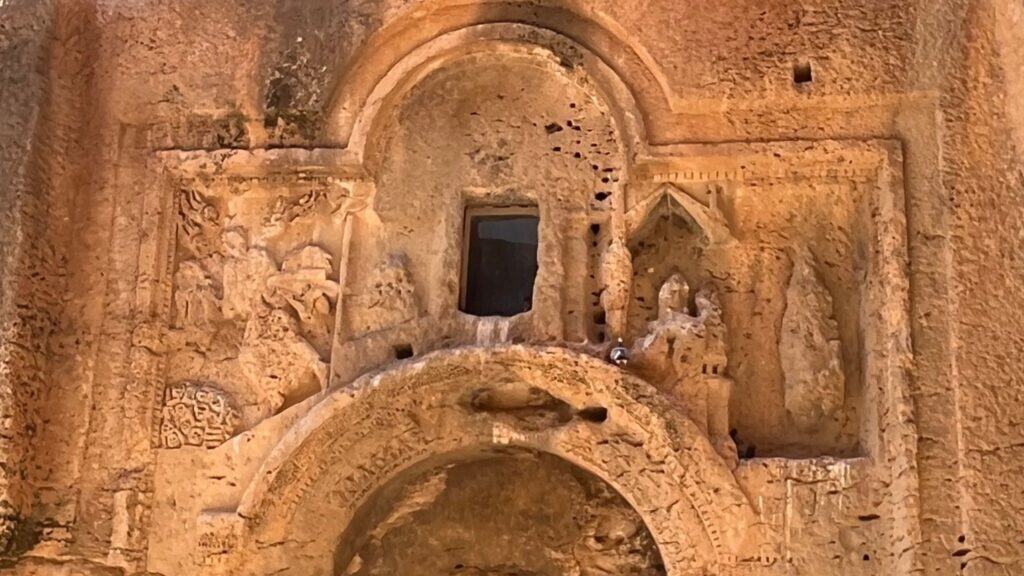
The illuminators working in scriptoria, some of them in this same Syriac world at the same time, left the four winds out. The people who cut this rock face on the Persian frontier put them in, four of them, one for each wind, at the prophet’s head.
They were reading the text more closely than the professional illustrators of two languages and four centuries. Mundell is explicit that these are winds and not angels: nothing in the carving makes them angels, and the vision does not call for any.13
Why did they choose this passage?
You will be told at the site, on the Ministry’s page and in most of what is written about Dara, that the chamber is a mass grave built in 591 to commemorate the soldiers killed in the Persian siege of 573.14 Half of that traces to real research and half of it does not.
The 591 horizon is Mundell’s, and it is a serious proposal. She lays out two moments in the sixth century when Ezekiel 37 would have carried particular weight at Dara. The first is the foundation, around 505–508, with the six-thousandth year running out. The second is what happened at the end of the century. She prefers the second, and so does Nicholson. Both look at the millennium and walk past it.
When the city fell in 573 the population was deported to Persia and resettled at New Antioch in Babylonia. Some escaped in 588; more came out when the Byzantine army opened the gates in 591. Some of them came home.15
Mundell’s suggestion, put carefully as a possibility rather than a finding, is that survivors who returned after eighteen years in exile may have chosen to be buried together in one tomb, marked with a scene not inappropriate to their own return.16 Read Ezekiel 37 with that in mind and the choice stops being decorative:
“Therefore prophesy, and say to them, Thus says the Lord God: Behold, I will open your graves and raise you from your graves, O my people. And I will bring you into the land of Israel. And you shall know that I am the Lord, when I open your graves, and raise you from your graves, O my people. And I will put my Spirit within you, and you shall live, and I will place you in your own land. Then you shall know that I am the Lord; I have spoken, and I will do it, declares the Lord.”
— Ezekiel 37:12-14
The promise there is territorial. It is made to deported people, in Babylon, and what it offers them is their own ground back. If Mundell is right, it was carved over a tomb by people who had been marched into Babylonia themselves and had walked back.
There is a second reading, and it is striking.
Oliver Nicholson, writing in 1985, accepted the Ezekiel identification and asked a different question: whose bones?
Start with a problem the Persians had in 573. They held a city full of dead defenders and meant to use it as a base, so the bodies had to go. But they were Zoroastrians, and a Zoroastrian cannot bury a corpse without polluting the earth. The obligation is to lay the dead on hard, impermeable stone and let them be stripped.17
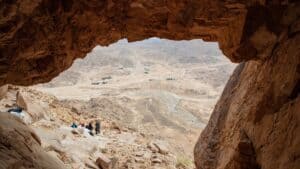
One place at Dara fits: the quarries. The Christians had been using those same cuttings as a cemetery, tombs carved into the rock faces. But the quarry’s “many flat ledges and steps,” Nicholson writes, “would fit Zoroastrian specifications admirably.”18
So on his reading the exiles came home in 591 to a quarry with the bones of their own dead still lying across it in the open, where the Persians had left them. Byzantines regarded an unburied body as an atrocity. These people, Nicholson suggests, would have expressed their distress “in an appropriately Biblical manner: can these bones live?“19
On that reading the returnees built the tomb for the men they had left behind, and filled it with bones gathered off open ground.
One detail of the prophecy fits this version better. Ezekiel’s bones were also an army:
So I prophesied as he commanded me, and the breath came into them, and they lived and stood on their feet, an exceedingly great army.
— Ezekiel 37:10
Mundell had noticed the same thing from the other direction. The carving, she wrote, “suggests that the sculptor was acquainted with similar heaps of bones, the consequences of the Sassanian custom of exposing their dead.”20 Nicholson’s suggestion is that the sculptor had it in front of him. He is careful about how much this proves: “The evidence is circumstantial, but it fits at every point.”21
So how much does the sign get wrong? Less than it appears. The 591 date is Mundell’s, the dead of 573 are Nicholson’s. What it drops is that both are hypotheses, that the two disagree about whose bones are in the chamber, and, above all, the mechanism, which is the most arresting thing either says and appears in no popular account. Keser-Kayaalp is more cautious than either about whether the chamber served as an ossuary this early, and no osteological study has been published to settle it.22
Both scholars point to one further detail. Figural sculpture at this scale is close to unknown in Early Christian Mesopotamia, and this relief is strange for its region. Mundell’s explanation is that the deportees had spent eighteen years in Persia, where they would have seen Sasanian rock-reliefs cut into cliffs at monumental size. Nicholson goes further: the stonecutters were themselves returnees. A later study of the necropolis calls that “entirely plausible.”23 If they are right, the carving looks Persian because the people who made it had been prisoners in Persia.
What about the right-hand side of the facade?
The other half of the carving is the part no one has definitively solved.
Mundell worked through the options. Ezekiel’s vision of the Temple (chapters 40–48) she rejected, and the abominations in the Temple of chapter 8 with it: the scene has a cypress tree and neither text has a tree. She tentatively read a small panel beside Ezekiel as the fiery furnace of Daniel 3, which Jewish tradition ties directly to the dry bones. For the large right-hand compartment she preferred, following Kraeling on Dura-Europos, the idolatry of Manasseh: the sins that brought the exile down on Judah in the first place, with the pagan temple, the altars, the sacrifice, sun and moon on the upper border, and the cypress standing in for the Asherah pole.24
Which would make the whole facade a single argument, read right to left in Syriac fashion: this is what sent us into exile, and this is what brings us home.
Nicholson reads the shape beside Ezekiel as a fire too, but the burning bush rather than the furnace: the fire from which God commissioned Moses to bring his people out of captivity into their own land. In the sixth century that bush still grew at the foot of Mount Sinai with a monastery church built round it, and pilgrims walked down the colonnade, past the gold of the apse mosaic, and out through the east end to stand before it. On the Dara facade the fire sits in the same relation to the carved colonnade and pediment. The centre of the carving, he suggests, may recall the pilgrimage site itself.25
Then the point that ties the facade together. Zoroastrians venerate fire. Set the burning bush, the fire God spoke from, against a people who worshipped fire and left the Christian dead unburied on a hillside, and the carving becomes an argument. On that reading the two halves say: your treatment of our dead is an abomination, and our God is the one who speaks out of the fire.
He offers it as a suggestion and no more. “This relief is in such a damaged condition,” he writes, “that any interpretation of its center and right-hand panels is bound to be tentative.”26
What will you be told at the site?
Something different again, and worth knowing before you are standing in front of the stone.
The reading you will hear from guides at Dara is that the right-hand scene is the Virgin and Child: a figure holding an infant, beside a cypress tree, beneath a roof that stands for the church. The cypress is explained as a tree of death, which is why it belongs above a grave. This is not one guide’s invention. It is the settled local tradition, and it turns up in almost the same words in the travel literature.27
It may be that no scholar has published that interpretation. Mundell, Nicholson, Cutler and Keser-Kayaalp between them have proposed the idolatry of Manasseh, the fiery furnace, Ezekiel’s temple, the burning bush, the pillar of cloud and fire, Moses and Aaron, and a general theme of exile and return. None of them says Mary. But two things are worth saying about it anyway.
The first is that the cypress part is well founded. Everyone calls that shape a cypress, Mundell included. And the cypress has been the tree of mourning in this part of the world for as long as there are records: sacred to the god of the dead in Greek and Roman practice, planted at tombs, and still the tree standing over every Turkish graveyard you will pass on the road to Dara. A cypress on the front of a tomb needs no explaining at all.28
The second is a connection we haven’t encountered in print, and we offer it as a possibility rather than a finding. From the fourth century the Fathers read the burning bush, the fire that burns without consuming, as a figure of the Virgin, who bore God and was not destroyed. It became an icon type of its own, the Theotokos of the Unburnt Bush. And the monastery Justinian raised at Sinai around that bush was dedicated to the Virgin of the Bush. It did not become St Catherine’s for another seven hundred years.29
So if Nicholson is right that the shape beside Ezekiel is the burning bush, and the colonnade and pediment beside it are the church built around it, then the scene a sixth-century Christian was looking at was a bush that signified the Virgin, in front of a church named for her.
Nobody knows for certain. The stone is too weathered and there is no inscription.
Who was John of Dara?
Two and a half centuries later, the bishop of this city wrote four books about the resurrection of the body.
John of Dara, Iwannis in Syriac, was made metropolitan of Dara around 825 by the Syriac Orthodox patriarch Dionysius of Tel Mahre, and died around 860. Before that he was a monk at Mar Hananyo, the monastery the Turks call Deyrulzafaran, which still stands in the hills outside Mardin.
He was formidable. Dionysius dedicated his Ecclesiastical History to him in 837 and praised his “unbridled desire upon the accumulation of wisdom.” Four centuries later Bar Hebraeus recorded that John’s writings were required reading in the monasteries. Among them are four treatises on the resurrection of human bodies, the second of which appeared in a critical edition with English translation as recently as 2020.30
Reading Ezekiel 37 as a promise of bodily resurrection was the settled Christian belief long before him. Justin Martyr had written that “joint shall be joined to joint, and bone to bone, and flesh shall grow again.” Cyril of Alexandria said the prophet had seen “the power of the Resurrection.” Theodoret of Cyrrhus, commenting on the very verses carved at Dara, wrote that God used the prophet “as an instrument of the Resurrection… a type not only of the recall of the Jews from captivity, but also of the resurrection of all.”31
We have no evidence John ever wrote about the carving. But he was bishop of a small city whose necropolis had Ezekiel and the four winds cut over the door.
Why does the coincidence go so deep?
Go back to the name.
In the Greek of Ezekiel 37, when the bones come together and the breath enters them, they ἔστησαν, estēsan: they stood. It is the same verb that gives anastasis its second half.32 The name of the city and the vision carved in its quarry are built out of the same word, and neither the emperor nor the sculptor arranged that.
It is the kind of accident a sixth-century we can noticed and enjoy. Set the four out in order:
- A city whose name is the Greek word for resurrection.
- Founded in the years when the general resurrection was expected, on every reckoning then in use.
- With the resurrection of the dead carved over its graveyard, following the text more closely than any manuscript of the period.
- And three centuries later, a bishop who wrote four books on whether the dead rise bodily.
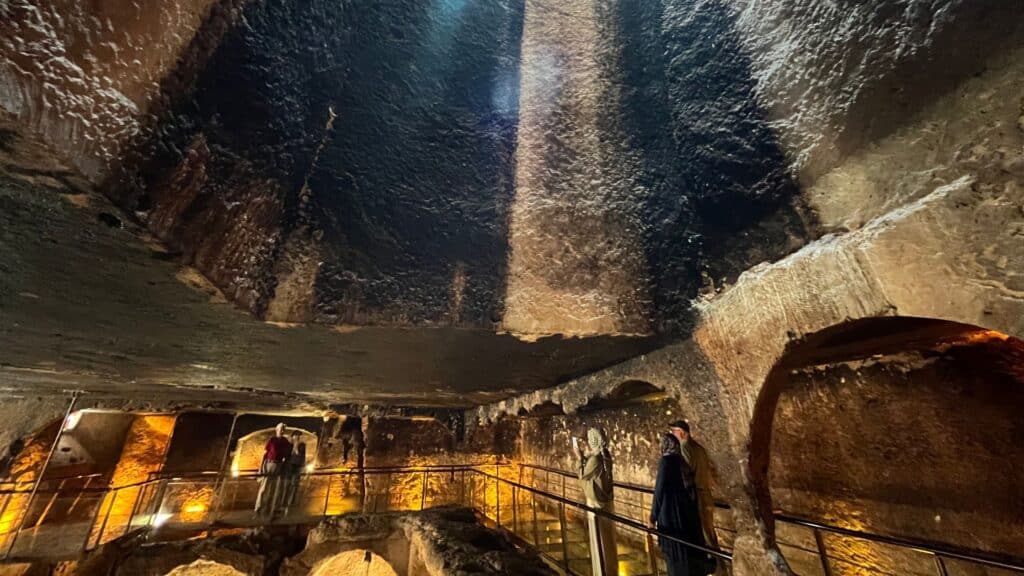
What is inside the tomb, and what else is standing?
The tomb chamber is roughly thirteen metres square, cut into a former quarry, its walls ringed by a two-tiered arcade. There is a niche beside the entrance, which may have held the most important of the burials. A nineteenth-century visitor recorded Greek epitaphs inside, since defaced.33
It held a great many people. Excavators describe men, women and children together, with lamps, coins, metalwork, and, oddly, a single horse’s jaw. Estimates of the number of individuals range from “over two thousand bones” in the archaeological literature to “three thousand people” in the press. No osteological report has been published; treat every figure as provisional. There is evidence that bodies were exhumed and brought here from elsewhere: second burials, carried in and laid together on purpose.34
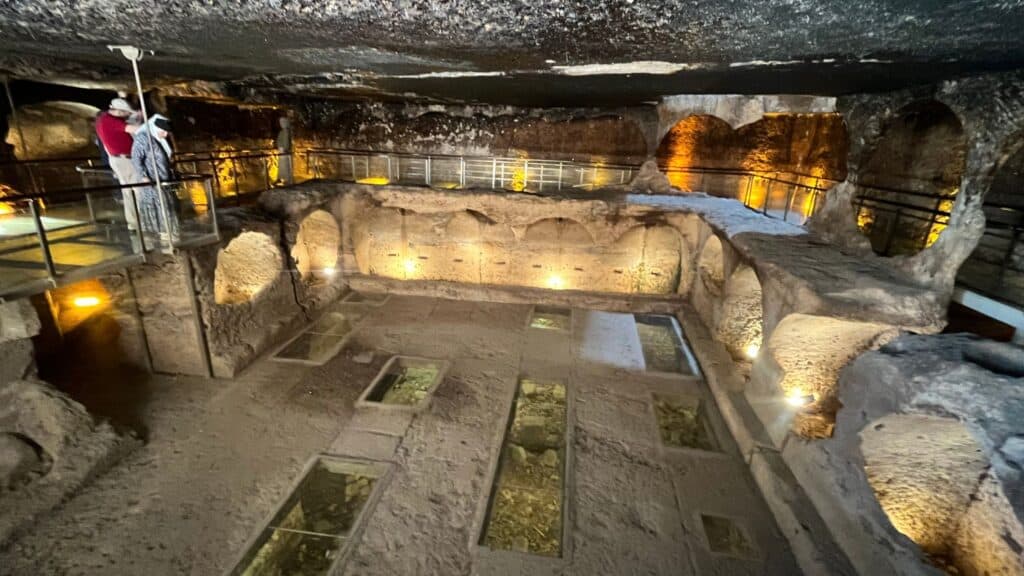
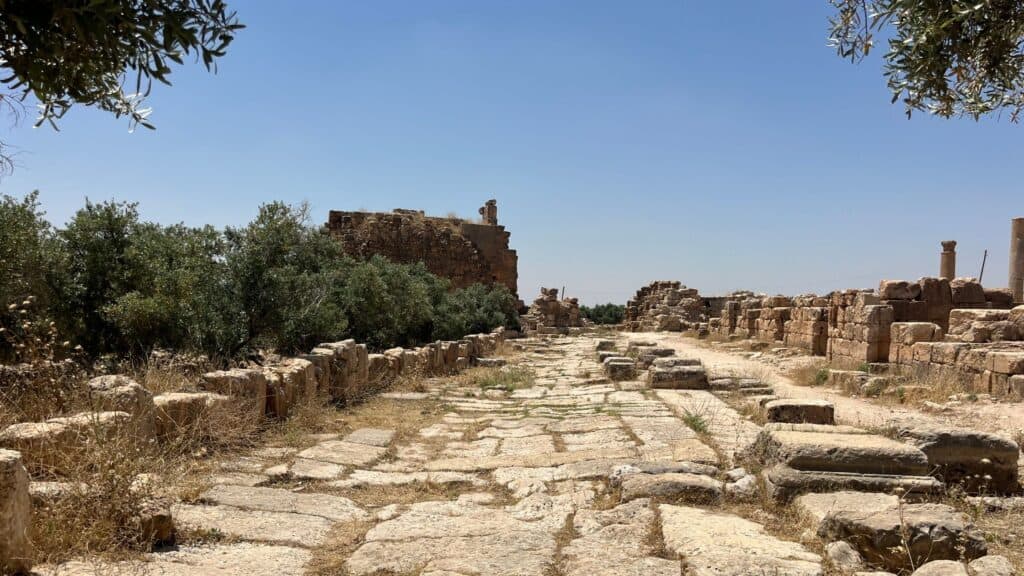
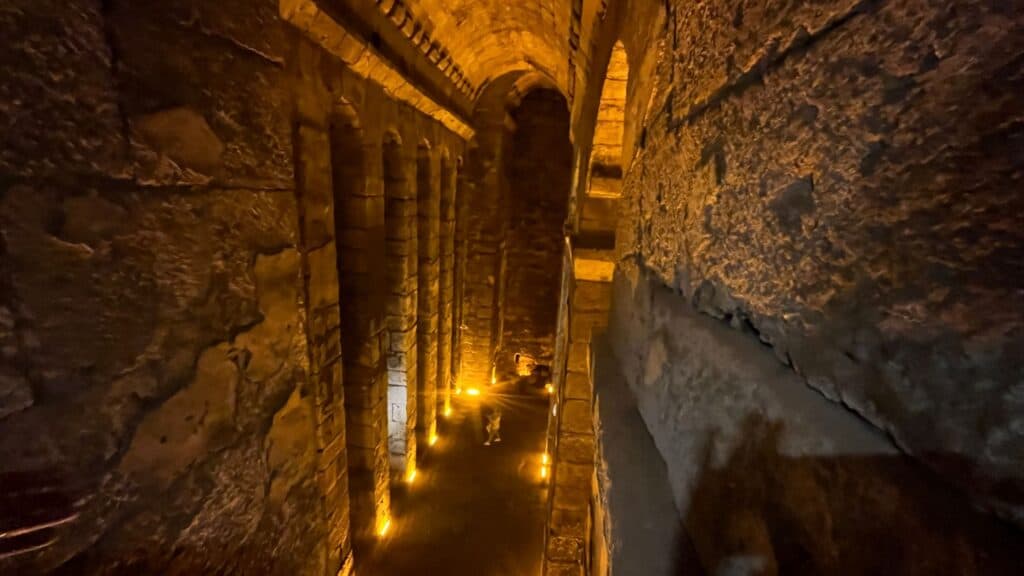
Outside the necropolis there is a great deal more: walls running roughly four kilometres with twenty-eight towers; a vaulted cistern beneath the city’s main church that the locals call the zindan, the dungeon; a castellum of ten barrel-vaulted water chambers; a “Great Church” with a polygonal apse and crypt and a second church associated with the apostle Bartholomew; a baptismal basin with mosaic floors; a paved market street with more than ten shops and workshops excavated since 2021, and evidence of glass and metal working; a Roman bridge with three arches standing in a dry stream bed.35 A fifty-square-meter (538 sq. ft.) mosaic floor was uncovered in July 2025.36
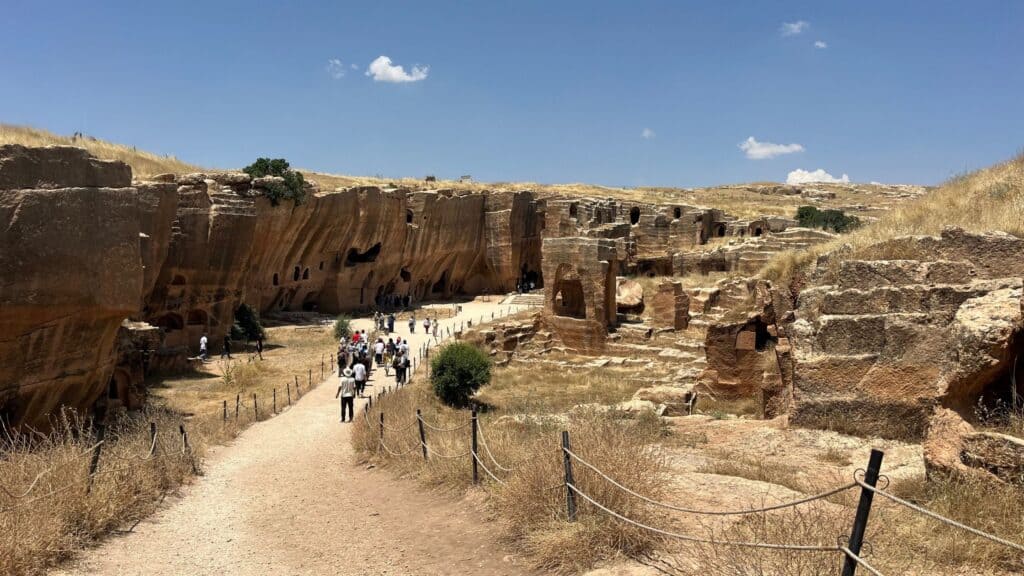
Visiting Dara on the Living Passages Genesis Expedition
Dara lies about 19 miles (30 km) southeast of Mardin, roughly 30 minutes by road, in the village of Oğuz. Nusaybin, ancient Nisibis and the city of Ephrem the Syrian, is about twenty-five kilometers further east. The city remains sit inside a working village and are more or less always accessible.
Dara sits naturally in the eastern Turkey itinerary, close to Mardin where we are already based. It also pairs with Nusaybin, which is on our route.
Nusaybin is Nisibis: Ephrem the Syrian’s city, the one Rome handed to Persia in 363, and the reason Dara was built at all. Seeing both in the same week gives you the history of this frontier in two stops. You stand in the city that was lost, and then in the city raised to replace it, in front of a carving the survivors of its worst day put up over their graves. This is the surviving heartland of Syriac Christianity, where the liturgy is still sung in a dialect of the language Jesus spoke.
It is also the right place on the itinerary to stop and teach on the resurrection of the body. The group will go into the chamber: a room cut down into a quarry and filled with the dead of a Byzantine city, entered under a carving of Ezekiel and the four winds, in a place whose name is the Greek word for resurrection.
Joel Richardson leads our Genesis Expedition through landscape of eastern Turkey: the Ark candidate sites, Göbekli Tepe, a Tower of Babel candidate site, Harran and the country of Abraham’s kin, and the early church of upper Mesopotamia.
Principal sources
- Marlia Mundell, “A Sixth Century Funerary Relief at Dara in Mesopotamia,” Jahrbuch der Österreichischen Byzantinistik 24 (1975), 209–227. The first full publication and still the standard one. Not available online in any authorised form.
- Oliver Nicholson, “Two Notes on Dara,” American Journal of Archaeology 89.4 (1985), 663–671.
- Anthony Cutler, “Πᾶς οἶκος Ἰσραήλ: Ezekiel and the Politics of Resurrection in Tenth-Century Byzantium,” Dumbarton Oaks Papers 46 (1992), 47–58.
Have you wondered about traveling to Eastern Turkey to see some of the ancient sites? Fill out the form to be contacted about upcoming Eastern Turkey tours.
Notes
- Recorded in the Syriac chronicle that goes under the name of Zachariah of Mytilene, compiled c. 569: “And Dara was completed, and it was named Anastasiopolis, after the name of the just king.” Bk. 7 ch. 6; text online. The narrative sources otherwise use Dara throughout. ↩︎
- ἀνάστασις, from ἀνά (“up”) and the stem of ἵστημι (“to stand”). The personal name Ἀναστάσιος derives from it. The church over the tomb in Jerusalem is the Anastasis. ↩︎
- J. P. Fletcher, Notes from Nineveh (1850), the earliest Western description of the relief, cited by Mundell 1975. ↩︎
- The peace of 363, following Julian’s death on campaign. Jovian ceded five provinces beyond the Tigris river as well as key fortresses like Nisibis; the Christian population was permitted to withdraw, and Ephrem the Syrian went to Edessa. ↩︎
- Commonly given as 18 km, including on Wikipedia. That figure derives from Procopius counting in stades and is corrected by Nicholson 1985, 664 n. 13: “The true distance, measured on the G.S.G.S. map, between Dara and Nisibis as the crow flies is about 26 km. Croke and Crow have been misled by Procopius into giving the distance from Dara to the border as 5 km. and from Dara to Nisibis as 18 km.” ↩︎
- The Constantinopolitan or Byzantine era placed creation at 5509 BC, giving A.M. 6000 = AD 492; Julius Africanus and Hippolytus at c. 5500 BC, giving AD 500; the Alexandrian era of Annianus at 5492/5493 BC, giving AD 508. The sexta-millennial scheme itself rests on Ps. 90:4 with 2 Pet. 3:8 and appears in Epistle of Barnabas 15, Irenaeus Adv. Haer. 5.28.3, Hippolytus and Lactantius Div. Inst. 7.14. The Annianus epoch is given as either 5492 or 5493 BC in different authorities, so AD 508 is conventional rather than exact. ↩︎
- Mundell 1975, 225. ↩︎
- Seder Olam Rabbah places creation at 3761 BC on the Masoretic text, so 2026 CE = AM 5786 and AM 6000 falls c. 2240 CE. https://en.wikipedia.org/wiki/Seder_Olam_Rabbah The gap of roughly 1,730 years is about 1,466 years of Septuagint-versus-Masoretic difference in the genealogies of Genesis 5 and 11, with most of the remainder from Seder Olam‘s compressed Persian period. On the shared framework, Sanhedrin 97a. ↩︎
- Procopius, De Aedificiis II.1–3. On the relationship between Procopius’ account and the surviving fabric, B. Croke and J. Crow, “Procopius and Dara,” Journal of Roman Studies 73 (1983), 158, which argues for a larger Anastasian contribution than Procopius allows. https://doi.org/10.2307/300078. ↩︎
- John of Ephesus, Ecclesiastical History 6.5, quoted in Nicholson 1985, 667, which is also the source for the corpses being thrown into the river and the cisterns. Nicholson gives the siege as six months; several secondary accounts say four. A reader of John of Ephesus put the dead as high as 89,000 (Nicholson 669 n. 57), a figure from one recension only and not reliable. ↩︎
- The Syriac manuscript is Paris, B.N. syr. 341, fol. 162r (6th–7th c.); the Greek is the Paris Gregory, Paris gr. 510, fol. 438v (880–883); the ivory is in the British Museum. On the tradition as a whole, Yoanna Planchette, “The Old Testament Prophecy of the Resurrection of the Dry Bones between the West and Byzantium,” Arts 10/1 (2021), open access. ↩︎
- Anthony Cutler, “Πᾶς οἶκος Ἰσραήλ: Ezekiel and the Politics of Resurrection in Tenth-Century Byzantium,” Dumbarton Oaks Papers 46 (1992), 47–58, at 51. ↩︎
- Mundell 1975, 214. ↩︎
- The claim appears on the Turkish Ministry of Culture’s page for the site and in the Turkish press, originating with Nihat Erdoğan as Mardin Museum director. Hüseyin Metin, who directed the academic excavation afterwards, described it as one theory among several, raised the battle of 530 as an alternative, and said such assumptions “should be supported by scientific studies. ↩︎
- The population was deported to New Antioch in Babylonia, near Ctesiphon. Some escaped in 588; more came out when the Byzantine army opened the gates in 591. Nicholson 1985, 669; Mundell 1975, 225–27. ↩︎
- Mundell 1975, 226–27: “If some of these people returned to Dara after an 18 years’ absence, they may have chosen to be buried together, commemorated by an ornate tomb decorated with a scene not inappropriate to their own return from exile.” ↩︎
- Nicholson 1985, 667–69, who assembles the supporting evidence: Procopius, Persian War 1.12.4, on the 520s Iberian conflict, where Christians were enjoined “not to bury their dead, but to expose them to dogs and birds”; burial denied to Christians martyred in Persia “in order, so they say, that the earth may not be contaminated”; and Agathias’ story of two Platonist philosophers who buried a corpse in Persia and found it thrown back into the open overnight. ↩︎
- Nicholson 1985, 669. ↩︎
- Nicholson 1985, 669. ↩︎
- Mundell 1975, 215, quoted at Nicholson 1985, 669 n. 56. ↩︎
- Nicholson 1985, 670. His conclusion is conditional throughout: “if it was cut in 591 as a tribute to the fallen of 573.” ↩︎
- Elif Keser-Kayaalp, “The beth qadishe in the Late Antique Monasteries of Northern Mesopotamia,” Parole de l’Orient 35 (2010), 333–34 and n. 45, which is also the fullest published summary of Nicholson’s argument. On the absence of an osteological report, see also Keser-Kayaalp and Erdoğan 2017: “It is too early to say anything certain about this.” ↩︎
- Mundell 1975, 226–27; Nicholson 1985, 670–71. Endorsed in Anaïs Lamesa and Nuri Erdoğan, “La nécropole rupestre de Dara (Turquie),” BAR, 2020: the suggestion that the monument was cut by stoneworkers returned from exile “paraît tout à fait plausible.” ↩︎
- Mundell 1975, 216–17, following C. H. Kraeling on the Dura-Europos programme. She rejects Ezekiel’s temple (chs. 40–48) and the abominations of ch. 8 because both scenes contain a cypress and neither text contains a tree, and identifies a small intervening panel, not the large right-hand compartment, as the fiery furnace of Daniel 3. ↩︎
- Nicholson 1985, 670. He also suggests the trunkless “cypress” may be the pillar of cloud and fire of the Exodus, which would explain the absent trunk, with the round object above it the remains of the Hand of God, and the facing figures Moses and Aaron. ↩︎
- Nicholson 1985, 670. ↩︎
- See for example this account: “the virgin Mary with a baby in her arms on the left side of that tree, symbolizing Jesus. Above sits a roof that stands for the church.” ↩︎
- The cypress was sacred to the god of the dead in Greek and Roman practice and planted at tombs; it remains the standard tree of Turkish and Greek cemeteries. Mundell also describes the shape as a cypress, differing only on what it signifies. ↩︎
- The typology is patristic, from the fourth century onward, and produced the icon type known as the Theotokos of the Unburnt Bush. On the monastery’s original dedication to the Virgin of the Bush and its renaming for St Catherine, see St Catherine’s Monastery, Sinai. ↩︎
- John of Dara’s Four Treatises on the Resurrection of Human Bodies, critical edition with English translation (Gorgias Press, 2020). ↩︎
- Justin Martyr, Apologia I.52; Cyril of Alexandria, De Dogmatum solutione 7, on the prophet beholding “the power of the Resurrection” (tēs anastaseōs dynamin); Theodoret of Cyrrhus, In Ezechielem, on 37:4–6. All three collected and translated in Cutler 1992, 48–51. ↩︎
- LXX Ezekiel 37:10: καὶ εἰσῆλθεν εἰς αὐτοὺς τὸ πνεῦμα καὶ ἔζησαν, καὶ ἔστησαν ἐπὶ τῶν ποδῶν αὐτῶν. Note that verse 10 reads ἔστησαν and not ἀνέστησαν: the noun anastasis does not occur in the passage, but is built from the same verb. LXX 37:9 reads Ἐκ τῶν τεσσάρων πνευμάτων, “from the four winds.” ↩︎
- Keser-Kayaalp and Erdoğan, “Recent Research on Dara/Anastasiopolis,” in E. Rizos (ed.), New Cities in Late Antiquity (Brepols, 2017). The Greek epitaphs were recorded by G. P. Badger in the nineteenth century. ↩︎
- Keser-Kayaalp and Erdoğan 2017 report over two thousand bones, of men, women and children, with lamps, coins, metalwork and a single horse’s jaw, together with evidence of exhumation and secondary burial. ↩︎
- Keser-Kayaalp and Erdoğan 2017; Ministry of Culture, site page. ↩︎
- Excavation has run year-round since 2024 under the Ministry’s Geleceğe Miras program, directed by Abdulgani Tarkan; the mosaic was reported in July 2025. https://www.anatolianarchaeology.net/nearly-intact-1500-year-old-mosaic-unearthed-in-ancient-city-of-dara-turkiye/ ↩︎