The Durupinar Site: What the 2026 Noah’s Ark Investigation Is Actually Testing
What is the Durupınar Site?
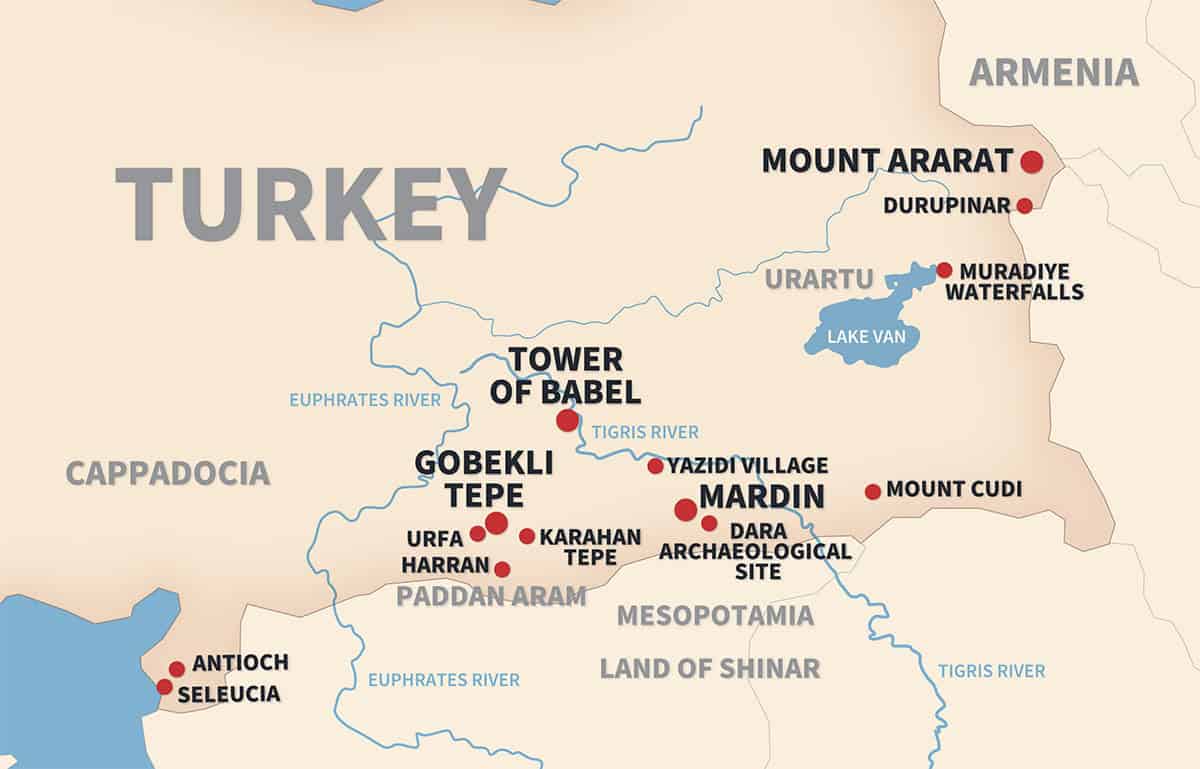
On a hillside in far eastern Turkey, in the Doğubayazıt district of Ağrı province, about twenty-nine kilometers (eighteen miles) south of Mount Ararat, a long ridge of earth runs across the slope in the shape of a ship’s hull. The Durupinar site, spelled Durupınar in Turkish, emerged in 1948, when heavy rains and earthquakes stripped away the mud around it. In 1959 a Turkish military cartographer named İlhan Durupınar spotted the outline in aerial survey photographs, and the formation has carried his name ever since. For nearly seventy years people have argued about whether it holds the remains of Noah’s Ark, and no one has ever been able to excavate or definitively test it.1
The dimensions are the reason anybody cares about this particular hillside in Turkey. Genesis 6:15 gives Noah’s Ark as 300 cubits long, and the formation measures about 157 meters (515 feet), which is very close to 300 cubits if the Egyptian cubit of 52.3 centimeters (20.6 inches) is the one intended.2 That correspondence has been the engine of every claim made about this site for forty years, and it is genuinely striking.

The match depends on choosing a particular cubit. David Fasold’s early team measured the formation at 164 meters (538 feet); later measurements produced 157 meters (515 feet). Different cubit standards were used across the ancient Near East, and the Hebrew text does not specify which one Genesis has in mind. A correspondence that requires selecting the right measuring stick from several available ones is suggestive rather than decisive, which is the whole problem the current investigation exists to solve.
Durupınar has been a protected national park since 1987. It sits more than eighty kilometers (fifty miles) from the nearest body of water. Tour groups, pilgrims and film crews have been coming for decades. The formation itself has never been excavated, and the one attempt to sample it at depth, a drilling campaign in 1988, reached ten meters at four points and settled nothing that both sides accept.
That is what changed in June 2026.
Was Noah’s Ark Found at Durupınar in 2026?
No. Nothing recovered at the site in 2026 amounts to a discovery of Noah’s Ark, and the research team working there has not claimed one.
Headlines in the spring of 2026 raised hopes. What actually happened? A survey team reported subsurface features it interprets as decks and a corridor, along with soil chemistry it reads as consistent with decayed organic material. In June, Turkish government agencies approved permits for the most extensive scientific investigation ever conducted at the formation. Scans are not an identification, and permits are not a finding. What 2026 produced is the first real opportunity to test a nearly seventy-year-old claim from the inside. The rest of this article is about what that investigation can and cannot show.
Why Has the Durupınar Ark Claim Never Been Settled?
The formation has never been excavated, the one subsurface campaign is nearly forty years old, and the arguments have otherwise had to run on surface observation and remote sensing.
The site entered wide public awareness in the 1980s through Ron Wyatt, an amateur explorer with a strong conviction that the Bible is true history but no formal training in archaeology. Wyatt made a long list of claims about Durupınar as well as several other sites, and his methods drew heavy criticism from working archaeologists, including many who share his convictions about Scripture.3 He is a real part of this story and he cannot be written out of it. He is also not an authority most would rest a conclusion on. The team working the site in 2026 states plainly that it is unaffiliated with him.4
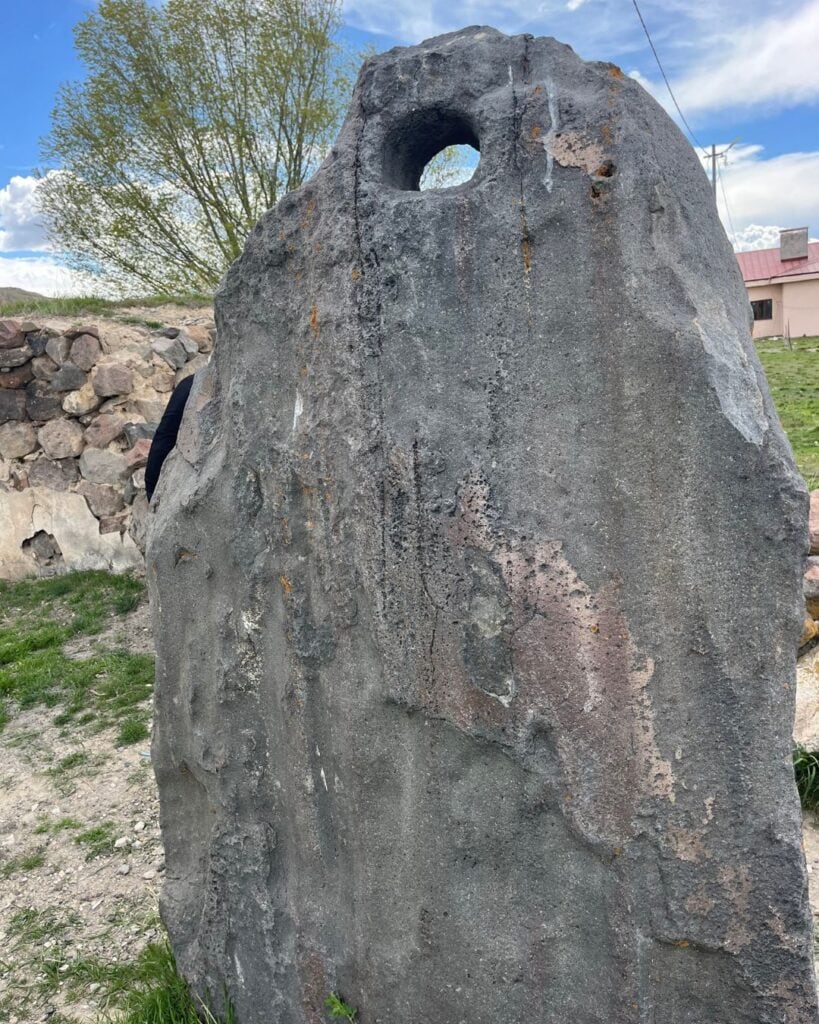
In 1985 the salvage expert David Fasold joined the effort along with geophysicist John Baumgardner, measuring the formation and pointing to large perforated stones in a nearby village that they believed were the ark’s anchors. Fasold made nine trips to the site over the following years, working with project leader Salih Bayraktutan of Atatürk University, and for a period was the only non-Turkish researcher with official access.5 He published The Ark of Noah in 1988 and became the most credible public advocate for the site.
Then Fasold changed his mind. In 1996 he co-authored a technical paper with Lorence Collins arguing the formation was a natural feature. In April 1997, as a plaintiff in an Australian court case he had helped bring, he repudiated his belief in the site outright and described the claim in language that left nothing ambiguous.6
Fasold passed away of cancer in April 1998, financially ruined by years of expeditions. What happened to his views at the very end is contested. His biographer June Dawes, along with the researchers David Allen Deal and Robert Michelson, reported that he returned to believing the site was the ark, with Dawes quoting him as saying there was too much going for it to be dismissed. Collins disputed that account in a 2016 letter to Perspectives on Science and Christian Faith, maintaining that Fasold held to his rejection until his death and that it cost him a cancelled book and most of what he had.7Anyone who states confidently what David Fasold believed in his last months is choosing a side in a disagreement between the people who knew him.
One more piece of that history matters for what is happening now, and it is often told wrong. In a newsletter dated 19 August 1988, Baumgardner wrote that between 28 July and 7 August he and Bayraktutan had “succeeded, praise God, in drilling four holes to a depth of ten meters and recovered reasonably good cores from each of the holes,” three of them near the centerline of the site and the fourth near the outer flank. His own later account is less tidy. Hole 1 reached ten meters and stayed in mudflow material the whole way. Holes 2 and 3 stopped near six, hitting layered bedrock at five. Hole 4 went barely a meter before bedrock, and the team stopped. The cores were mudflow clay above and bedrock below, with nodules of the yellow iron mineral limonite at three places in the mudflow layer — which Baumgardner at the time thought “could represent the rusted remains of metallic iron objects.”8
He found nothing else. “There was, for example, no evidence for wood, petrified or otherwise,” he wrote in the same newsletter, before adding the sentence that matters most for what is being attempted in 2026: “However, core drilling is severely limited in its ability to find buried archaeological structure, especially if it is sparsely distributed and has been significantly altered by decay and chemical weathering.”
Baumgardner, a geophysicist then at Los Alamos, has since written that the 1988 drilling settled the question for him: he concluded the formation is a natural one, mud that flowed around a ridge of basement rock still sitting inside the boat shape.9 His Turkish colleague on that expedition, Salih Bayraktutan, did not follow him. He has led work at the site ever since. His argument is about compaction rather than outline. The surrounding landslide terrain subsided after the earthquakes, he says, while the boat-shaped mass did not: “despite the landslide terrain collapsing after the earthquake, this ship-shaped mass rises up. There is something anomalous there.”10
What 2026 offers is not the first look beneath the surface. It is a deeper, continuous and far better instrumented one, reaching depths the 1988 campaign never approached.
What Do Geologists Say About the Durupınar Formation?
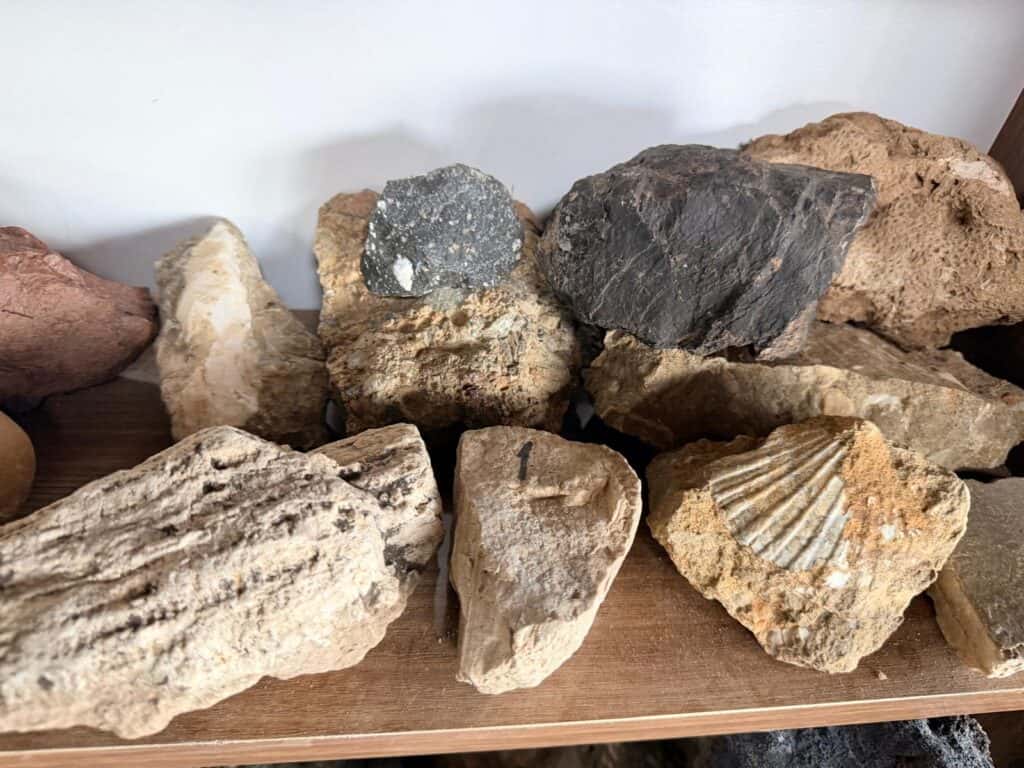
The published geological case against Durupınar as Noah’s Ark is Collins’s, and it is specific rather than dismissive. Writing in the Journal of Geoscience Education in 1996, he identified the structure as a doubly plunging syncline, a naturally occurring downfold of sedimentary rock shaped into its outline by erosion. The paper works through the claimed artifacts one at a time: a supposed iron bracket is weathered volcanic mineral, the metal-braced walls are natural concentrations of limonite and magnetite in steeply inclined sedimentary layers, the fossilized gopherwood bark is metamorphosed peridotite, and the anchor stones at Kazan derive from local andesite.11 A Turkish geologist, Murat Avcı, has separately described the landform as part of the Telçeker earth flow.12 He concluded: “The shiplike feature is a piece of undeformed remnant of the hard limestone, brought down by a slump type landslide.”

That paper remains the peer-reviewed claim on the table, and anyone arguing for the site has to answer it. To its credit, the current team hosts a copy of it on its own website.
There is a second geological objection which comes from within the creationist community. Andrew Snelling worked through the 1987 and 1988 survey data in Creation magazine and concluded the site has “a perfectly reasonable natural geological explanation.” A bed of fossiliferous limestone, packed with the shells of microscopic marine foraminifera, outcrops inside the formation and can be traced east and west beyond it cutting straight across the boat shape, which a petrified hull could not do. The magnetometer survey found a fault running north to south down the centreline, offsetting that limestone bed, and mapping found another along the western edge. On Snelling’s reading the mud flows around an uplifted erosional remnant of basement rock the way water flows around a rock in a riverbed, and the near-vertical “walls” are fault scarps pushed up by the 1948 and 1978 earthquakes, which is also why the shape came into view when it did. He accounted for Baumgardner’s limonite the same way: iron oxide weathering out of pyrite, which occurs in the local rock, rather than metal rusting. 13
Andrew Jones, the software developer and independent researcher who has driven the current work and whom the project describes as explicitly not an archaeologist or historian, answers two of the natural explanations directly. To the claim that the formation is a solid block of rock carried down from higher up and weathered into shape over millions of years, he replies that the surveys show otherwise: “it’s not a solid block of rock. It’s actually soil. And so then, why is the soil stable?” To the claim that mud piled up around a boulder, he applies fluid dynamics: material flowing past an obstruction should heap into a rounded end on the uphill side and taper to a point below it, and at Durupınar, he says, it is the uphill end that is pointed.14
Why Do So Many Noah’s Ark Researchers Reject Durupınar?
The strongest criticism of Durupınar has come from Noah’s Ark researchers who believe the ark was real, want it found, and went to the site hoping to confirm it. Bill Crouse and Gordon Franz, both committed to the historicity of the flood, and published detailed critiques concluding the formation is geological. Andrew Snelling published an extended rejection. 15 Gordon Franz has been blunter: the discovery is “BOGUS, a geological formation, and NOT Noah’s Ark.” And John Morris of the Institute for Creation Research, who has made more than a dozen trips to Turkey looking for the ark, surveyed Durupınar twice and concluded that “everything there has a perfectly rational and simple geologic explanation.” 16
Snelling’s objection is methodological rather than doctrinal, and it is the sharpest thing anyone has said. Geophysical surveys, whether ground-penetrating radar, LiDAR or resistivity, do not produce photographs. They produce data that must be interpreted, and interpretation always involves expectation. Snelling’s charge is that Jones was convinced of what the site was before he saw the survey results, and that the reports describe features as decks and corridors without seriously canvassing what else those signals could be. 17 The second half of that is not new: Snelling made the same point in 1992, citing a Turkish Air Force photograph of three similar boat shapes in the mudflow on the footslopes of Lesser Ararat.

Christian apologist Wesley Huff, who has been among the most recent visible critics, put the underlying problem in a sentence: “‘It looks like a boat to me’ just doesn’t amount to real evidence.”18 Huff has also pointed out the limits of ground-penetrating radar in this kind of terrain, and, writing in April, that no formally trained archaeologist was on the scanning team.
During an interview on 23 April 2026, New Testament scholar Jeremiah Johnston brought up that boat-shaped landforms of this kind occur naturally elsewhere. He also sharpened the radar objection considerably, arguing that ground-penetrating radar is notoriously unreliable in mountainous hill country, whatever its value in the dry sands of Egypt. 19 That’s a claim about instruments rather than about motives, and it is the kind of objection that core samples are capable of answering.
There is also a precedent for it at this exact site. In 1987 Tom Fenner of Geophysical Survey Systems Inc., a professional radar operator, spent a day and a half attempting to reproduce the radar records Wyatt and Fasold had obtained the year before. “After numerous attempts over a period of one and a half days we were unable to duplicate their radar records in any way,” he wrote. His own survey found a shallow flat-lying reflector — bedrock beneath the mudflow — rather than the walls and bulkheads the earlier scans were said to show.20 Radar at Durupınar has failed to replicate once already.
That is a serious body of criticism but two things complicate it, and to be fair our account has to include them.
The first is that the soil survey was run blind. Jones has described taking 88 samples across 22 sites inside and outside the formation, labeled with letters and numbers rather than as inside or outside, and sent to Atatürk University in Erzurum for analysis without indicating which was which.21 That is the standard answer to a confirmation-bias objection, and it is to the team’s credit that they did it before anyone demanded it.
The second is that the staffing objection has been overtaken by events. The permitted 2026 expedition is directed by Professor Cenker Atila of the archaeology department at Sivas Cumhuriyet University, a working academic archaeologist with a recent publication record in Journal of Archaeological Science: Reports.22 This season’s work is not being run without credentialed supervision.
What remains of the criticism is the part that perhaps matters most. Snelling’s objection is not that the scans show natural rock. It is that scans alone cannot settle the question either way, which is precisely the argument for doing what is being done this year.

What Is Happening at the Durupinar Site in 2026?
In June the Noah’s Ark Scans team announced that its Turkish partner had secured permits from multiple government agencies for the most extensive scientific investigation ever conducted at the Durupınar site.23 That approval is the genuinely new thing here, and it is separable from the headlines that surround it.
The published plan runs to six phases. Drones equipped with LiDAR and thermal imaging build a 3D model of the topography. Next-generation ground-penetrating radar and 30-channel electrical resistivity tomography scan the full length of the formation. A dry sonic core drilling program is designed to recover continuous, undisturbed stratigraphic cores from 75 to 100 meters, roughly ten times the depth reached in 1988 and with a method that keeps the core intact. Deeper electrical and audio-magnetotelluric surveys map the formation’s roots below 300 meters. Robotic cameras are then inserted into any voids found, and the results are fused into a single model intended for peer-reviewed analysis.24 The stated approach is non-destructive first, with excavation only if the data justify it, on the reasoning that archaeology destroys what it examines and cannot put it back.25
The team reports angular subsurface structures, a corridor-like void running along the centre of the formation, layered features they interpret as decks, and soil chemistry showing roughly three times the organic content inside the formation compared with outside it, with associated differences in potassium and pH consistent with decayed organic material.26 Jones’ team has put a figure on the soil result, calculating less than a five percent probability that the differences are random.27 He has stated publicly that he believes the site holds the decayed remains of the ark.28
The team has also pushed back on how its work gets described, saying it has never claimed to have found an intact wooden ship, and that it is looking for residual traces of a decayed vessel.29
Have you wondered about traveling to Eastern Turkey to see some of the ancient biblical sites? Fill out the form to be contacted about upcoming Eastern Turkey tours.
What Evidence Would Show Durupınar Is Noah’s Ark?
When the cores come up, the reporting will be loud in both directions. It will be much easier to judge if you decide now what would count.
Wood, or its chemical ghost, at depth, in context. The decisive find would be worked timber, or an unambiguous chemical signature of decayed timber, recovered from inside the formation at the depths the scans describe, with the sampling documented well enough that another lab could confirm it. Elevated organic content in surface soil is suggestive. Bitumen or wood fibre in a continuous core from deep inside the mound is a different order of evidence.
Cores that contradict the syncline. Collins’s reading predicts a particular sequence of folded sedimentary layers. Continuous cores either match that sequence or they do not. This is the cleanest test in the entire program, because it can falsify the leading skeptical explanation directly.
Blind interpretation. Snelling’s confirmation-bias objection has a straightforward answer available, and the team has used it once already on the soil survey. Giving raw geophysical data to interpreters who are not told what site it came from would neutralize the strongest criticism against the project. If that does not happen, the criticism stands regardless of what the scans show.
Whether they answer Collins. The doubly plunging syncline is the peer-reviewed explanation on the table, and the team’s own research collection hosts it alongside a 2025 paper by Eşref Atabey reaching the same conclusion. A serious result will engage that reading directly rather than around it.
Peer review that actually happens. Watch whether the results appear in a journal with independent reviewers, or only in press releases and documentaries.
Dating that hangs together. Any organic material recovered will be dated, and the numbers will have to be reconciled with whatever chronology a reader holds. Watch for consistency across samples and labs rather than a single striking figure.
Given how much credentialed opinion, including friendly credentialed opinion, expects the formation to be natural, the probable result is not a discovery announcement. But it is still the thing worth watching. For nearly seventy years the argument has run on an outline, a handful of surveys, and four holes of which one reached ten meters. This year it goes ten times deeper.
Visiting Durupınar While the Question Is Open
In April 2026, when the scan reports were everywhere, Wesley Huff posted a blunt assessment. He believes there was a Noah and an ark, he wrote, but the formation in the Anatolian mountains is almost certainly not the remains of it.30
Joel Richardson replied the same afternoon. His answer was not a defense of the site. It was a point about procedure: “We cannot say it is legit or not legit UNTIL it has been properly examined. That would be the next step. This is how archeology works.”31
Six weeks later, the permits came through.
That is roughly where the evidence leaves us. Huff is skeptical and has good reasons. Richardson is unconvinced either way and wants the ground opened. Neither of them is claiming to know. The formation is real, the correspondence with the Genesis dimensions is striking, the geological objections are serious, the sharpest critics are believers, and for the first time since 1988 there is a permitted program capable of producing an actual answer.
Richardson leads our first Genesis Expedition, which visits Durupınar in June 2027, in the same window early results from this investigation could be circulating and argued over. Travelers will see the formation at the one point in nearly seventy years of argument when the question is being answered rather than only debated. Whatever the cores turn out to show, standing on the ground while the evidence is still being weighed is a different experience from reading the verdict afterward.
Living Passages visits the Durupinar Site during our Genesis expeditions with Joel Richardson, in the eastern Turkey itinerary that also takes in Göbekli Tepe, Harran, Ararat and Mount Cudi as well as a possible Tower of Babel site.
Notes
- “New scan data of Turkish formation is reviving the Noah’s Ark debate,” The Brighter Side of News, 24 April 2026. https://www.thebrighterside.news/post/new-scan-data-of-turkish-formation-is-reviving-the-noahs-ark-debate/ ↩︎
- Lorence G. Collins gives the length as 515 feet, or 157 metres, and notes that this is circumstantially the same as 300 Egyptian cubits and so matches the dimensions given in Genesis 6:15. See Collins, “Noah’s Ark near Dogubayazit, Turkey?,” Perspectives on Science and Christian Faith 68, no. 4 (December 2016): 219. https://www.asa3.org/ASA/PSCF/2016/PSCF12-16Complete.pdf The higher figure of 538 feet derives from David Fasold’s own measurements, reported in his The Ark of Noah (New York: Wynwood, 1988) ↩︎
- For a detailed catalogue of the Wyatt claims and the responses to them, see the Durupınar resource collection maintained by NoahsArkSearch.com. https://www.noahsarksearch.com/resources/durupinar/ ↩︎
- Reported in Leah MarieAnn Klett, “Wesley Huff, Jeremiah Johnston dispute viral Noah’s Ark claim,” The Christian Post, 27 April 2026. https://www.christianpost.com/news/wesley-huff-jeremiah-johnston-dispute-viral-noahs-ark-claim.html ↩︎
- Collins and Fasold describe Fasold’s nine trips, his work with Bayraktutan and his access to the site in the introductory section of their 1996 paper. Full text hosted at California State University Northridge. https://www.csun.edu/~vcgeo005/Nr1Bogus2.pdf ↩︎
- Gary Edmond and David Mercer, “Creating (public) science in the Noah’s Ark case,” Public Understanding of Science 8, no. 4 (1999): 317–343, which is also the fullest scholarly account of the trial and its press coverage. https://journals.sagepub.com/doi/10.1088/0963-6625/8/4/304 (paywalled). Contemporary reporting: “Noah’s Ark case leaves professor high and dry,” Times Higher Education, 13 June 1997; E. Finkel, “Australian Geologist Battles ‘Ark’ Claim,” Science 276, no. 5311 (18 April 1997): 348, https://doi.org/10.1126/science.276.5311.348 (paywalled). ↩︎
- June Dawes, Noah’s Ark: Adrift in Dark Waters (Belrose, NSW: Noahide, 2000), 184; David Allen Deal, Noah’s Ark: The Evidence (Muscogee, OK: Artisan, 2005), 45–46. For the contrary account, Lorence G. Collins, “Pursuing the Truth despite the Cost,” letter, Perspectives on Science and Christian Faith 68, no. 4 (December 2016): 279–280 — “Wikipedia, when recently checked, claims that Fasold later changed his mind and again believed that the site in eastern Turkey was Noah’s ark. This is not true.” https://www.asa3.org/ASA/PSCF/2016/PSCF12-16Collins2.pdf (Not to be confused with Collins’s separate article in the same issue, pp. 218–228.) ↩︎
- John R. Baumgardner, newsletter “A Search for the Elusive Ark,” 19 August 1988, for the drilling dates, the four holes, the limonite nodules and the caveat on core drilling; his emails of 20 March 1999, 6 October 2014 and 10 August 2021 for the hole-by-hole depths and the rock types. All collected in “Durupınar Core Drilling Locations and Results,” hosted by Noah’s Ark Scans: https://www.noahsarkscans.com/research The accompanying figure marking the four hole positions is the coordinate diagram (Fig. 6) from John R. Baumgardner and M. Salih Bayraktutan, July 1987 Geophysical Investigation of Noah’s Ark (Durupınar Site), Mahşer Village, Doğubayazıt, Ağrı (Erzurum, November 1987), 9 — where it carries no hole numbers, since it predates the drilling; the numerals were added afterwards, and their placement matches Baumgardner’s description of three holes near the centerline and one on the outer flank. The project’s own homepage nonetheless captions the 1988 slide of its photo timeline: “1988 — Bayraktutan & Baumgardner attempted core drilling campaign tried to drill down in 4 locations without success.” https://www.noahsarkscans.com/ ↩︎
- John Baumgardner, letter on his position regarding the Durupinar site. https://www.tentmaker.org/WAR/BaumgardnerLetter.html See also his letter of 22 February 2008. https://www.tentmaker.org/WAR/baumgardner_letter2.html ↩︎
- https://ilkha.com/bilimteknoloji/hazreti-nuhun-gemisi-olduguna-inanilan-izde-arastirmalar-devam-ediyor-294621 ↩︎
- Collins and Fasold, Journal of Geoscience Education 44, no. 4 (September 1996): 439–444. DOI 10.5408/1089-9995-44.4.439. Abstract: https://www.tandfonline.com/doi/abs/10.5408/1089-9995-44.4.439 Free full text (PDF): https://www.csun.edu/~vcgeo005/Nr1Bogus2.pdf (the Taylor & Francis page is paywalled). ↩︎
- https://www.noahsarksearch.com/resources/durupinar/ linking to https://www.noahsarksearch.com/AvciMurat/TelcekerEarthFlow.pdf ↩︎
- Andrew A. Snelling, “Special report: Amazing ‘Ark’ exposé,” Creation 14, no. 4 (September 1992): 26–38, published by Creation Ministries International — not Answers in Genesis; the two organisations separated in 2005 and pre-2005 Creation content remained with CMI. https://creation.com/special-report-amazing-ark-expose ↩︎
- Andrew Jones, interviewed by Tim Mahoney, “The Hunt for Noah’s Ark: Durupinar – Part 1,” Patterns of Evidence, 10 April 2026. https://www.patternsofevidence.com/2026/04/10/the-hunt-for-noahs-ark-durupinar-part-1/ Jones does not name the author of the “solid block of rock” paper he is answering; the description does not match Atabey. The team’s evidence page: https://www.noahsarkscans.com/noahs-ark-evidence Its research collection, which hosts opposing work including Collins and Fasold (1996) and Eşref Atabey, “Nuh’un Gemisi Heyelan Etkisiyle Oluşmuş Jeolojik Bir Yapı” (June 2025), concluding the shape is “a geological formation of a synclinal structure shaped by the processes of folds, erosion and landslides due to the Eastern Anatolian compression tectonics”: https://www.noahsarkscans.com/research ↩︎
- For Bill Crouse (“Ron Wyatt: Are His Claims Bonafide?”) and Andrew Snelling, see the resource collection at https://www.noahsarksearch.com/resources/durupinar/ ↩︎
- Gordon Franz, “‘Noah’s Ark is (still) in Turkey’ by Dan Eden,” Life and Land, 2 January 2014: https://www.lifeandland.org/2014/01/noahs-ark-is-still-in-turkey-by-dan-eden/ John D. Morris, “That boat-shaped rock … is it Noah’s Ark?,” Creation 12, no. 4 (September 1990): 16–19: https://creation.com/that-boat-shaped-rock-is-it-noahs-ark For Snelling, see note 13. ↩︎
- Snelling, “Special report: Amazing ‘Ark’ exposé,” as above. ↩︎
- Wesley Huff, quoted in Klett, The Christian Post, 27 April 2026. https://www.christianpost.com/news/wesley-huff-jeremiah-johnston-dispute-viral-noahs-ark-claim.html ↩︎
- Jeremiah Johnston, interviewed by Michael Knowles, 23 April 2026. https://www.youtube.com/watch?v=VAsPqSwBuYc ↩︎
- Snelling, “Special report: Amazing ‘Ark’ exposé,” as above. ↩︎
- Andrew Jones, interviewed by Tim Mahoney, “The Hunt for Noah’s Ark: Durupinar, Part 2,” Patterns of Evidence, 17 April 2026. https://www.patternsofevidence.com/2026/04/17/the-hunt-for-noahs-ark-durupinar-part-2/ ↩︎
- Project page, Noah’s Ark Scans, naming “Prof. Dr. Cenker Atila of the Department of Archaeology at Sivas Cumhuriyet University” as Project Director: https://www.noahsarkscans.com/the-ark-project ↩︎
- Official authorization announcement, Noah’s Ark Scans, June 2026, under a Scientific Research Plan directed by Prof. Dr. Cenker Atila; the authorization letter names the Erzurum Regional Directorate of the Ministry of Environment, Urbanization and Climate Change. https://www.noahsarkscans.com/the-ark-project See also “Noah’s Ark Searchers Win Turkish Permits for the Durupinar Site,” Weird Darkness, 19 June 2026. https://weirddarkness.com/noahsark2026/ ↩︎
- 2026 Research Operations schedule, Noah’s Ark Scans project homepage, listing the six phases: aerial baseline mapping, deep subsurface scanning, sonic core drilling, deep ERT and audio-magnetotelluric survey, void exploration, and data fusion. https://www.noahsarkscans.com/ ↩︎
- “New scan data of Turkish formation is reviving the Noah’s Ark debate,” The Brighter Side of News, 24 April 2026. https://www.thebrighterside.news/post/new-scan-data-of-turkish-formation-is-reviving-the-noahs-ark-debate/ ↩︎
- “In 2024, soil tests produced a breakthrough finding: samples collected inside the structure contained nearly three times more organic material than those from outside.” Project page, Noah’s Ark Scans: https://www.noahsarkscans.com/the-ark-project The project homepage credits the team’s soil scientist and agronomist, William “Bill” Linklater Crabtree, with the sampling behind it — “By conducting systematic sampling inside and outside the boat-shaped formation, Bill’s expertise is instrumental in verifying chemical anomalies, such as validating the presence of 3x more organic matter within the structure, providing a primary line of evidence for the project” — in his entry in the team roster: https://www.noahsarkscans.com/ For the subsurface structures and the corridor-like void, see “Noah’s Ark Found? Radar Scans Reveal 3 Underground Decks and 13-Foot Hidden Tunnel in Turkey,” International Business Times UK, June 2026. https://www.ibtimes.co.uk/noahs-ark-radar-scans-turkey-1800118 ↩︎
- Weird Darkness, 19 June 2026, as above. https://weirddarkness.com/noahsark2026 ↩︎
- Jones, speaking on Fox & Friends First, quoted in The Brighter Side of News, 24 April 2026. https://www.thebrighterside.news/post/new-scan-data-of-turkish-formation-is-reviving-the-noahs-ark-debate/ ↩︎
- “Scientists Claim New Evidence of Noah’s Ark at Turkey’s Durupınar Formation,” Greek City Times, 26 April 2026. https://greekcitytimes.com/2026/04/26/noahs-ark-found-turkey-durupinar-formation-gpr-evidence-2026/ See also Billy Hallowell, “Is This Noah’s Ark? Researcher’s Compelling Evidence as Speculation Builds,” CBN News, 13 May 2025, interviewing Andrew Jones. https://cbn.com/news/us/noahs-ark-researchers-compelling-evidence-speculation-builds ↩︎
- Wesley Huff (@WesleyLHuff), X, 23 April 2026. https://x.com/WesleyLHuff/status/2047447384305926179 ↩︎
- Joel Richardson (@Joel7Richardson), X, 23 April 2026. https://x.com/Joel7Richardson/status/2047457794299658656 ↩︎