
From Paul to Now: The Spirit Moving on Mars Hill
The God who made the world and everything in it, being Lord of heaven and earth, does not live in temples made by man,[a] 25 nor is he served by human hands, as though he needed anything, since he himself gives to all mankind life and breath and everything.
From Paul to Now: The Spirt Moving on Mars Hill
By Rhonda Sand.
Having visited Mars Hill with many leaders and teachers over the years, this spring, I was in awe of the gripping moments that were experienced after the sun went down on this balmy evening on our recent Footsteps of Paul expedition. To stand where Paul preached on Mars Hill to the Greeks a powerful and moving sermon (an excerpt above found in Acts) moved our travel group to something extraordinary.
Worship on the Hill
Our group of 53 went up on Mars Hill as were in Athens, Greece, alone after the crowds were gone. We stood where Paul preached on Mars Hills hundreds of years before to the Greeks and we felt the Spirit heavy. And our group began to worship. The visit and the moments were different from any other visit I have ever experienced. I will say, they were a more youthful group – almost all graduate students, but the one thing we have in common is that we love Jesus and we love that our God allows us to see and experience these places with The Word in our hands and the songs in our hearts.

Worship at Mars Hill
As we travel to these places, it is always fascinating to see what The Holy Spirit will create when we say, yes and Amen. So, if you have visited Mars Hill before, come back to it. They have rebuilt the stairs, and it is even more accessible in the past. You also may have a new refreshing appointment.
History of Mars Hill
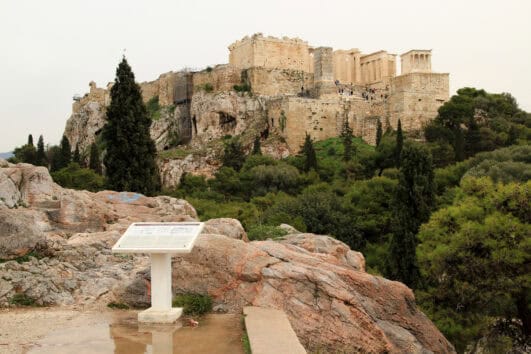
High above the ancient city of Athens, rising 377 feet into the sun-scorched sky, stands a rocky outcrop known to the Romans as Mars Hill—and to the Greeks as the Areopagus, the Hill of Ares. Named after the god of war who, according to legend, once stood trial there before the other deities, this place was no mere geological formation. It was a place of power, philosophy, justice, and ultimately, truth.
At the crossroads of culture and thought, Mars Hill was home to the Areopagus Court—the highest court in ancient Greece, presiding over civil, criminal, and religious matters. Even under Roman rule, its influence endured. It was here that Athens' finest thinkers, philosophers, and lawmakers gathered, not only to uphold law and order but to engage in the most human of pursuits: searching for meaning.
And it was here, on this hill soaked in myth and intellectual pride, that the Apostle Paul delivered one of the most compelling gospel presentations recorded in Scripture (Acts 17:16–34).
A City Given to Idols
When Paul arrived in Athens during his second missionary journey, what he found was not merely a city of philosophers but a city drowning in idols. As Acts 17:16 tells us, “his spirit was provoked within him.” While the architecture may have been glorious and the intellectual discourse lofty, the spiritual condition of Athens was tragic. The people worshiped everything except the one true God.
Paul did what he always did—he went to the synagogue to reason with the Jews and devout Gentiles, and then he moved to the Agora, the bustling marketplace where people debated and discussed new ideas. It was here that he caught the attention of two prominent philosophical groups: the Epicureans, who believed pleasure was the chief good and that God was distant and uninvolved; and the Stoics, who believed the divine was impersonal and that emotional detachment was the path to virtue.
To these people, Paul’s message about Jesus and the resurrection sounded like strange babbling. But rather than dismiss him, their curiosity was piqued. “You’re bringing some strange ideas to our ears,” they said, “and we would like to know what they mean” (Acts 17:20). So they brought Paul to the Areopagus—Mars Hill—the very heart of Athenian thought.
The Unknown God Made Known
Standing among altars, statues, and the heavy shadows of ancient gods, Paul began not with condemnation, but with a compliment: “Men of Athens, I perceive that in every way you are very religious” (Acts 17:22).
Paul masterfully used their altar “To the Unknown God” as his starting point. He wasn’t there to attack their ignorance, but to fill it with truth. He declared to them the God they didn’t yet know—the Creator of heaven and earth, who gives life and breath to all things, who doesn’t dwell in man-made temples or need anything from human hands.
In a few powerful words, Paul dismantled their worldview and introduced a biblical one—where God is personal, sovereign, and near. He challenged their understanding of existence, showing that this God had made all nations from one man, determined their times and boundaries, and designed us all to seek Him.
“But now,” Paul said, “He commands all people everywhere to repent. For He has fixed a day on which He will judge the world in righteousness by a Man whom He has appointed. And of this He has given assurance to all by raising Him from the dead” (Acts 17:30–31).
The Gospel Meets the Greek Mind
Paul’s address on Mars Hill is often celebrated as a brilliant example of apologetics in action. He began with their culture, engaged their questions, and led them to Christ crucified and risen—always the heart of his message (1 Corinthians 2:2).
His message was met with mixed reactions:
-
Some mocked him—scoffing at the resurrection, which to the Greek mind was absurd.
-
Some were intrigued, asking to hear more.
-
And some believed—including Dionysius the Areopagite and a woman named Damaris (Acts 17:34).
This diversity of responses reminds us that the gospel will always divide opinion. But it also reminds us of our task: not to tailor the message to please, but to proclaim it faithfully, trusting God with the results.
Acts 17:22-31:
22 So Paul, standing in the midst of the Areopagus, said: “Men of Athens, I perceive that in every way you are very religious. 23 For as I passed along and observed the objects of your worship, I found also an altar with this inscription: ‘To the unknown god.’ What therefore you worship as unknown, this I proclaim to you. 24 The God who made the world and everything in it, being Lord of heaven and earth, does not live in temples made by man,[a]
25 nor is he served by human hands, as though he needed anything, since he himself gives to all mankind life and breath and everything.26 And he made from one man every nation of mankind to live on all the face of the earth, having determined allotted periods and the boundaries of their dwelling place, 27 that they should seek God, and perhaps feel their way toward him and find him. Yet he is actually not far from each one of us,
28 for “‘In him we live and move and have our being’;[b] as even some of your own poets have said, “‘For we are indeed his offspring.’[c] 29 Being then God's offspring, we ought not to think that the divine being is like gold or silver or stone, an image formed by the art and imagination of man. 30 The times of ignorance God overlooked, but now he commands all people everywhere to repent, 31 because he has fixed a day on which he will judge the world in righteousness by a man whom he has appointed; and of this he has given assurance to all by raising him from the dead.”
Living Passages arranges customized Christian travel arrangements for the Bible scholar and their participants that can reach into areas of scripture that are generally overlooked. Call us to plan your next expedition at 208-765-8500.


